Skip to content

If you received money or property from a foreign trust and did not file Form 3520, the IRS penalty is the greater of $10,000 or 35% of the gross value of what you received. For a $120,000 trust distribution, that is $42,000. The IRS Streamlined Filing Compliance Procedures offer a legal path to resolve this, reduce the penalty to as low as zero, and close the IRS exposure window before an examination begins.
Amina’s mother passed away in Nigeria and left her $120,000 through a family trust. Amina received the funds, reported her income correctly on her U.S. tax return, and assumed everything was in order. She had never heard of Form 3520.
Fourteen months later, the IRS sent a penalty notice. The amount: $42,000. That figure is not a mistake. It is exactly 35% of the $120,000 distribution she received, which is the standard IRS penalty for failing to file Form 3520.
Amina did not hide anything. She simply did not know the form existed. That distinction matters, and it is exactly why the IRS Streamlined Filing program exists.
What Is Form 3520 and Who Has to File It?
Form 3520 is an annual return used to report transactions with foreign trusts and the receipt of large foreign gifts or inheritances. It is filed with the IRS but is not part of your regular income tax return.
You are required to file Form 3520 if any of the following apply:
- You received a distribution from a foreign trust
- You are treated as the owner of a foreign trust under U.S. grantor trust rules
- You transferred money or property to a foreign trust
- You received more than $100,000 in gifts or inheritances from a nonresident alien or foreign estate in a single year
- You received more than $16,649 (inflation-adjusted threshold) in gifts from a foreign corporation or foreign partnership
For full IRS guidance on what triggers a Form 3520 filing requirement, the IRS Form 3520 information page covers the official definitions and thresholds in detail.

What Counts as a Foreign Trust Distribution?
Many taxpayers assume Form 3520 only applies to formal legal trusts set up by attorneys. That assumption leads to missed filings.
The IRS defines foreign trust broadly. Common situations that trigger the Form 3520 filing requirement include:
- Receiving money from a family estate structured as a trust in another country
- Inheriting funds from a foreign relative whose assets were held in a trust arrangement
- Receiving distributions from a foreign pension fund classified as a trust under U.S. tax rules
- Being named a beneficiary of a foreign insurance arrangement that qualifies as a trust
- Receiving funds routed through a foreign legal entity that the IRS treats as a trust
The trust does not need to have a formal name or legal document. The IRS applies its own classification rules. If the arrangement functions as a trust under IRC Section 7701, Form 3520 applies.
The Penalty for Missing Form 3520: What the Numbers Actually Mean?
The IRS penalty structure for Form 3520 is one of the steepest in the international reporting system. It is calculated as a percentage of the transaction value, not a flat fee.
| Measurement | Violation Type | IRS Penalty |
| Trust distribution | Late or missing Form 3520 | Greater of $10,000 or 35% of gross distribution value |
| Trust transfer | Failure to report property transferred | Greater of $10,000 or 35% of gross value transferred |
| Foreign gift | Large foreign gift not reported | 5% of gift amount per month, up to 25% total |
| Continuing penalty | Non-compliance after IRS notice | Additional amounts assessed until compliance |
There is no cap on the 35% penalty. A $500,000 trust distribution with a missed Form 3520 triggers a $175,000 penalty. A $1,000,000 distribution triggers $350,000. The IRS assesses this penalty automatically once the missing filing is identified, without requiring a formal audit.
The statute of limitations on the relevant tax return also stays open indefinitely until Form 3520 is filed. This means the IRS can go back as far as they need to once the missing form is discovered.
What Streamlined Filing Does and Why It Matters Here?
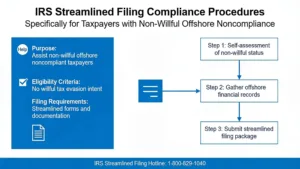
The IRS Streamlined Filing Compliance Procedures are the only formal amnesty program that addresses unreported foreign trust transactions. If your failure to file Form 3520 was non-willful, meaning no intentional concealment, the program dramatically reduces what you owe.
Two tracks are available:
- Streamlined Foreign Offshore Procedures (SFOP): Zero penalty. For U.S. persons who lived outside the U.S. during the covered period.
- Streamlined Domestic Offshore Procedures (SDOP): 5% penalty on the highest aggregate value of all unreported foreign financial assets. This replaces the standard 35% penalty entirely.
| Measurement | Standard IRS Penalty | Streamlined Filing (SDOP) |
| $120K trust distribution | $42,000 (35% of distribution) | 5% of highest balance only |
| Multiple missed years | Penalty assessed per year | All covered years in one submission |
| Penalty cap | None | Fixed 5% calculation |
| Foreign track option | Not applicable | $0 penalty (if residency qualifies) |
In Amina’s case, the SDOP penalty on a $120,000 distribution would be $6,000 total instead of $42,000. The streamlined program does not reduce the standard penalty. It replaces the entire penalty framework with a fixed 5% calculation.
The Form 3520 CPA Filing service at Ed Parsons CPA is specifically structured for unreported foreign trust cases. The submission includes the corrected Form 3520, any required amended tax returns, and the non-willful certification the IRS scrutinizes most closely.
Who Qualifies for Streamlined Filing on a Form 3520 Violation?
Eligibility is determined on four factors the IRS evaluates before accepting a streamlined submission:
- Non-willful failure: the missed filing was not the result of intentional concealment
- No open IRS civil examination or criminal investigation
- No prior use of the Offshore Voluntary Disclosure Program for these transactions
- Meeting the residency requirements for the applicable track (SFOP or SDOP)
The non-willful certification is the most scrutinized component. The IRS expects a detailed, factual narrative explaining how you came to receive the trust distribution, why you were unaware of the Form 3520 requirement, and what your reasonable basis for non-compliance was.
A vague statement such as ‘my accountant did not mention it’ is rarely sufficient on its own. This is the same non-willful certification framework covered in our articles on FBAR penalty and streamlined filing and Form 8938 FATCA penalties. The IRS applies consistent scrutiny across all international reporting violations.
Common Mistakes That Increase Your Exposure
- Assuming the foreign trust distribution does not count because it came from a family member, not a formal institution
- Reporting the income on your tax return and assuming that satisfies the Form 3520 separate filing requirement
- Filing Form 3520 late without attaching a penalty abatement or reasonable cause statement
- Contacting the IRS informally about the missed filing before establishing the proper non-willful narrative
- Waiting for an IRS notice, which eliminates streamlined eligibility for those specific transactions
Late filing without a penalty abatement argument is treated the same as non-filing for penalty purposes. The 35% penalty applies in both cases unless the IRS accepts a reasonable cause argument or a streamlined submission.
What Happens If You Do Not Address This?
Foreign financial institutions in most countries report U.S. beneficiary information to the IRS directly through FATCA reporting agreements. If a foreign trust made a distribution to a U.S. person, that transaction may already be visible to the IRS through third-party data.
Once the IRS opens an examination related to the missed Form 3520, streamlined eligibility is gone. The standard 35% penalty framework applies. Reasonable cause arguments are still available but require strong documentation and are harder to win once an examination is active.
The lowest-risk path is to address this before the IRS does. The Form 3520 CPA Filing service at Ed Parsons CPA handles the complete submission: the corrected Form 3520, amended returns where required, the penalty calculation, and the non-willful certification narrative that determines whether your submission is accepted or rejected.