Skip to content

If you are the U.S. owner of a foreign trust and Form 3520-A was never filed, the IRS penalty is 5% of the trust’s gross asset value at year-end. That responsibility falls on you personally, even if the foreign trustee was supposed to file. For a $400,000 trust, that is $20,000 per missed year. The IRS Streamlined Filing Compliance Procedures offer a legal path to resolve this and significantly reduce total penalty exposure before an IRS examination begins. If the trust also holds a bank or brokerage account, the FBAR position for foreign trusts is a separate filing question.
Tariq moved from Pakistan to the United States and became a U.S. permanent resident. Years earlier, he had set up a family trust in Pakistan to hold property for his relatives. He continued managing the trust from the U.S., assuming Pakistani law fully governed the arrangement.
What Tariq did not know: under U.S. tax rules, transferring assets to a foreign trust makes you the deemed U.S. owner. That triggers Form 3520-A, an annual return the trust must file with the IRS. The Pakistani trustee had never heard of it.
Three years of unfiled Form 3520-A. Trust value: $400,000. IRS penalty notice: $60,000. Tariq had not hidden anything. He simply did not know two separate IRS forms were required.
What Is Form 3520-A and Why Does It Exist?
Form 3520-A is the Annual Information Return of a Foreign Trust With a U.S. Owner. It is filed separately from Form 3520 and has a different purpose, a different filer, and a different due date.
While Form 3520 is filed by the U.S. person who receives distributions or makes transfers, Form 3520-A is filed by the foreign trust itself through its trustee. The IRS uses it to obtain a complete picture of the trust’s income, assets, and the U.S. owner’s beneficial interest.
The critical point: if the foreign trustee does not file Form 3520-A, the penalty falls on the U.S. owner. The IRS does not pursue the foreign trustee. It pursues you.
Who the IRS Considers a U.S. Owner of a Foreign Trust?
The IRS uses IRC Section 679 to determine whether a U.S. person is treated as the owner of a foreign trust. The rules are broader than most people expect.
You may be classified as a U.S. owner if:
- You transferred property or money to a foreign trust at any point
- You have the power to revoke the trust and reclaim the assets
- The trust is structured so that the income or assets benefit you or a U.S. family member
- You are a deemed owner through constructive transfer rules, even without a formal transfer
This classification applies even if the trust was set up before you became a U.S. person. Immigrants who established family trusts abroad before immigrating can still be treated as U.S. owners under these rules. The IRS foreign trust reporting guidance covers the full scope of these ownership determinations.

Form 3520 vs. Form 3520-A: What Each Form Does
These two forms are frequently confused. They cover different obligations, have different filers, and carry separate penalties. Missing either one is a separate violation.
| Measurement | Form 3520 | Form 3520-A |
| Filed by | U.S. person (owner or beneficiary) | The foreign trust itself (trustee) |
| Due date | April 15 (or October 15 with extension) | March 15 (earlier than Form 3520) |
| Covers | Distributions received, transfers made, gifts | Trust income, assets, and U.S. owner details |
| Penalty for failure | Greater of $10,000 or 35% of transaction value | 5% of gross trust asset value at year-end |
| Who is liable if unfiled? | The U.S. person who received or transferred | The U.S. owner, even if trustee fails to file |
If you received a distribution from the trust and also own the trust, both Form 3520 and Form 3520-A may be required. Each missed form carries its own penalty. Our article on Form 3520 penalties and foreign trust distributions covers the Form 3520 side in detail.
What the Form 3520-A Penalty Actually Costs?
The penalty for a missing or late Form 3520-A is 5% of the gross value of the trust’s assets at the close of the tax year. This applies for each year the form is missing.
There is no minimum threshold and no cap. A trust holding $1,000,000 in assets generates a $50,000 penalty per missed year. Three missed years produce $150,000 in penalties before any additional charges.
| Measurement | Standard Penalty | Streamlined Filing (SDOP) |
| Trust value: $400,000 | $20,000 (5% per missed year) | 5% of highest aggregate balance |
| Three missed years | $60,000 total exposure | Single 5% calculation, all years covered |
| Foreign track option | Not available | $0 penalty if residency qualifies |
| Penalty cap | No statutory cap | Fixed percentage, no compounding |
The statute of limitations on the relevant tax return also stays open indefinitely until Form 3520-A is filed. The IRS can go as far back as needed once the missing form is identified.
What Is a Substitute Form 3520-A and When Is It Used?
If the foreign trustee refuses or fails to file Form 3520-A, the U.S. owner has the option to file a substitute Form 3520-A on behalf of the trust. This is a protective measure that allows the U.S. owner to demonstrate compliance even when the foreign trustee is uncooperative.
Filing a substitute Form 3520-A is attached to the U.S. owner’s Form 3520. It must contain all information the IRS would expect from the foreign trustee’s filing, including the trust’s income, assets, and distributions during the year.
A substitute Form 3520-A does not automatically eliminate the penalty for prior years where the form was missing. For past violations, the streamlined filing or reasonable cause path is the appropriate resolution route.
How Streamlined Filing Reduces the Penalty Exposure?
The IRS Streamlined Filing Compliance Procedures are the primary resolution path for U.S. owners who have missed Form 3520-A filings and can demonstrate the failure was non-willful.
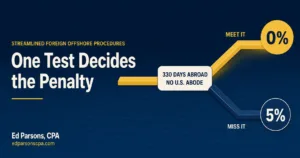
- Streamlined Foreign Offshore Procedures (SFOP): Zero penalty. Available if you lived outside the U.S. during the covered period.
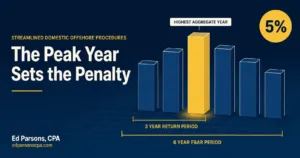
- Streamlined Domestic Offshore Procedures (SDOP): 5% of the highest aggregate value of all unreported foreign financial assets across three covered years. This replaces the per-year 5% penalty structure with a single calculation.
For Tariq’s $400,000 trust, three missed years under the standard penalty structure mean $60,000 in exposure. Under SDOP, a single 5% calculation on $400,000 produces $20,000 total, covering all three years. Under SFOP, if residency qualifies, the penalty is zero.
Ed Parsons CPA corrects both Form 3520 and Form 3520-A violations in a single streamlined submission, which carries the non-willful certification narrative, the corrected forms, and the penalty calculation the IRS requires.
People land here because a trustee abroad never filed something they had never heard of, and the reflex is to fix the one form and move on. The streamlined route asks for a good deal more than that, which is why I put five short emails together on it. They cover the eligibility rules, the returns and account reports that have to be assembled and filed together rather than piecemeal, and the fact that getting any single piece wrong can cost you the program itself rather than just the argument. Send me the five streamlined emails. Nothing goes out until you answer the confirmation email, and every email after it carries a link to stop them.
Common Mistakes That Make the Penalty Worse
- Assuming the foreign trustee handled U.S. filing requirements without verifying
- Filing Form 3520 for distributions received but not filing Form 3520-A for the trust itself
- Filing a late Form 3520-A without attaching a reasonable cause statement or streamlined certification
- Waiting for IRS contact, which eliminates streamlined eligibility entirely
- Assuming the trust is too small or informal to trigger U.S. reporting requirements
These same eligibility rules apply across all international reporting violations, including FBAR and Form 8938 FATCA obligations. A streamlined submission can cover all missed forms in a single filing.
The lowest-risk path is to address missed Form 3520-A filings before the IRS identifies them. Foreign trust reporting is exactly the situation this work is built for: reviewing the trust structure, determining the correct streamlined track, preparing the substitute or corrected Form 3520-A, and drafting the non-willful certification narrative the IRS scrutinizes most closely.