Skip to content
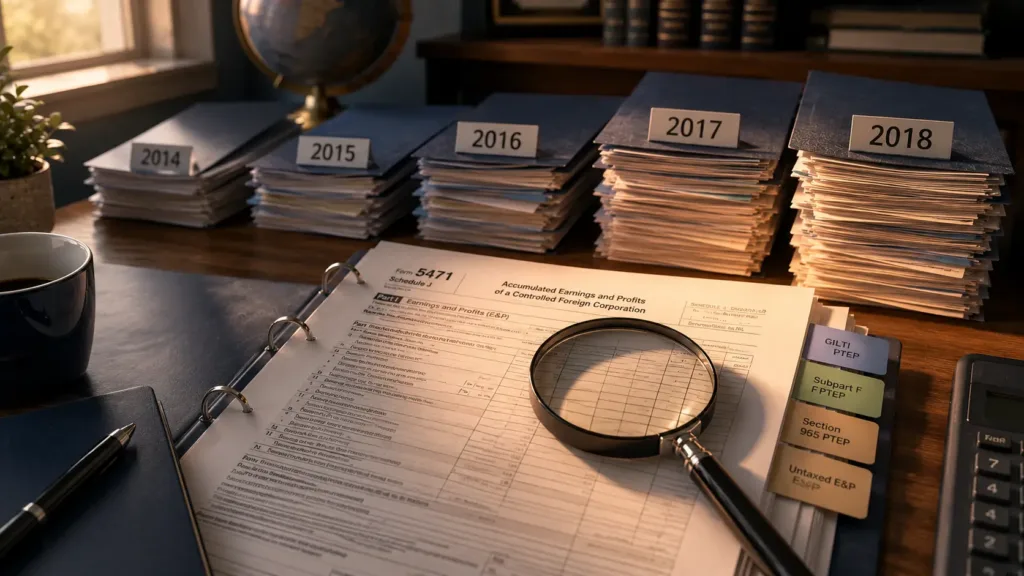
Schedule J of Form 5471 tracks a Controlled Foreign Corporation’s accumulated earnings and profits (E&P) and previously taxed earnings and profits (PTEP) from formation forward. Errors in Schedule J cascade into incorrect GILTI/NCTI inclusions, Subpart F characterizations, and distribution treatment for every subsequent year the foreign corporation operates. When unreported or miscalculated E&P sits in prior year filings, the IRS Streamlined Filing Compliance Procedures may allow non-willful taxpayers to correct the historical record without facing the standalone $10,000 per-form Section 6038(b) penalty.
Why Schedule J Is the Master Calculation?
Every other Form 5471 schedule depends on Schedule J being right.
Schedule I-1 (GILTI) draws from tested income that feeds E&P. Schedule M reflects distributions whose tax character depends on PTEP layers. Schedule P tracks PTEP by U.S. shareholder, which only reconciles when Schedule J has clean E&P layers.
Get E&P wrong in 2018 and the error rolls forward into every year after. Each year inherits the mistake and adds new errors on top. By the time the IRS or a new CPA reviews it, multiple years are compromised.
What Schedule J Actually Tracks?
Schedule J has evolved into one of the most detailed schedules on Form 5471. The current version requires E&P broken into specific categories:
- Post-2017 PTEP: E&P that gave rise to GILTI (Section 951A) inclusions, now NCTI for 2026 and forward
- Subpart F PTEP: E&P that gave rise to Subpart F (Section 951) inclusions
- Section 965 PTEP: Section 965(a) PTEP from the 2017 transition tax
- Reclassified PTEP: Section 965(b)(4)(A) reclassified earnings
- Section 956 PTEP: Section 956 PTEP from investments in U.S. property
- Hovering deficits: E&P deficits that suspend until matched by current E&P
- Non-previously taxed E&P (NPTE): E&P not yet included by any U.S. shareholder
PTEP is distributed tax-free in the U.S. Untaxed E&P generates a taxable dividend. Mix the layers and the distribution tax treatment goes wrong.
How Errors Cascade Across Years?
One bad Schedule J number is rarely a single-year problem.
| What Was Wrong | What Cascades Forward | Measurement |
| Opening E&P missing transition tax inclusion | Distributions misclassified as dividends instead of PTEP | Tax paid on income already taxed |
| GILTI inclusion not added to PTEP layer | Future distributions taxed twice | Double taxation when distributed |
| Subpart F inclusion missing from Schedule J | Schedule P does not reconcile to Schedule J | IRS notice and audit risk |
| Hovering deficit not tracked | Premature E&P offset and lost deferral | Income recognized too early |
| Foreign currency translation error | E&P stated in wrong functional currency | Penalty exposure on every dependent schedule |
| Section 959 ordering rule ignored | Wrong PTEP layer drawn down first | Tax cost on the wrong category |
The cost is rarely visible in the year the error happens. It usually surfaces years later, when the CFC pays a distribution or the U.S. shareholder sells.
Conversational Questions From CFC Owners
- “My CPA filed Form 5471 for five years but left Schedule J blank. Is that a problem?”
- “I paid GILTI tax in 2018 but my Schedule J does not show that PTEP. Will I be double taxed when I take a distribution?”
- “The IRS sent a notice saying my Schedule P does not match my Schedule J. What is happening?”
- “I sold my foreign company in 2024. The gain depended on E&P. How do I know it was right?”
Common Schedule J Mistakes
- Leaving Schedule J blank and assuming it can be caught up later
- Treating accumulated E&P as a single bucket rather than separate PTEP and untaxed layers
- Skipping the post-2017 split between Subpart F PTEP and GILTI PTEP
- Forgetting that GILTI inclusions create PTEP under Section 959(c)(2)
- Reporting E&P in U.S. dollars when functional currency rules require local currency tracking
- Applying distributions to the wrong PTEP category and overstating taxable dividend amounts
- Failing to roll the prior year ending balance into the current year opening balance
Why Going Back to Day One Often Matters?
E&P is cumulative from the date the foreign corporation was acquired or formed.
If the CFC was acquired in 2014 and Schedule J reporting started in 2020 with a guessed opening balance, every year from 2014 forward is technically in error. The 2014-2019 period was not reported, and the 2020 opening cannot be verified.
Rebuilding historical E&P requires going back to original financial statements, applying U.S. tax adjustments under Section 964 and Reg. 1.964-1, and tracking PTEP layers as they accumulated. Consumer tax software typically cannot do this.
For filing categories that drive which schedules apply, see Filed the Wrong Form 5471 Category? Streamlined Filing May Help Correct Past IRS Exposure. For the penalty structure on unfiled Form 5471s, see Unreported Foreign Corporation Ownership and Streamlined Filing.
How Streamlined Filing Helps With Historical E&P?
For taxpayers whose Schedule J errors stem from non-willful failure, the Streamlined Filing Compliance Procedures allow a coordinated correction across three years of returns and six years of FBARs.
The package replaces prior incomplete filings with corrected Form 5471s, including a rebuilt Schedule J showing the proper E&P and PTEP layers. SFOP carries a zero miscellaneous offshore penalty for non-resident taxpayers. SDOP applies 5% on the highest year-end aggregate balance.
Without streamlined relief, the standalone Section 6038(b) penalty applies at $10,000 per form per year, expandable to $60,000 through continuation penalties. A multi-year Schedule J rebuild touching three or four years across one CFC can exceed $100,000 in standalone penalties before any tax adjustments.
For a structured engagement, see Form 5471 CPA Filing or the broader Streamlined Filing CPA Package.

Schedule J and CFC E&P FAQs

Next Step
If your Schedule J shows blanks, mismatches, or layers that do not reconcile, the streamlined correction path can absorb a full rebuild into the broader compliance package. The starting point is a transcript pull, a review of prior Form 5471 filings, and an inventory of available CFC financial statements.
For a complete filing engagement, see Form 5471 CPA Filing. For the full streamlined package, see Streamlined Filing CPA Package.
External references: IRS Instructions for Form 5471 and IRS Section 965 Transition Tax.