Skip to content

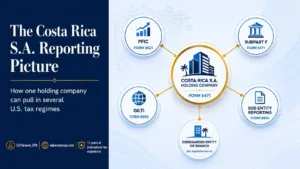
A foreign corporation can be both a Controlled Foreign Corporation (CFC) and a Passive Foreign Investment Company (PFIC) at the same time. Without invoking the overlap exclusion under IRC Section 1297(d), a U.S. shareholder can face double taxation: PFIC excess distribution tax with interest charges on the same income that is also captured by CFC Subpart F or GILTI inclusions. For taxpayers with unreported CFC or PFIC ownership in prior years, the IRS Streamlined Filing Compliance Procedures may allow coordinated correction of Form 5471 and Form 8621 filings while resolving the overlap properly. If you already hold a company that is both, tell me about the holdings and the open years and I will tell you what I would correct first.
The Double Tax Problem in Plain Terms
A foreign corporation holding investments often meets both definitions: a CFC because U.S. shareholders own more than 50%, and a PFIC because 75% of its income or 50% of its assets are passive.
The two regimes were never designed to apply simultaneously. PFIC stops passive investment deferral by non-controlling owners; CFC stops the same deferral by controlling owners.
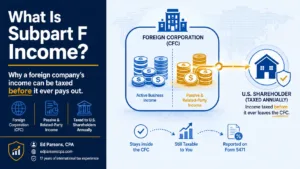
When both apply, the same passive income can be hit twice: once as a PFIC excess distribution with interest charges, and again as a Subpart F or GILTI inclusion.
How a Single Foreign Corporation Becomes Both?
The definitions overlap mostly for investment-heavy structures.
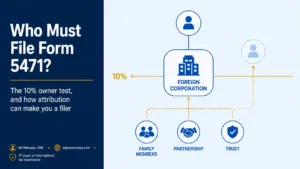
A CFC exists when U.S. shareholders, each owning at least 10% by vote or value, collectively own more than 50%. Only those 10%+ U.S. shareholders trigger CFC status.
A PFIC exists when 75% of the foreign corporation’s gross income is passive (income test) or 50% of its assets produce passive income (asset test). No ownership threshold applies. A single U.S. shareholder with 1% can still have PFIC exposure.
The standalone $10,000 Section 6038(b) penalty for unfiled Form 5471s sits alongside the PFIC penalty under Section 1298(f). For penalty cascade details, see Unfiled Form 5471 Penalties Can Grow Fast.
The Section 1297(d) Overlap Rule
IRC Section 1297(d) resolves the conflict for U.S. shareholders who qualify as 10%+ U.S. shareholders of a CFC.
The rule treats the foreign corporation as a CFC (not a PFIC) for that shareholder during the qualified portion of the holding period. PFIC status terminates and CFC treatment applies.
The catch: the rule applies only during the period the shareholder is a 10%+ U.S. shareholder of a CFC. Pre-CFC periods or below-10% periods still carry PFIC consequences. Transition years are where most double-tax errors occur.
Tax Treatment Comparison: PFIC vs CFC
| Element | PFIC (Default Excess Distribution) | CFC (Subpart F / GILTI) | Measurement |
| Triggering income | Gain on disposition; excess distributions | Subpart F passive; GILTI/NCTI active above QBAI | Income captured |
| Tax rate | Highest ordinary rate plus interest back to year 1 | Ordinary rate in year earned | Effective rate on inclusion |
| Cost basis treatment | FMV step-up under MTM; deferred under excess distribution | Increased by inclusion under Section 961 | Future gain reduction |
| FTC for individuals | Limited | Available through Section 962 | Credit-side disparity |
| Distribution after inclusion | Excess distribution rules continue | PTEP comes out tax-free | Double tax risk on cash |
| Election alternatives | QEF or Mark-to-Market | Section 962 | Election complexity |
| Statute of limitations | Open under IRC 6501(c)(8) until 8621 filed | Open under IRC 6501(c)(8) until 5471 filed | Indefinite exposure |
Selecting the wrong regime, or failing to invoke the Section 1297(d) overlap, results in tax under both at once.
For how Subpart F captures passive income at the CFC level, see Unreported Foreign Passive Income and Streamlined Filing. For GILTI/NCTI on active CFC income, see Unreported GILTI Income and Streamlined Filing.
Read that table again on the pre-CFC years, because that is where the PFIC column keeps applying long after people assume the overlap rule has taken over. Those years are their own body of rules, and my PFIC email series sets them out across five emails once you leave an email address: what makes a corporation passive enough to be caught, why the default excess distribution treatment is so expensive on a long holding period, what the QEF and mark to market elections require and when they close, and why the years with a Form 8621 missing stay open to the IRS. A confirmation email has to be clicked before the series will start. Unsubscribe any time.
Conversational Questions From Overlap Investors
- “My foreign holding company has both investment income and a small operating business. Is it a CFC, a PFIC, or both?”
- “I owned 8% for two years, then bought up to 25%. Do I file Form 8621 for years 1 and 2, and Form 5471 for year 3?”
- “I paid PFIC tax on a distribution last year. Now my CPA says it should have been Subpart F. What now?”
- “My CFC is winding down to a passive holding shell. Am I about to flip from CFC to PFIC?”
Common Mistakes That Trigger Double Taxation
- Filing only Form 8621 when the foreign corporation also qualifies as a CFC
- Filing only Form 5471 without checking whether PFIC rules apply to pre-CFC holding periods
- Missing the Section 1297(d) overlap statement when both regimes technically apply
- Treating QEF and Mark-to-Market elections as interchangeable with CFC inclusion treatment
- Paying PFIC excess distribution tax on income that should have been Subpart F PTEP
- Missing the requirement to file both Form 5471 and Form 8621 in transition years
Why PTEP Tracking Becomes Critical in Overlap Situations
When a foreign corporation flips from PFIC to CFC (or vice versa), the previously-taxed amounts must be tracked separately to prevent the same income from being taxed again on distribution.
For CFCs, PTEP layers under Section 959 sit on Schedule J of Form 5471. For PFICs, basis adjustments and QEF inclusions track separately on Form 8621. Distributions during the wrong regime can pull from the wrong layer.
For Schedule J E&P and PTEP layering mechanics, see Unreported CFC Earnings and Profits Problems. For how a miscategorized Form 5471 cascades into PTEP errors, see Filed the Wrong Form 5471 Category.
PTEP layering is not something to work out from an article, and it is not something I can quote on without the ownership timeline in front of me. The short version of what I need is the count and the calendar. Describe the holdings and the open years and I will scope the correction. The form asks how many funds are in play and which years are still to file, and gives you space to explain where the ownership shifted. You will not get an automated reply from it. What comes back is my read on your facts.
How Streamlined Filing Resolves CFC/PFIC Overlap?
For taxpayers who failed to report either CFC or PFIC obligations and whose non-compliance was non-willful, the Streamlined Filing Compliance Procedures can absorb corrected Form 5471s and Form 8621s into a coordinated package covering three years of returns and six years of FBARs.
The submission includes a Section 1297(d) overlap analysis for years where both regimes applied. The package waives Section 6038(b) and Section 1298(f) penalties, eliminates accuracy-related penalties on the tax, and closes the statute of limitations three years after filing.
For a structured engagement on the CFC side, see Form 5471 CPA Filing. For the PFIC side, see Form 8621 PFIC Filing.

CFC and PFIC Overlap FAQs

Next Step
If your prior returns missed CFC or PFIC reporting, or applied the wrong regime, a streamlined correction usually produces the lowest total exposure. The starting point is an ownership timeline against the 10% threshold, an income/asset test for PFIC status, and a Section 1297(d) overlap analysis.
For the Form 5471 side, see Form 5471 CPA Filing. For the Form 8621 side, see Form 8621 PFIC Filing.
External references: IRS Instructions for Form 8621 and IRS Instructions for Form 5471.