Skip to content

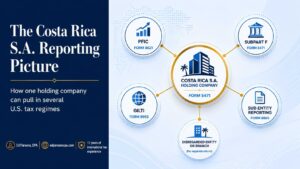
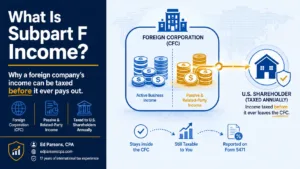
Subpart F income (passive and certain other categories of CFC income) is taxed to U.S. shareholders in the year the CFC earns it, regardless of whether any distribution is made. The categories include foreign personal holding company income (dividends, interest, rents, royalties), foreign base company sales and services income, and insurance income under IRC Sections 951 through 954. For taxpayers with unreported Subpart F inclusions tied to prior year CFC ownership, the IRS Streamlined Filing Compliance Procedures may allow correction at substantially reduced exposure compared to standard delinquent filing under Section 6038(b). Passive income is also where a company can be pulled into the PFIC rules at the same time, which the CFC and PFIC overlap guide walks through.
Why Subpart F Eliminates Deferral on Passive Income?
Long before GILTI, Congress targeted what it called “tax haven” income.
The concern: U.S. taxpayers could form a foreign corporation in a low-tax jurisdiction, route passive income through it, and defer U.S. tax indefinitely. Subpart F, enacted in 1962, ended that.
Today, a U.S. shareholder of a CFC is taxed currently on the CFC’s Subpart F income whether or not the CFC distributes. Cash in a Cayman holding company earning interest is taxed to you in real time. For the plain-language version of the rule before the penalties, see what Subpart F income is.
The Categories of Subpart F Income
Subpart F income is defined under IRC Section 952. The biggest category is foreign base company income (FBCI), which has its own subcategories.
- Foreign Personal Holding Company Income (FPHCI): Dividends, interest, royalties, rents, annuities, and gains from property producing them
- Foreign Base Company Sales Income: Buying or selling goods involving a related party where the goods come from outside the CFC’s country
- Foreign Base Company Services Income: Services performed outside the CFC’s country for a related party
- Insurance Income: Insuring risks located outside the CFC’s country
- International Boycott Income: Income tied to a participating boycott
- Illegal Payments: Bribes, kickbacks, or similar payments
Each category has its own definition, exceptions, and interaction with the high-tax exclusion under Section 954(b)(4).
The Scenario That Catches CFC Investors
A common pattern: a U.S. investor sets up a CFC in a low-tax jurisdiction. The CFC holds investments generating interest and dividends. The investor believes the structure defers U.S. tax until repatriation.
In reality, the interest and dividend income is FPHCI under Section 954(c). It is Subpart F income from day one. The U.S. shareholder owes tax annually whether or not the CFC distributes.
The reverse also happens. An active operating CFC has a small interest-bearing account. The interest is FPHCI, taxable currently even when active business income is excluded.
How Subpart F Interacts With GILTI
The two regimes work together but apply in a specific order. Subpart F applies first. Whatever gets included as Subpart F is excluded from GILTI tested income. The remaining active CFC income flows into GILTI under Section 951A.
| Element | Subpart F | GILTI / NCTI | Measurement |
| Triggering income | Passive and FBCI | Active CFC income above QBAI return | Income type categorization |
| Statutory section | Sections 951, 952, 954 | Section 951A | IRC source |
| Order of application | Applied first | Applied to remaining income | Sequencing |
| Default individual rate | Up to 37% | Up to 37% | Same rate exposure |
| FTC (individual default) | Available under Section 901 | Not available without Section 962 | Credit-side disparity |
| 2026 OBBBA changes | Largely unchanged | NCTI rename, QBAI eliminated | Stability vs disruption |
The interaction matters. Misclassifying Subpart F as GILTI (or vice versa) changes the FTC treatment, the Section 962 calculation, and the PTEP layer in Schedule J.
Two regimes dividing one company’s income between them stops being academic the moment a filing is late, because both have to be computed for every open year. My email series takes that on. It covers the passive earnings reached in the year they arise, and what a coordinated correction involves once several of those years are behind you, including whether the streamlined route is still available to you. Send the series to my inbox. There is a confirmation email in between and the series holds for it. Unsubscribe on any of them.
Conversational Questions From CFC Investors
- “My CFC holds investments and earns interest. I never took a distribution. Why does the IRS want tax?”
- “I set up the CFC for asset protection, not tax deferral. Is the interest still Subpart F?”
- “I have a small medical practice in Costa Rica through a CFC. Does Subpart F apply to my fees?”
- “My CFC earns rental income from properties it owns directly. Is that automatically Subpart F?”
Common Subpart F Mistakes That Trigger Penalties
- Treating Subpart F as a problem only for large multinationals, not individual CFC owners
- Skipping Schedule I (Subpart F summary) when filing Form 5471
- Missing the de minimis rule (passive income under 5% of gross income or $1 million stays out of FBCI)
- Ignoring the full inclusion rule (over 70% gross income means all FBCI is Subpart F)
- Failing to claim the high-tax exception under Section 954(b)(4) when CFC income was taxed above 90% of the U.S. rate
- Confusing Subpart F PTEP with GILTI PTEP on Schedule J, leading to wrong distribution treatment
- Ignoring Section 956 deemed dividend rules when the CFC invests in U.S. property
Why Schedule I Errors Cascade
Schedule I summarizes the U.S. shareholder’s pro-rata share of Subpart F income. The supporting detail flows from Schedule G and the CFC’s financial accounts.
When Schedule I is wrong, the Form 1040 Subpart F inclusion is wrong. The mistake rolls into Schedule J’s PTEP layers, where it sits until a future distribution exposes the misclassification.
For how GILTI sits alongside Subpart F, see Unreported GILTI Income and Streamlined Filing. For PTEP tracking across both regimes, see Unreported CFC Earnings and Profits Problems. For category and penalty background, see Filed the Wrong Form 5471 Category and Unreported Foreign Corporation Ownership.
How Streamlined Filing Resolves Subpart F Exposure
For taxpayers whose Subpart F inclusions were not reported in prior years and whose non-compliance was non-willful, the Streamlined Filing Compliance Procedures allow corrected returns and Form 5471s to be submitted as a coordinated package covering three years of returns and six years of FBARs.
Unreported Subpart F income is added to taxable income for each covered year, with tax and interest assessed but the Section 6038(b) penalty waived. SFOP carries no miscellaneous offshore penalty. SDOP applies 5% on the highest year-end aggregate balance.
Without streamlined relief, the standalone Form 5471 penalty runs $10,000 to $60,000 per form per year, before tax and accuracy-related penalties on the unreported income.
For a structured engagement, see Form 5471 CPA Filing or the broader Streamlined Filing CPA Package.

Subpart F FAQs

Next Step
If your prior returns missed Subpart F inclusions and the facts support non-willful failure, a streamlined correction usually produces the lowest total exposure. The starting point is a CFC-by-CFC categorization of income and a high-tax exception analysis.
For a complete engagement, see Form 5471 CPA Filing. For the full streamlined package, see Streamlined Filing CPA Package.
External references: IRS Instructions for Form 5471 and IRS Streamlined Filing Compliance Procedures.