Skip to content
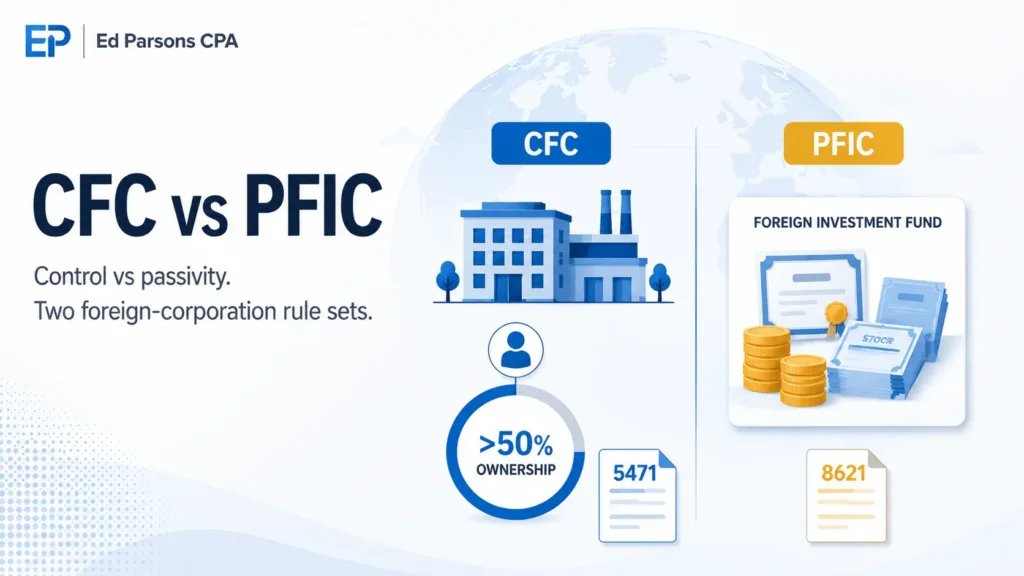
A CFC and a PFIC are two separate sets of U.S. tax rules for foreign corporations. A CFC is about control: a foreign company more than 50% owned by U.S. shareholders who each hold at least 10%. A PFIC is about passivity: a foreign company that earns mostly passive income or holds mostly passive assets, no matter who owns it. CFCs are reported on Form 5471, PFICs on Form 8621. Tell me what the company holds and who owns it, and I will tell you which form applies and what it would take.
People mix these two up for good reason. Both deal with foreign corporations, both create U.S. tax obligations, and both come with their own information return. Yet they target very different situations and usually do not apply to the same person at the same time.
This guide explains the difference in plain English, with a short example, so you can tell which one fits your situation. If the PFIC side is new to you, the overview of what a PFIC is fills in the background.
The Core Difference: Control vs Passivity
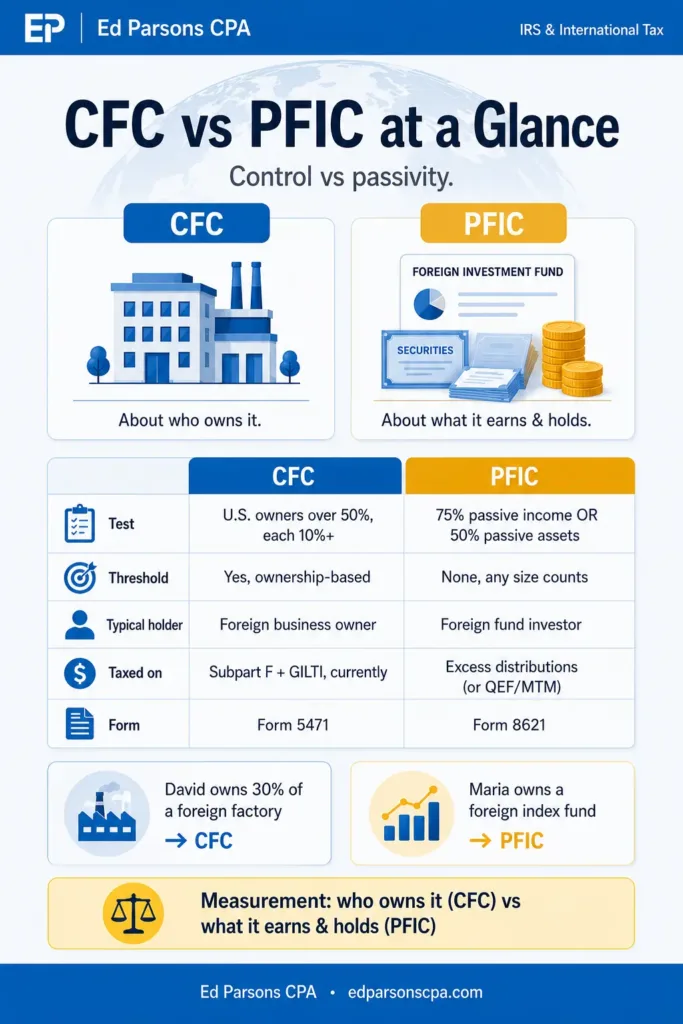
Here is the whole idea in one line. A CFC is about who owns the company. A PFIC is about what the company does.
The CFC rules exist to stop U.S. owners from parking active business profits in a foreign company they control. The PFIC rules exist to stop U.S. investors from sheltering passive investment income inside a foreign fund. One is a business-owner problem. The other is an investor problem.
Knowing which one describes you is the first move, because it points to a different form, a different tax calculation, and a different set of deadlines.
What Makes a Company a CFC
A foreign corporation is a Controlled Foreign Corporation when U.S. shareholders own more than 50% of it, by vote or by value. A U.S. shareholder, for this purpose, is a U.S. person who owns at least 10% of the company.
Attribution rules can fold in shares owned by family members or related entities, so you can become a 10% shareholder without buying that much yourself. The typical CFC owner is someone with a real foreign operating business, not a passive investor.
The tax side is demanding. U.S. shareholders can be taxed currently on Subpart F income and GILTI, meaning the company’s profits can hit your return even if nothing was distributed to you. People often call this phantom income, because you can owe tax in a year you never received a dollar from the company. Reporting is on Form 5471, described on the IRS About Form 5471 page.
What Makes a Company a PFIC
A foreign corporation is a PFIC when it meets either of two tests: 75% or more of its income is passive, or at least 50% of its assets are passive. Meeting one is enough.
There is no ownership threshold. A 0.1% stake in a foreign fund counts the same as a large one. That is why ordinary investors holding foreign mutual funds and ETFs are the most common PFIC holders.
A typical fund tends to meet both tests at once, since it holds mostly securities and cash and earns mostly dividends, interest, and gains. There is no special intent required, the structure of a fund does it automatically.
The default tax method is the harsh excess distribution regime, unless a QEF or mark-to-market election is in place. Reporting is on Form 8621, and who must file it depends on your activity for the year. The IRS summarizes the form on its About Form 8621 page.
Side by side, the contrast is clean:
| Feature | CFC | PFIC |
| What it tests | Ownership and control | The company’s income and assets |
| Ownership threshold | U.S. owners over 50%, each holding 10% or more | None, even a tiny stake counts |
| Typical holder | Owner of a foreign operating business | Investor in foreign funds or ETFs |
| How you are taxed | Subpart F income and GILTI, taxed currently | Excess distribution regime, or a QEF or mark-to-market election |
| Form | Form 5471 | Form 8621 |
| Measurement: what controls the answer | Who owns the company | What the company earns and holds |
Same country, same foreign corporation label, two completely different rule sets. The trigger is control on one side and passivity on the other.
A Quick Example
Two people, two foreign corporations, two different outcomes.
Maria buys shares of a foreign index fund through an overseas broker. She owns a tiny fraction, has no control, and the fund holds nothing but stocks and cash. Her fund is a PFIC, and she reports it on Form 8621.
David and two U.S. friends together own 80% of a foreign manufacturing company, and David’s share is 30%. They control the company, and David is a 10% U.S. shareholder, so the company is a CFC. David reports it on Form 5471 and can owe tax on GILTI and Subpart F income even if the company keeps its profits overseas.
Maria’s concern is passivity. David’s concern is control. Neither label depends on the country the company sits in.
When Both Could Apply
A single company can technically meet both definitions. The tax code includes a coordination rule so the same income is not taxed twice under both regimes.
In short, if you are a 10% U.S. shareholder of a CFC, the company generally is not also treated as a PFIC for you during that period. That overlap has its own traps and its own reporting steps, but the key takeaway here is simpler: the two regimes are built not to stack, provided everything is classified and reported correctly.
Most readers who get this far already know which side of the line they are on, and it is usually the investor side. If that is you, the CFC half of this page is background and the PFIC half is your actual problem. My PFIC email series takes only that half: five emails to one email address, covering the income and asset tests, why the default regime taxes a gain at top ordinary rates with interest reaching back over your holding period, how QEF and mark to market differ and what each one demands, and why an unfiled Form 8621 leaves the whole return exposed. Expect a confirmation email before anything else, since the series starts when you click it. Unsubscribe any time.
CFC vs. PFIC: Practical Examples of Tax Classification
- Treating a small stake in a foreign company as a CFC issue, when it is usually a PFIC issue.
- Treating a controlled foreign business as a PFIC and filing the wrong form.
- Assuming no distribution means no tax, when both regimes can tax you without one.
- Filing Form 5471 when Form 8621 was required, or the reverse.
- Overlooking attribution rules that can make you a 10% CFC shareholder through family.
Questions People Ask
“I own 5% of a foreign company. Is that a CFC for me?”
On its own, no. A CFC needs U.S. owners holding more than 50% in total, each with at least 10%. A 5% stake is more likely a PFIC question, depending on what the company earns and holds.
“My foreign company is an active business. Can it still be a PFIC?”
If you and other U.S. owners control it, the CFC rules generally take priority and the PFIC rules step aside for you. If you do not control it and it holds mostly passive assets, the PFIC rules can apply.
Why Getting It Right Matters
Picking the wrong regime is not a harmless slip. File Form 5471 when Form 8621 was required, or the reverse, and you can end up with the wrong tax and a return that is still incomplete.
Both forms share a quiet danger. An unfiled Form 5471 or Form 8621 can keep your entire tax return open to IRS review with no clear end date. On the PFIC side, the most favorable elections also tend to expire if they are not made early, so waiting can quietly remove options you would have wanted.
Getting the regime right is a question about your facts, not about the rules, and it takes about a minute to describe. Tell me what you actually hold and I will price the work from that. The survey asks how many funds are involved, which years are still unfiled, and leaves you room to explain the situation in your own words. Nothing about bank details or account numbers. There is no automatic receipt on this one, so do not wait for a robot to answer: it lands on my desk and the reply comes from me.
Which One Is You?
The practical question is which regime your situation falls under, because the answer decides the form you file, how you are taxed, and the deadlines you face. Guessing wrong can mean the wrong return and years of avoidable exposure.

Get a clear classification.
A CPA tax resolution case analysis can sort out whether your situation is a PFIC matter calling for Form 8621 filing, a CFC matter calling for Form 5471 filing, or both.
Starting on the investor side?
Run a fund through the PFIC Analyzer to see whether it is likely a PFIC before you decide your next step.