Skip to content

By Edward Parsons, CPA | Ed Parsons CPA, Doral, Florida | Representing taxpayers nationwide |
Is your foreign mutual fund a PFIC? Almost certainly yes. Nearly every mutual fund organized outside the United States meets the IRS definition of a Passive Foreign Investment Company, because these funds hold mostly passive assets and earn mostly passive income. If you are a U.S. taxpayer who owns one, special tax rules and a yearly form can apply, even in years when you never sold a share.
You opened a brokerage account in another country, or kept one from before you moved to the United States, and bought a normal-looking fund. Nobody warned you it could become a tax problem. Now you have come across the term PFIC, and you are wondering whether it applies to you.
It very likely does. This article gives you the plain-language answer and shows why ordinary foreign funds get pulled in. For the full background on the classification, see the overview of what a PFIC is.
The Short Answer: Almost Always Yes
A Passive Foreign Investment Company is exactly the kind of thing a mutual fund is. A fund pools money and holds stocks, bonds, and cash, which produce dividends, interest, and gains. That is passive income sitting on top of passive assets, which is the precise pattern the PFIC rules were built to catch.
This is not about exotic offshore arrangements. A plain index fund bought at a bank in Canada, the United Kingdom, India, or anywhere else can be a PFIC. The country does not matter. The structure does.
So if you hold a foreign mutual fund, the safe assumption is that it is a PFIC until a professional confirms otherwise. The interesting question is usually not whether, but what to do about it.
That assumption holds across borders and account types. A retirement-style account in one country, a regular brokerage account in another, and a single fund bought on a whim while living abroad can all land in the same place. The label on the product changes, but the underlying analysis does not.
How People Usually Find Out
Most people do not go looking for the PFIC rules. The rules find them, usually in one of a few familiar ways.
- New U.S. residents who kept mutual funds or retirement savings from their home country.
- Americans who lived abroad and invested locally while they were there.
- People who inherited a foreign brokerage or fund account from a relative.
- Investors whose accountant flagged a foreign fund, or who received a confusing year-end statement.
If any of those sound like you, you are in the same position as most PFIC holders. Recognizing the issue is the hardest part, and you have already done it.
Why Funds Get Caught
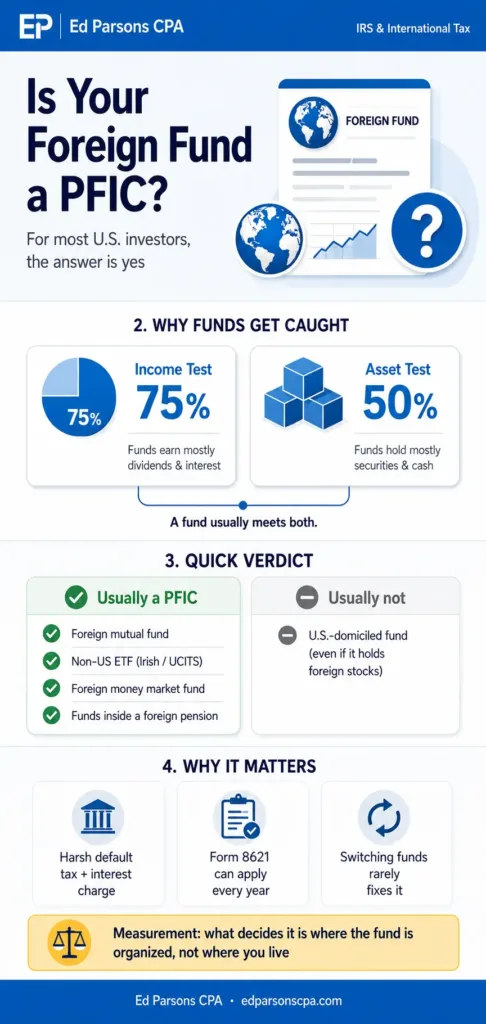
The IRS uses two tests to decide whether a foreign company is a PFIC, and meeting either one is enough. A typical fund tends to meet both, which is why funds are caught so reliably.
Both tests are restated in the IRS instructions for Form 8621, and a fund usually satisfies them without anyone trying.
The income test. If 75% or more of the company’s gross income is passive, it is a PFIC. A fund earns almost all of its income from dividends, interest, and investment gains, so it clears this bar easily. The mechanics are covered in the guide to the PFIC income test.
The asset test. If at least 50% of the company’s assets are passive, it is a PFIC. A fund’s assets are almost entirely securities and cash, which are passive by nature. The details are in the guide to the PFIC asset test.
A fund is designed to be passive. That design is what makes it fail both tests at once, with no special intent on anyone’s part.
What About ETFs?
The same logic applies to exchange-traded funds. A foreign ETF is a foreign corporation that holds a basket of passive assets, so it is usually a PFIC for the same reasons a mutual fund is.
Irish-domiciled ETFs are a common example. Many non-US investors hold UCITS funds organized in Ireland or elsewhere in Europe because they are easy to buy abroad, and those are almost always PFICs for a U.S. taxpayer.
Here is the part that surprises people. A non-US ETF that holds U.S. stocks is still a PFIC, while a U.S.-domiciled ETF that holds foreign stocks generally is not. What matters is where the fund itself is organized, not what it invests in or where you happen to live.
This is also why switching from one foreign ETF to another rarely solves the problem. The replacement is usually a PFIC too, and the sale of the first one can create its own reporting event.
Common Holdings That Are Usually PFICs
If you recognize any of these in your portfolio, treat PFIC status as the starting assumption:
- Foreign mutual funds and unit trusts.
- Non-US ETFs and index funds, including Irish and other UCITS funds.
- Foreign money market funds.
- Pooled funds held inside a foreign pension or insurance wrapper.
- Foreign hedge funds and other collective investment vehicles.
The table below sorts the most common cases. Notice that the deciding factor is always where the fund is organized.
| Your investment | A PFIC? | Why |
| Foreign mutual fund | Yes | A pool of passive assets earning passive income |
| Non-US ETF (Irish or other UCITS) | Yes | A foreign-organized fund of securities |
| Foreign money market fund | Yes | Holds cash and short-term passive instruments |
| U.S.-domiciled fund holding foreign stocks | No | It is organized in the United States |
| Foreign pension or insurance wrapper | Often | The pooled funds inside it can each be PFICs |
| Measurement: what decides it | Where it is organized | Not where you live or what it holds |
A fund’s marketing name and your home country tell you nothing about PFIC status. Its country of organization does.
Why It Matters
PFIC classification is not a paperwork footnote. The default tax method is one of the harshest in the code: gains and unusually large distributions are spread back across your holding period and taxed at the highest ordinary rate, with an interest charge added on top. There is no long-term capital gains rate.
Two elections can soften that treatment, but each carries conditions and is usually made early in your ownership of the fund. That timing is one more reason the classification question is worth answering sooner rather than later, since the best options can quietly expire.
There is also a reporting side. Owning a PFIC can require a yearly Form 8621, sometimes even in a year when you received nothing and sold nothing. Who has to file, and when, is laid out in the guide on Form 8621 filing requirements, and the IRS summarizes the same rules on its About Form 8621 page.
There is no flat dollar penalty for a missed Form 8621, but skipping it carries a quieter risk: an unfiled form can keep your entire tax return open to IRS review with no clear end date.
Common Mistakes
- Assuming a foreign fund is taxed the same way as a U.S. fund.
- Feeling safe because you never sold the fund or took money out.
- Believing only large accounts are worth worrying about.
- Overlooking funds held inside a foreign retirement or insurance account.
- Trusting a fund’s name or marketing instead of where it is organized.
Questions People Ask
“I never sold the fund and it pays almost nothing. Am I fine?”
Not necessarily. PFIC status does not depend on selling or receiving income, and a reporting obligation can apply even in a completely quiet year.
“It is a tiny holding. Does it really count?”
Classification does not change with size. A small holding is still a PFIC, though the amount can affect whether a limited reporting exception applies.
“My fund only holds U.S. companies. Surely that is not foreign?”
If the fund itself is organized abroad, it is still a PFIC, even when every stock it holds is American.
Find Out for Sure
The safe assumption is that your foreign fund is a PFIC, but the right next step depends on your specific holdings, how long you have owned them, and whether any years were reported. Getting a clear read early is far easier than untangling it later.

Have your funds reviewed.
A CPA tax resolution case analysis can confirm which of your holdings are PFICs and whether Form 8621 filing is required for the years involved.
Want a quick first read?
Run a fund through the PFIC Analyzer to see whether it is likely a PFIC before you decide what to do next.