Skip to content
By Edward Parsons, CPA | Ed Parsons CPA, Doral, Florida | Representing taxpayers nationwide |
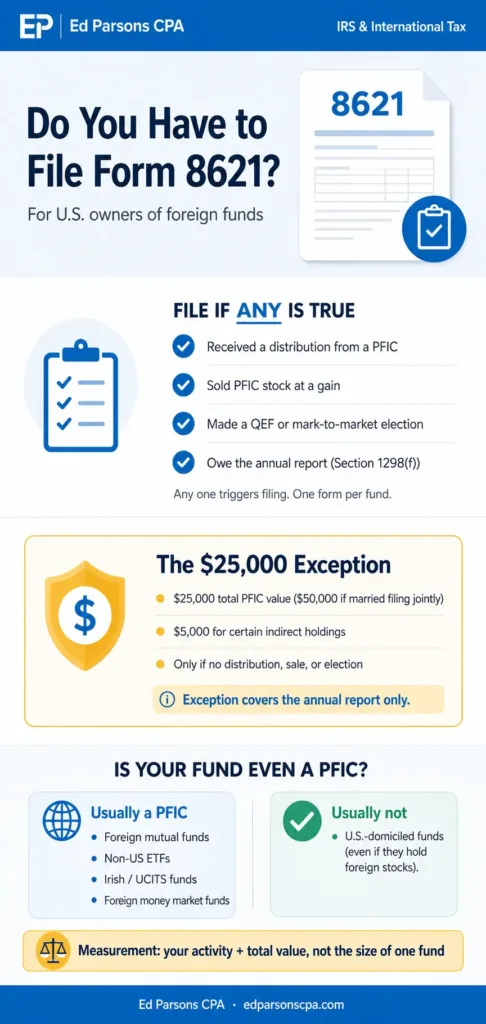
You must file Form 8621 if you are a U.S. person who is a direct or indirect shareholder of a PFIC and, during the year, you received a distribution, sold at a gain, made or reported a QEF or mark-to-market election, or owe the annual report under Section 1298(f). Because most foreign mutual funds and ETFs are PFICs, ordinary overseas investors are the most common filers. A separate form is filed for each fund.
The hardest part of Form 8621 is realizing it applies to you at all. Most people who have to file are not sophisticated investors. They hold a single foreign mutual fund or ETF and have no idea it carries a U.S. filing obligation.
This guide answers the practical question that follows once you know what a PFIC is: given that you may hold one, do you actually have to file?
Two things decide the answer: whether your fund is a PFIC, and what you did with it during the year.
Who Counts as a Shareholder
The form reaches any U.S. person, which includes citizens, green card holders, residents who meet the substantial presence test, and domestic entities. New U.S. residents who kept investments from abroad are caught surprisingly often.
Ownership comes in two forms, and both can require filing:
- Direct shareholder: you own the fund or foreign company stock in your own name.
- Indirect shareholder: you own it through something else, such as a foreign corporation, a partnership, a trust, or another PFIC.
Being an indirect PFIC shareholder does not remove the obligation. In a chain of ownership, the first U.S. person in line generally carries the filing duty, even if an entity above them filed something of its own. The IRS summarizes who files on its About Form 8621 page.
The Five Situations That Require Filing
Per the IRS instructions for Form 8621, a U.S. shareholder of a PFIC generally files for any year in which one of these is true:
- You received certain direct or indirect distributions from a PFIC.
- You recognized gain on a direct or indirect disposition of PFIC stock.
- You are reporting a QEF or mark-to-market election.
- You are making an election reportable in Part II of the form.
- You are required to file an annual report under Section 1298(f).
The fifth one is the surprise. The annual report can apply even in a completely quiet year, with no distribution, no sale, and no taxable income. Holding the fund is enough to put it on the table.
Is Your Foreign Fund a PFIC?
This is where most of the uncertainty lives. The honest short answer is that the great majority of pooled investment funds organized outside the United States meet a PFIC test.
- Foreign mutual funds and unit trusts are usually PFICs.
- Foreign and non-US ETFs, including Irish-domiciled and other European (UCITS) funds, are commonly PFICs.
- Foreign money market funds and many foreign index funds fall in the same category.
What matters is where the fund is organized, not where it invests. A U.S.-domiciled ETF that holds foreign stocks is generally not a PFIC, while a non-US ETF that holds U.S. stocks usually is. Whether a fund qualifies comes down to the income test and the asset test, and meeting either one is enough.
The De Minimis Exception and the Ownership Threshold
There is a narrow exception that can switch off the annual report for small holdings. It is the one place where the size of your position matters.
- Total PFIC value of $25,000 or less ($50,000 for married filing jointly) at year-end.
- A lower $5,000 threshold for certain PFIC stock owned indirectly through another PFIC.
- Available only for Section 1291 funds, meaning no QEF or mark-to-market election is in place.
The exception is easy to over-read. It disappears the moment another trigger applies, so if you received a distribution, sold at a gain, or have an election in place, you file regardless of value. It also applies to the annual report only, not to the other four situations above.
The table below sorts the common scenarios into file or do not file. Notice that what you did usually matters more than how much you hold.
| Your situation this year | File? | Why |
| Received a distribution from a PFIC | Yes | Required regardless of the size of your holding |
| Sold PFIC stock at a gain | Yes | A disposition triggers filing on its own |
| Have a QEF or mark-to-market election | Yes | The de minimis exception does not apply |
| Hold a PFIC, no distribution or sale, total value over the limit | Yes | The annual report under Section 1298(f) applies |
| Hold a PFIC, no distribution or sale, total value at or under the limit | Often no | The de minimis exception can apply if no other trigger does |
| Measurement: what controls the answer | Activity + total value | Not the size of any single fund |
One distribution or one sale can move you from the bottom row to the top in a single year.
Common Mistakes
- Assuming a foreign fund is treated like a U.S. fund and skipping the form entirely.
- Treating the $25,000 exception as a blanket pass after a distribution or sale.
- Filing one form for several funds instead of one form per PFIC.
- Overlooking indirect ownership through a partnership, trust, or another PFIC.
- Believing a quiet year with no income means there is nothing to file.
- Forgetting funds held inside a foreign pension or insurance wrapper.
Questions People Ask
“My foreign fund did not pay anything this year. Do I still file?”
Often yes. The annual report under Section 1298(f) can apply even with no distribution or sale, unless your total PFIC value is small enough to qualify for the de minimis exception.
“It is just one small ETF. Does the threshold get me off the hook?”
Only if your total PFIC value stays under the limit and you had no distribution, sale, or election that year. A single sale changes the answer.
“I own it through a foreign partnership, not directly. Am I clear?”
Not necessarily. Indirect shareholders can carry the filing obligation, and being one step removed does not remove it.
Find Out If You Have to File
The filing question turns on three moving parts: whether the fund is a PFIC, what you did with it during the year, and how you own it. Each one can flip the result, and a wrong call can leave a return open to IRS review long after you thought the year was closed.

Get a clear answer for your situation.
A CPA tax resolution case analysis can confirm whether your funds are PFICs and whether Form 8621 filing is required for each year involved.
Want to check the classification first?
Run the fund through the PFIC Analyzer to see whether it is likely a PFIC, then return to the PFIC overview for the full picture.