Skip to content

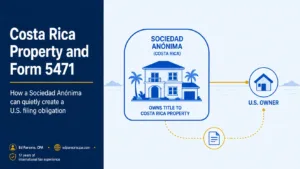
A Costa Rican Sociedad Anónima that holds a home, a lot, or a rental is a foreign corporation for U.S. tax purposes, and your reporting does not stop at Form 5471. Depending on what the company holds, what it earns, and how much of it you own, the same structure can raise PFIC questions, trigger Subpart F or GILTI inclusions on rental or business income, and require Form 8858 for any disregarded entity beneath it. The result is an ongoing reporting picture, not a one-time filing.
If you already know you own a Costa Rican Sociedad Anónima, the practical question is no longer whether you report it, but what that reporting includes, year after year. The answer is rarely just one form. A Costa Rican S.A. is a foreign corporation for U.S. tax purposes, and depending on what it holds, what it earns, and how much of it you own, it can pull in several U.S. regimes at once. Any account the company holds can bring the FBAR and Form 8938 into it as well, and I show how those filings and Form 5471 fit together on one structure.
Our companion guide on buying Costa Rica property through a corporation covers how the obligation arises in the first place. This page goes a layer deeper, into the ongoing reporting picture for owners who already have the structure. For the form at the center of it, see our complete guide to Form 5471.
Start With the Baseline: Annual Form 5471
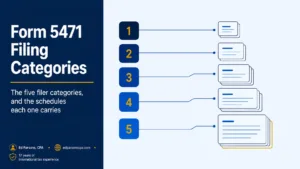
Every U.S. owner who controls or holds a significant stake in the S.A. files Form 5471 each year. The form is due whether or not the company earns income, and your filer category, usually Category 4 for a controlling owner or Category 5 for a shareholder of a controlled foreign corporation, decides which schedules attach. The same is true for each foreign corporation you hold, so a second Costa Rican company means a second annual Form 5471.
That much is constant. The variation, and the real complexity, comes from what the company does beyond simply existing.
Is It a CFC? That Question Drives the Rest
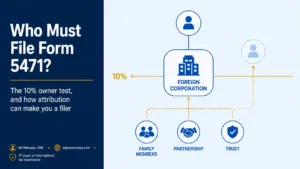
The single most important question for the rest of your reporting is whether the S.A. is a controlled foreign corporation, a CFC: U.S. shareholders who each own at least 10% together own more than half of it. For a typical personal holding company that you wholly or mostly own, the answer is yes.
Why it matters: if the company is a CFC and you are a 10% U.S. shareholder, the CFC rules govern your income from it, and the passive foreign investment company rules generally do not apply to you. If the company is not a CFC, for instance a maritime-zone structure where local owners hold the majority, the PFIC rules can apply instead. CFC status is the fork in the road, and most of what follows depends on which way it points.
When a Passive Holding Company Raises PFIC Questions?
A company that mainly holds property, especially a non-income or rental real-estate company, looks a lot like a passive foreign investment company on paper, because most of its assets or income are passive. That is what raises the PFIC question in the first place.
The saving grace for most owners is the CFC overlap rule: if the S.A. is a CFC and you are a 10% U.S. shareholder, it is generally not treated as a PFIC as to you. The owners who actually face PFIC treatment tend to be those with smaller, non-controlling stakes in a company that is not a CFC. Working out which side of that line you are on is a core part of the analysis, not a footnote. The distinction is far from academic, because the two regimes calculate tax in very different ways and rarely produce the same result.
When Rental Income Triggers Subpart F or GILTI
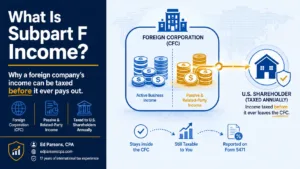
Once the S.A. earns money, the income rules wake up. If it is a CFC and collects rent, that rent is passive income that can become Subpart F income, taxed to you in the year it is earned even if the company never distributes it.
If the company runs an active business rather than just holding property, say active property management or development, its income above a routine return can fall under GILTI, recently renamed Net CFC Tested Income. A pure rental holding company leans toward Subpart F; an operating business leans toward GILTI. Many Costa Rican structures sit somewhere in between, which is exactly why the income has to be characterized carefully rather than assumed.
Rent inside a controlled company is reached in the year it is earned, and that is usually the point at which an owner wants the rest of the picture. Five emails from me give it, including one on the layer this section opens: the possibility that a further information return is owed for a branch or disregarded entity sitting under the company, carrying its own exposure when it is skipped. Send the series to my inbox. Confirm the address when the first note lands. Unsubscribe on every email. None of it is written for a Costa Rican structure, so your own facts still need reading.
When Form 8858 Enters: Sub-Entities and Branches
Reporting can extend below the S.A. itself. If the Costa Rican company owns a foreign disregarded entity or operates through a foreign branch, a separate Form 8858 is generally required on top of Form 5471, with its own $10,000 penalty for non-compliance.
This catches more structures than people expect: a second entity held beneath the S.A., a single-member entity treated as disregarded, or a branch operating in another country. Each layer of the structure can carry its own U.S. form.
| Majority U.S.-owned S.A. (a CFC) | Majority local-owned S.A. (often not a CFC) | |
| Form 5471 | Yes, Category 4 or 5 | Maybe, depends on your stake |
| Measurement (which income rules apply) | CFC rules: Subpart F and GILTI | PFIC rules may apply |
| On rental income | Subpart F inclusion likely | PFIC treatment possible |
| PFIC rules | Overridden by CFC status | Can govern the U.S. owner |
What This Adds Up To
- Form 5471 is required every year, by category, regardless of income.
- Whether the S.A. is a CFC decides whether CFC rules or PFIC rules apply to you.
- Rental income can trigger Subpart F, and active business income can trigger GILTI.
- A disregarded entity or branch beneath the S.A. adds Form 8858.
- Each form carries its own $10,000 penalty and its own deadline.
Common Mistakes
- Treating Form 5471 as the only U.S. form the structure requires.
- Assuming the PFIC rules apply without checking whether CFC status overrides them.
- Overlooking that rental income can be taxed currently as Subpart F, with no distribution.
- Missing Form 8858 for a disregarded entity or branch held beneath the S.A.
- Reporting each form in isolation instead of as one coordinated picture.

Questions S.A. Owners Ask
Is my Costa Rica company a PFIC or a CFC?
Usually a CFC if you own most of it, which means the CFC rules apply and PFIC generally does not. A minority stake in a locally controlled company is where PFIC is more likely.
I only collect a little rent, does that matter?
It can. Rent is passive income, and even a modest amount can create a Subpart F inclusion if the company is a CFC.
I have a second entity under the S.A., is that a problem? Not a problem, but likely another form. A disregarded entity or branch beneath the company generally brings Form 8858 into the picture.
A Costa Rican Holding Structure Needs a Reporting Plan
The theme across all of this is that a Costa Rican S.A. is not a single-form obligation but a small reporting system: Form 5471 at the center, with PFIC, Subpart F, GILTI, and Form 8858 questions radiating out from what the company holds and earns. Handled piecemeal, the pieces conflict and gaps appear; handled together, they form one coherent filing.
If you own a Costa Rican holding company and want the full picture mapped and filed correctly, Form 5471 CPA Filing covers the core return and its schedules, and Form 8858 CPA Filing handles any disregarded entity or branch beneath it. The structure is common; coordinating its U.S. reporting is the part worth getting right.
For the official rules, the IRS About Form 5471 page and the Instructions for Form 5471 set out the filing categories and penalties, though neither maps your particular structure.

Own a Costa Rican Holding Company?
A Sociedad Anónima rarely reports through Form 5471 alone. PFIC, Subpart F, GILTI, and Form 8858 questions all turn on what the company holds and earns. Ed Parsons, CPA maps the full reporting picture and files it as one coordinated set.
Start with Form 5471 CPA Filing for the core return and schedules. Have an entity or branch beneath the S.A.? Form 8858 CPA Filing covers that layer.