Skip to content

By Ed Parsons, CPA |
Licensed since 2009. Ed Parsons, CPA works with U.S. taxpayers and businesses that own or invest in foreign corporations, in English and Spanish.
Form 5471 is an information return that certain U.S. persons must file each year for their interests in foreign corporations. It does not calculate tax by itself; it reports ownership, financials, and income that feed rules like Subpart F and GILTI. You generally must file if you own 10% or more of a foreign corporation or control one, and the penalty for not filing is $10,000 per corporation, per year, with your entire tax return staying open to audit until you do. If a year or more already went by without the form, start with how I approach a late Form 5471 when the income was already reported, then come back here for the rest.
Form 5471 is one of the most complex and most heavily penalized forms in the U.S. tax system, and one of the easiest to miss. If you own part of a company outside the United States, this is often the form standing between you and a clean return. This guide maps the whole thing, what the form is, who must file it, the five categories, the penalty, and the core concepts behind it, then points to deeper guides on each piece.
What Form 5471 Is
Form 5471, the Information Return of U.S. Persons With Respect to Certain Foreign Corporations, is exactly what its name says: an information return. It does not calculate or pay any tax on its own. It reports the ownership, financials, and income of foreign corporations connected to U.S. persons, and that information feeds the rules that do tax you. The IRS uses the data to enforce its anti-deferral rules and to see inside foreign structures that would otherwise be invisible, which is why the obligation applies even when no U.S. tax is ultimately due.
The filing requirement comes from Internal Revenue Code sections 6038 and 6046. The form is attached to your income tax return, the 1040, 1120, 1065, or 1041, and is due when that return is due, including extensions. There is no separate Form 5471 deadline.
Two features catch people off guard. Each foreign corporation needs its own Form 5471, so a U.S. person with three foreign subsidiaries files three forms every year. And there is no small-company exception: a dormant entity with a few dollars of activity carries the same obligation as a multi-million-dollar operating company.
Form 5471 at a Glance
- It is an information return, not a tax bill, required under IRC 6038 and 6046.
- You generally file if you own 10% or more of a foreign corporation or control one.
- It is filed with your income tax return, on the same deadline, including extensions.
- Each foreign corporation requires its own separate form.
- The penalty for not filing is $10,000 per corporation, per year, with no small-company exception.
Who Must File Form 5471
Form 5471 applies to U.S. persons, a broader group than many realize: U.S. citizens and residents, including green card holders, and U.S. entities, no matter where they live. An American running a company abroad on a U.S. passport is still a U.S. person for this purpose, and the definition does not bend for how long you have lived overseas or whether you also pay tax to another country.
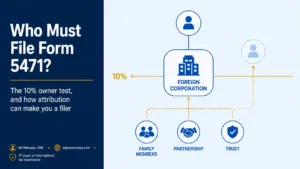
The most common triggers are owning 10% or more of a foreign corporation’s vote or value, controlling one with more than 50%, or serving as an officer or director when a U.S. person crosses the 10% mark. Our guide to who must file Form 5471 and who counts as a U.S. shareholder walks through the threshold in detail.
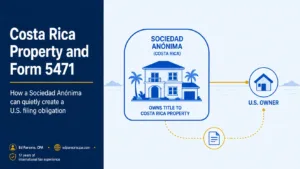
The trap is constructive ownership. Under the attribution rules in IRC 958, shares held by family members, partnerships, and trusts can be counted as yours, so you can owe Form 5471 on a corporation you do not directly own. That same attribution is how the IRS can reclassify a foreign company as a controlled foreign corporation years later. It even reaches passive structures: holding foreign real estate through a corporation, such as buying Costa Rica property through a Sociedad Anónima, can put you in filing territory.
The Five Filer Categories
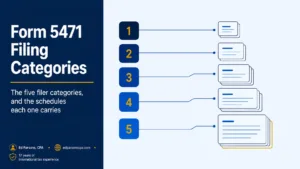
The IRS sorts filers into five categories, and your category decides which schedules you complete. They are not mutually exclusive; one person can fall into several and files a single Form 5471 covering all of them.
- Category 1: a 10% U.S. shareholder of a specified foreign corporation, tied to the section 965 transition rules.
- Category 2: a U.S. officer or director of a foreign corporation in which a U.S. person acquires a 10% stake.
- Category 3: a U.S. person who acquires or disposes of stock crossing the 10% threshold.
- Category 4: a U.S. person who controls a foreign corporation, more than 50% of vote or value, for at least 30 days in the year.
- Category 5: a U.S. shareholder who owns 10% or more of a controlled foreign corporation at any point in the year.
Most owners of a foreign business land in Category 4, Category 5, or both. Our breakdown of the Form 5471 filing categories maps each one and its schedules, and filing under the wrong category is treated the same as not filing at all, which is why getting this right matters. Each category’s schedules are mapped in Form 5471 filing categories.
| Category 4 | Category 5 | |
| Who it captures | Controls a foreign corporation | A 10% shareholder of a CFC |
| Measurement (what triggers it) | More than 50% of vote or value | Owns 10% or more of a CFC |
| The focus | Control of the corporation | Reporting the CFC’s income |
| Common filer | Majority or sole owner | Most owners of a foreign business |
What the Form Includes: The Schedules
Beyond the main form, Form 5471 is a bundle of schedules, and your category decides which ones you complete. Even a schedule with all zero amounts often still has to be filed, which surprises people who assume an inactive corporation means nothing to report.
At a high level, Schedules A and B report stock ownership and the list of shareholders; Schedules C and F are the corporation’s income statement and balance sheet; Schedules E and H deal with foreign taxes and current earnings and profits; Schedule J tracks accumulated earnings and profits across years; and Schedules I, I-1, P, and Q carry the Subpart F, GILTI, and previously taxed income detail. Category 4 and Category 5 filers commonly complete a dozen or more of these per corporation, per year, which is where the real work, and the real risk of error, lives.
The $10,000 Penalty and the Open Statute of Limitations
The penalties are what make Form 5471 a high-stakes form. Under IRC 6038(b), failing to file on time, or filing an incomplete or incorrect form, brings a $10,000 penalty for each foreign corporation, for each year.
If you do not respond within 90 days after the IRS mails a notice, an additional $10,000 applies for each 30-day period, capped at $50,000, so a single form can reach $60,000 a year. The penalties stack per corporation and per year, the IRS continues to assess them even as the issue is litigated, and there is also a reduction in the foreign tax credits you can claim, so they should not be treated as optional. The math compounds quickly: a U.S. person who owns interests in three foreign corporations and misses two years can face six figures in penalties before any tax is even calculated, because the $10,000 applies to each corporation, for each year.
The quieter danger is the statute of limitations. Under IRC 6501(c)(8), a missing Form 5471 keeps your entire tax return open to assessment, not just the form, until three years after you file it, and effectively indefinitely if you never do. Our guides on unreported foreign corporations and how unfiled 5471 penalties grow go deeper on that exposure.
If you reached the end of that section wanting the machinery rather than the headline number, I have five emails that give it. The longest of them is about earnings and profits, the running record the whole form leans on, rebuilt from the year the company was formed. Another sets out what a catch-up engagement actually does, from confirming the category through to whether the streamlined procedures apply. Start the series. Confirm the address when asked, or nothing arrives. Every email carries an unsubscribe link. Reading them is not the same as having somebody look at your own prior returns.
The Core Concepts the Form Feeds
Form 5471 exists to support the anti-deferral rules, the regimes that tax U.S. shareholders on a foreign corporation’s income before it is ever distributed. These rules exist because the United States taxes its persons on worldwide income and does not want profit parked in a foreign corporation to escape tax indefinitely. Three concepts drive most of the complexity.
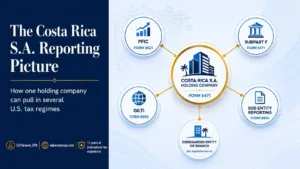
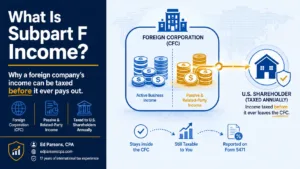
- Subpart F income: certain passive and mobile income taxed to U.S. shareholders in the year it is earned. See what Subpart F income is and how to resolve unreported Subpart F.
- GILTI: a current inclusion of a CFC’s income above a routine return, recently renamed Net CFC Tested Income under new legislation. See GILTI and Form 5471 and the Section 962 election that can lower the rate.
- Earnings and profits: the running calculation, tracked on Schedule J, that feeds everything else. See why a CFC’s E&P history matters.
CFC Status and Related Forms
Most of these rules turn on whether the foreign corporation is a controlled foreign corporation, a CFC: a foreign corporation owned more than 50%, by vote or value, by U.S. shareholders who each hold at least 10%. CFC status is the switch that turns on Subpart F and GILTI. Below that threshold, a foreign corporation generally is not a CFC and those rules do not apply in the same way, though the form may still be required for other reasons.
A foreign corporation can also be a passive foreign investment company, or PFIC, and the two regimes can overlap. Our guide to CFC versus PFIC and the double-tax trap explains how to keep the same income from being taxed twice. And if your corporation operates through a foreign branch or disregarded entity, Form 8858 is a separate, related obligation many filers miss. The income categories behind most of these inclusions are explained in what Subpart F income is.
Common Form 5471 Mistakes
Letting a missed year slide, which keeps the entire return open indefinitely.
Ignoring constructive ownership, where family or entity attribution quietly makes you a filer.
Filing one Form 5471 for several corporations instead of one form per foreign corporation.
Assuming a dormant or tiny corporation is exempt; there is no size threshold.
Filing under the wrong category and leaving required schedules incomplete.
Treating the form as a tax calculation rather than the information return that feeds other rules.

Questions People Ask About Form 5471
Fixing a Missed or Wrong Filing
Form 5471 is one of the few forms where doing it yourself is genuinely risky. The categories, the schedules, the currency translation, and the interaction with Subpart F and GILTI leave little room for error, and the penalties for getting it wrong are automatic.
If you have never filed for a foreign corporation you own, or you suspect a past filing was wrong, there are structured ways to correct it, often before the IRS ever notices, from the delinquent submission procedures to a reasonable-cause filing depending on the facts. Form 5471 CPA Filing handles the return and its schedules end to end, and a Business CPA Tax Resolution Case Analysis reviews your exposure and the cleanest path to fix prior years. The map above is the starting point; the filing itself is where it gets solved.
For the official rules, the IRS About Form 5471 page and the Instructions for Form 5471 set out the categories, schedules, and penalties, though neither replaces advice on your own structure.

Own Part of a Foreign Corporation?
Form 5471 is mandatory whether or not your foreign company owes U.S. tax, and the penalties for missing it are automatic. Ed Parsons, CPA prepares Form 5471 and its schedules and helps U.S. owners correct prior years before the IRS makes contact.
Start with Form 5471 CPA Filing, which handles the return and schedules end to end. Not sure where you stand? A Business CPA Tax Resolution Case Analysis reviews your exposure and the path to fix prior years.