Skip to content

The U.S. taxes its citizens and residents on worldwide income wherever they live, and it classifies Australian arrangements under its own definitions. Superannuation, family trusts, Pty Ltds, and managed funds all translate into U.S. categories with their own forms and penalties, and Australian tax paid rarely maps across automatically. This guide covers the whole terrain. If you are already behind on filings, the route I walk through is streamlined filing for Australians.
Two tax systems claim you. Australia taxes by residence and source, the way most of the world does. The United States taxes its people, citizens, green card holders, and residents, on everything, everywhere, for as long as the status lasts.
For anyone with a foot in both countries, the collision is not abstract. It lives inside your super fund, your family trust, your company, your ETFs, and the exchange rate on your mortgage. This guide maps the whole terrain and points to the deeper analysis each piece deserves.
The One Rule Everything Flows From
A U.S. person, and dual citizens count in full, owes U.S. tax and international reporting on worldwide income, wherever they live and whatever Australia already taxed. Nothing about an Australian passport, an Australian accountant, or an Australian address switches that off.
The discipline that keeps the rest readable is separating four questions that people fuse together: is something taxable in the U.S., what must be reported regardless, does a treaty position change anything, and what penalties attach to what was missed. Related questions, four different answers, every time.
Who This Guide Is For
Three readers keep arriving at the same cliff from different directions. The American who moved to Sydney or Melbourne, built a completely normal Australian financial life, and only later heard that normal translates badly. The Australian who took a U.S. job or a green card and left super, shares, and a trust interest running at home.
And the dual citizen who has always lived in Australia, holds both passports, and has never filed a U.S. return, because nobody ever said the obligation existed. Different stories, one shared trait: the Australian adviser’s brief ends at the border, the U.S. preparer never sees past the W-2, and the gap belongs to no one until it belongs to you.
The Numbers That Make This Worth Twenty Minutes
The stakes are not theoretical:
- Australians hold more than AUD 4 trillion in superannuation, and the U.S. has never definitively classified any of it.
- An unreported trust distribution carries a penalty of the greater of $10,000 or 35 percent of the amount.
- A missed Form 5471 runs $10,000 per form, per year, assessed automatically, no audit required.
- Each pooled fund can demand its own Form 8621, and a full portfolio multiplies fast.
- Required forms left unfiled hold the audit window open on the entire return, indefinitely.
- The foreign streamlined track, for those who qualify, carries no offshore penalty at all.
Superannuation: The Biggest Asset, The Least Settled Answer
The IRS has never definitively classified Australian super, so everything starts with how the U.S. views your fund: pension arrangement, trust you own, or something in between, with retail and industry funds and SMSFs often heading in different directions.
Control is the hinge. SMSFs frequently land in foreign trust territory, where Forms 3520 and 3520-A come into scope unless an IRS relief framework excuses them, and large contributions can break that relief on their own. Even the compulsory employer money is not neutral, because contributions can count as U.S. income depending on classification and vesting.
Investments: Where Australian Normal Meets U.S. Harsh
The pooled products Australians hold by default, managed funds, ETFs, listed investment companies, are frequently PFICs under U.S. rules, each carrying its own Form 8621 and a default regime built to punish holding and compounding.
Direct shares bring their own illusion: franking credits generally do not become U.S. foreign tax credits, because they represent company tax you never paid, and what actually goes where on the U.S. return uses fewer numbers from the statement than anyone expects.
Structures: The Family Group Problem
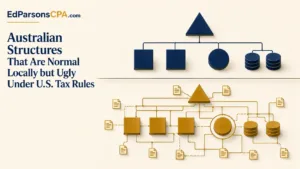
Australian planning runs on entities, and each one translates badly. The family discretionary trust becomes a foreign trust whose real funder, not its paper settlor, decides who reports what. The Pty Ltd becomes a possible CFC with Form 5471 due annually and phantom income rules reaching profits nobody distributed.
The damage compounds at the joints, where trusts own companies and stream into bucket companies, which is why the whole-group view of Australian structures matters more than any single entity: one U.S. person can activate the entire map.
Life Events: Dates That Change Everything
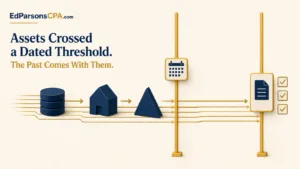
Status has a start date and sometimes an end date, and transition years are where fortunes are made and lost by sequence: assets arrive with historic basis and old holding periods, and leaving the system triggers exit tests of its own.
Ordinary events crystallize quietly too. Selling or refinancing an Australian home can create ordinary income on the mortgage payoff that the residence exclusion never touches. And the treaty, per the official treaty documents, helps less than hoped: a saving clause lets the U.S. tax its own people largely as if the treaty were not there.
Here is the whole translation problem at a glance.
| What You Have | How Australia Sees It | How the U.S. May See It |
| Superannuation | Concessionally taxed retirement savings. | A classification question: pension, trust, or account. |
| Family trust | Streaming and asset protection. | A foreign trust with owner and distribution reporting. |
| Pty Ltd | A company taxed at the company rate. | A possible CFC with Form 5471 due annually. |
| Managed funds and ETFs | Ordinary diversified investments. | Frequently PFICs, one Form 8621 each. |
| Franking credits | Tax already paid on your behalf. | Company tax with no U.S. address. |
| The tax treaty | The shield against double taxation. | Narrowed by a saving clause for U.S. persons. |
| Measurement | Measures labels and local outcomes. | Measures classification, control, and what actually moved. |
If this guide is the map, the email series is the slower walk through it. Send me the Australia and U.S. tax emails and I will take six of these subjects one at a time over a few weeks, each with a link to the article that goes deepest and one thing to look for in it: the treaty, super, franking credits, Australian funds as PFICs, the family company and trust, and the catch-up route. A confirmation email arrives first and nothing follows unless you click it. Unsubscribing is one click.
When Years Are Already Missing
Most people find all of this late, which is why the cluster ends where the work usually begins: the streamlined catch-up procedures, three years of returns, six years of FBARs, the missing international forms, and a sworn non-willfulness narrative. Australians abroad often qualify for the foreign track with no offshore penalty, and the door stays open only while the IRS has not reached you first.
The instinct to file quietly forward and ignore the past is the one move that makes everything worse: missing forms hold the audit window open indefinitely, and the silent improvement documents that at some point, you knew.
Australian fact patterns are often genuinely strong raw material for the non-willfulness story: local-normal structures, adviser silence, and not one U.S. form ever arriving in the mail. Strong raw material still has to be built into a credible sworn account, which is where the craft lives.
Common Mistakes Across the Whole Terrain
- Assuming the Australian label decides the U.S. answer. Classification, control, and funding decide it.
- Treating Australian tax paid, by the fund, the company, or via franking, as your own U.S. credit.
- Reading no U.S. paperwork as no U.S. obligation. Nobody issues forms for Australian assets.
- Quoting the treaty without testing the saving clause and the disclosure duty.
- Reviewing entities one at a time when the family group interacts as a system.
- Fixing the current year while prior years sit open and compounding.

Questions People Ask About Australia-U.S. Tax

Where to Start
The review order is the method: classify each asset and entity first, determine the reporting second, test any treaty position third, and measure penalty exposure for missed years last. Run it in that order and every article above becomes a chapter instead of a scare.
The output should be one page you can act on: each entity classified, each U.S. person’s exposure quantified, and the fixes sequenced so open years are protected rather than advertised. And the cheapest version of every fix in this guide is the one done before the event, before the move, the sale, the restructure, or the next June resolution.
Mapping your whole Australian financial life against the U.S. definitions, super, investments, structures, and events together, is the work of a Personal CPA Tax Resolution Case Analysis. Ed Parsons, CPA runs these reviews for U.S. citizens, dual citizens, and green card holders with Australian assets, working remotely with clients nationwide and abroad.