Skip to content
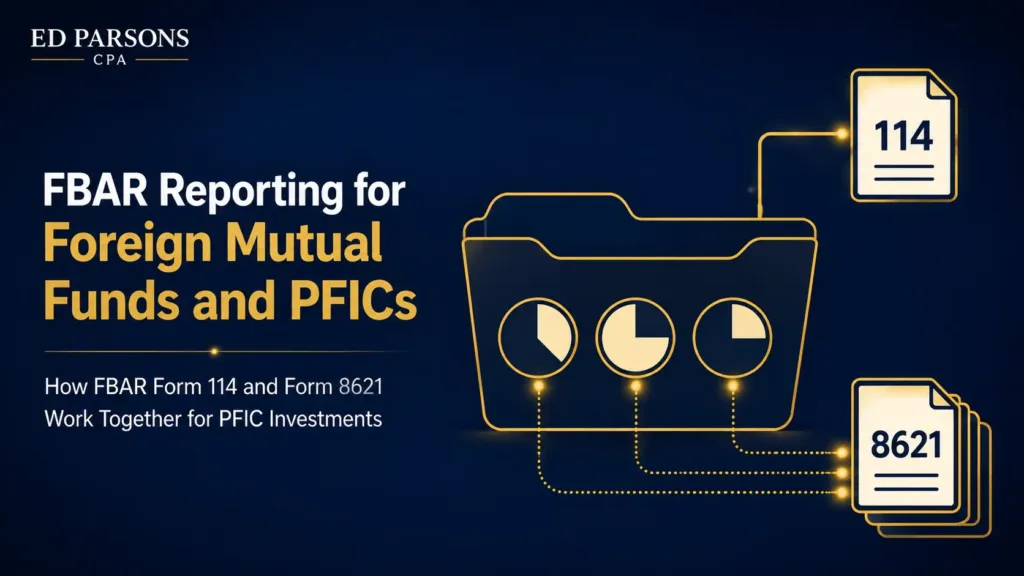
A foreign brokerage or investment account generally belongs on the FBAR at its highest value for the year. The foreign mutual funds and ETFs inside that account are usually PFICs, which the IRS taxes and tracks separately on Form 8621, fund by fund. The FBAR reports the account. Form 8621 reports the fund. Filing one never satisfies the other, and years of clean FBARs can sit on top of a serious PFIC problem. The three reports a single fund account can trigger are compared in FBAR vs Form 8938 vs Form 8621.
The fact pattern behind most PFIC surprises
You open a brokerage account abroad, or you had one before moving to the United States. Inside it sit Irish UCITS funds, Canadian mutual funds, UK investment trusts, or the local index ETF everyone at work owns.
To you, it is one investment account. To the U.S. reporting system, it is two different questions answered on two different filings, under two different bodies of law.
The pattern hits new U.S. residents hardest: green card holders and visa arrivals who kept the accounts they built at home, and expats who opened local accounts abroad. Nobody warned them that the funds inside those accounts carry their own U.S. reporting regime.
What the FBAR sees: the account, not the fund
The FBAR is an account disclosure. Under 31 C.F.R. 1010.350, a securities or brokerage account maintained with a foreign financial institution is generally reportable once all your foreign accounts combined exceed $10,000 at any time during the year.
When your funds sit inside that brokerage account, the account is what gets reported, at its highest value for the year, with the funds counted inside that value. The individual funds are not listed separately on the report.
Hold a fund directly with the fund company instead, with no brokerage in between, and the analysis shifts. A mutual fund or similar pooled fund with regular net asset value pricing and regular redemptions can itself be the reportable account.
The thresholds, control rules, and the account categories that surprise people are mapped in our advanced FBAR reporting guide.
What Form 8621 sees: the fund, not the account
A PFIC is a passive foreign investment company: a foreign corporation that meets a 75 percent passive income test or a 50 percent passive asset test. Nearly every non-U.S. mutual fund, UCITS fund, and foreign-listed ETF meets one of them.
The Form 8621 instructions require reporting per fund, per year. Ten funds means ten filings, each carrying its own purchase history and its own math.
The default treatment, the excess distribution regime, allocates gains and large distributions across your entire holding period, taxes them at the highest ordinary rate for each of those years, and adds an interest charge on top. There is no long-term capital gains rate.
Elections exist, QEF and mark-to-market, that can change the math, and a narrow filing exception applies when total PFIC value stays under $25,000. Which of those actually fits is a fund-by-fund, year-by-year determination.
Skipping the form has a quieter cost too. Form 8621 carries no standalone dollar penalty the way some international forms do, but an unfiled 8621 can hold the assessment window open on your entire tax return until it is filed.
Why filing one never satisfies the other
The FBAR runs under Title 31 and asks where your accounts are. Form 8621 runs under the Internal Revenue Code and asks what your funds earned and how that gets taxed. Neither form collects the other’s information, so neither filing can stand in for the other.
The same account can also trigger a third report, Form 8938, under its own thresholds. That three-way split is broken down in our FBAR vs Form 8938 vs Form 8621 comparison.
| FBAR (FinCEN Form 114) | Form 8621 (PFIC) | |
| Reports | The foreign account, at its highest annual value | Each PFIC fund’s income, gains, distributions, and elections |
| Filed with | FinCEN, through the BSA E-Filing System | The IRS, attached to your income tax return |
| Measurement | $10,000 combined maximum account value in the year | 75% passive income test or 50% passive asset test |
| Missing it costs | Up to $16,536 per report if non-willful; far more if willful | Excess distribution tax at top ordinary rates plus interest, and an open assessment window |
A simple example of how this goes wrong
An investor keeps a foreign brokerage account and reports it on the FBAR every year at a maximum value around $180,000. The FBARs are complete and accurate.
Inside the account, Dublin-domiciled ETFs pay dividends that reinvest automatically, and one fund is sold at a gain. None of it reaches the U.S. return, and no Form 8621 is ever filed.
The FBAR side of this file is clean. The tax side is not: the reinvested dividends were taxable income, the sale triggered the excess distribution math across every year of ownership, and the missing 8621s leave those return years open indefinitely.
That example is the whole problem in one file: the account side spotless, the fund side untouched. The fund side is the harder half to learn on your own, and it is what my PFIC email series covers. Give me an email address and five emails follow the fund rather than the account: the income and asset tests, why the default regime spreads a gain back across every year you held the fund and charges interest on top, what QEF and mark to market each require, and why a missing Form 8621 keeps the return open. The first email is a confirmation and the rest wait on your click. Unsubscribe any time.
The transparency paradox: disclosed accounts help you and expose you
Years of accurate FBARs are a genuinely favorable fact. They show the account was never hidden, which supports a non-willful narrative if a correction becomes necessary.
They do not cure a single missed Form 8621, and they cut the other way too. The government already has the institution, the account number, and the balances, so fund income missing behind a disclosed account is a visible gap, not a hidden one.
How that gap gets repaired depends on the years involved, the income, and the willfulness picture. The paths and their trade-offs are covered in how foreign account mistakes are repaired.

Triage: four steps before anything gets filed
- Identify the accounts: every foreign brokerage, platform, and direct fund holding, with maximum values for each year.
- Identify the PFICs: each fund inside those accounts, its domicile, and its full purchase history.
- Review the income: what the funds actually paid or gained each year, matched against what the returns reported.
- Determine the correction path: current-year compliance, amended returns, or a coordinated program, based on the complete picture.

Step four is where these cases are won or lost, and it is the one step that should not be improvised. Our Form 8621 CPA PFIC Filing service handles the fund-by-fund analysis, the election decisions, and the filings, and the FinCEN Form 114 FBAR CPA Filing service keeps the account side aligned with it.