Skip to content
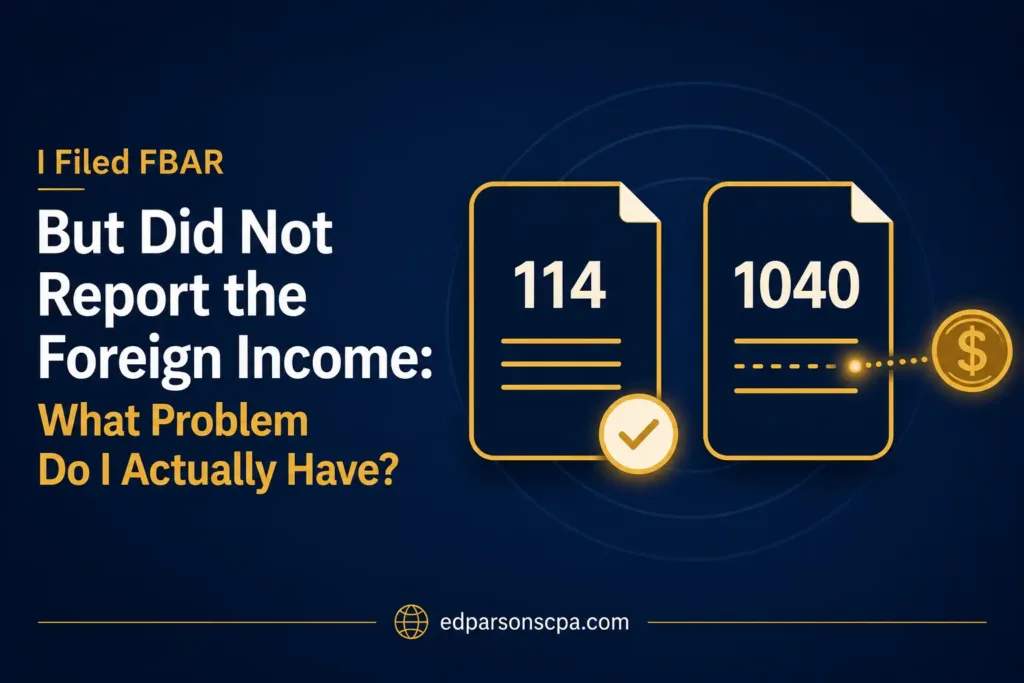
A complete and accurate FBAR stays valid even when foreign income was left off your tax return. The FBAR has no income lines: it discloses accounts, not earnings. Unreported interest, dividends, gains, fund income, or pension distributions are a Form 1040 problem. Fixing them can also pull Form 8938, Form 8621, and your streamlined eligibility into the correction. Whether that correction runs on the domestic or the foreign track depends on where you lived, which I compare in domestic vs foreign streamlined filing.
Start with the part that is still fine
If your FBARs went in on time, covered every account, and carried the right maximum values, the FinCEN side of your file is in order. An income omission on the return does not reach back and turn a complete FBAR into a violation.
That matters because it narrows the problem. You are not facing an account disclosure failure. You are facing a tax return that missed income, which is a different repair, governed by different rules, with different exposure.
The pattern is common: expats whose local bank quietly paid interest, new U.S. residents holding accounts from home, and anyone whose preparer asked about foreign accounts but never asked what those accounts earned.
Why the FBAR could not have reported your income
The FBAR is a Bank Secrecy Act account report filed with FinCEN, separate from your tax return. It collects institution names, account numbers, and each account’s highest value for the year. There is no field for interest, dividends, or gains anywhere on the form.
The worry usually shows up as a search box question:
“I filed my FBAR every year but never reported the interest. Am I in trouble?”
“My foreign account earned money but I owed no U.S. tax. Do I still fix the return?”
“Does the missed income make my FBAR wrong?”
Short answers: some trouble, usually fixable. Usually yes. No, not if the FBAR itself was complete. The account rules are mapped in our advanced FBAR reporting guide; this article covers the other half of the file.
What each filing actually captures
| FBAR (FinCEN Form 114) | Income tax return (Form 1040) | |
| What it asks | Where are your foreign accounts | What did you earn, worldwide |
| What it contains | Institutions, account numbers, maximum annual values | Income, deductions, credits, and the international forms that attach to it |
| Where foreign income goes | Nowhere. The report has no income lines | Schedule B, Schedule D, other income lines, plus Forms 8938 and 8621 where required |
| Measurement | $10,000 combined maximum account value in the year | Every dollar of worldwide income, no minimum threshold |
| A gap costs | FBAR penalties only when the report itself is late, missing, or wrong | Tax, interest, accuracy penalties, and extended assessment windows |
The income that slips through
Six categories cover nearly every case of this kind:
- Interest on foreign savings, checking, and time deposit accounts.
- Dividends from foreign shares and funds, including amounts that were reinvested automatically.
- Capital gains from sales inside foreign brokerage accounts.
- PFIC income from foreign mutual funds and ETFs, taxed under its own regime and reported fund by fund. The split between the account and the funds is covered in our FBAR and PFIC guide.
- Pension distributions and, under some plan structures, earnings that accrue before any payout.
- Foreign trust distributions, which carry their own reporting layer on top of the income.
Reinvestment is the classic trap. Nothing landed in a U.S. bank account, so nothing felt like income. The tax law counts it anyway, in the year it was earned.
The numbers that define the exposure
- $0: income lines on the FBAR. The report cannot carry earnings, so it cannot have reported yours.
- 6 years: the assessment window when more than $5,000 of income tied to a foreign financial asset is omitted.
- 20% to 40%: accuracy penalties on the understatement, with the top rate reserved for income traced to assets missing from Form 8938.
- 3 + 6: the amended returns and FBARs inside a streamlined submission.
- 0% or 5%: the streamlined penalty rate, foreign or domestic track.
Schedule B asks the questions that connect the filings
Schedule B, Part III asks two things every year: whether you held a foreign account, and whether you received a distribution from, or were a grantor of, a foreign trust. The Schedule B instructions tie those boxes directly to the FBAR requirement.
Those questions matter beyond interest and dividends. A return that answers no while your own FBARs say yes creates a contradiction inside your file, and examiners and courts read those answers when they weigh how a mistake happened.
If a preparer checked the boxes without ever asking you, that fact belongs in the record you build now, documented while memories are fresh.
No tax due is not the same as nothing to fix
Foreign tax credits or treaty positions sometimes eliminate the U.S. tax on the missed income. The income still belonged on the return, and the return is still wrong without it.
A related misconception does real damage here. The foreign earned income exclusion covers wages and self-employment earnings, not interest, dividends, or gains, so excluded salary never sheltered the investment income sitting next to it.
The information side does not care about the bottom line. Form 8938 and Form 8621 duties ride on asset values and fund status, not on tax due, and missing information forms keep assessment windows open on their own.
So the real question is never only how much tax. It is which filings the facts required, and which of them actually exist.
That question is the one my FBAR emails keep circling back to, from several different angles. Five of them go out, covering what pushes you over the reporting line in the first place, whose accounts count when your name is not on them, why the willful or non-willful label changes the size of everything, and how a catch-up gets filed so the relief actually holds. None of it substitutes for someone reading your returns alongside the FBARs you already filed. Send me the five FBAR emails. A confirmation note arrives first and nothing follows until you answer it, and every email carries an unsubscribe link.
Three correction lanes, one decision
There are three realistic ways forward, and they are not interchangeable. Each fits a different fact pattern, and each forecloses something if chosen wrong.
Lane one is the amended return. Quiet amendments can fit narrow, recent, clearly non-willful gaps, and they carry real risk when the years stack up or the pattern looks deliberate in hindsight.
Lane two is the streamlined filing compliance procedures, built for exactly this pattern when it is non-willful: three years of amended returns, six years of FBARs, and a certification signed under penalty of perjury. FBARs you already filed slot into that set if they were complete.
Lane three is neither, yet. When the facts could read as willful, or the years run deep, the lane choice needs professional review before anything is submitted, because a wrong first move can close the better options.
One clarification, since the terms get mixed up: the penalty-free late-FBAR path you may have read about serves the mirror image of your situation, people who reported the income but missed the FBARs. It is not your lane.
The streamlined filing procedures build the full correction: the amended returns, the FBAR set, the certification, and the international forms the income drags in. Where fund income is involved, the PFIC rules add a layer inside it.

Common mistakes in this exact situation
- Assuming the FBAR reported the income. It has no field for it.
- Treating zero tax due as zero problem. The filings ride on the facts, not the bottom line.
- Amending quietly before the streamlined eligibility question has been answered.
- Fixing the 1040 while leaving Forms 8938 and 8621 unexamined.
- Letting Schedule B answers contradict the FBARs already on file.
- Waiting for a notice on accounts the government can already see.
Your filed FBARs are an asset. Use them properly.
Years of complete FBARs show the accounts were never hidden, and that is genuinely valuable. Courts measure reasonable cause against ordinary business care and prudence, and in Jarnagin v. United States that standard was not met by taxpayers who never reviewed what they signed. A clean disclosure record, built and documented deliberately, is how you avoid that outcome.
Disclosure cuts both ways, though. The same FBARs mean the institution, the account numbers, and the balances are already visible, so income missing behind them is a findable gap. Timing favors the taxpayer who moves first.
The penalty landscape on the account side, and why per-report matters, is covered in FBAR penalties after Bittner. The repair on the return side starts with one lane chosen correctly, with the whole file on the table.