Skip to content
Update: the IRS has withdrawn the Delinquent FBAR Submission Procedures. The programme’s page on irs.gov now returns an error, and the IRS list of options for taxpayers with undisclosed foreign financial assets names only three routes: the Criminal Investigation Voluntary Disclosure Practice, the Streamlined Filing Compliance Procedures, and the delinquent international information return submission procedures, which is a separate programme for information returns rather than FBARs. This page is kept for reference and describes the procedures as they operated while they were open. One of the correction paths described below has since been withdrawn. The streamlined path, which is the main subject here, is unaffected and still open: how the streamlined procedures repair a foreign account gap. If the income was reported and only the FBARs were missed, I cover that case in I reported the foreign income but never filed FBARs.
The streamlined filing compliance procedures are a coordinated correction: three years of amended returns, six years of FBARs, and a non-willfulness certification signed under penalty of perjury. They are not an upload window for late FBARs.
Which lane fits, delinquent FBAR submission, streamlined foreign, streamlined domestic, or voluntary disclosure, depends on your income reporting, your residency, and whether the facts genuinely read as non-willful.
What streamlined is, and the upload it is not
People arrive at the streamlined filing compliance procedures expecting a portal where old FBARs get uploaded and forgiven. That is not what this is. Streamlined is a full repair of the tax file: returns, information forms, account reports, and a sworn explanation, built to agree with each other.
The program exists because the law changed faster than people’s habits. FATCA turned foreign institutions into reporters, millions of ordinary taxpayers surfaced as technically non-compliant, and the IRS built streamlined as the structured way home for the non-willful ones. Structured is the operative word.
At Ed Parsons CPA, the streamlined engagement starts with the question the program itself asks first: are these facts non-willful, and can that be certified truthfully under penalty of perjury? Everything else is sequencing.
The confusion usually shows up in three questions:
“Can I just upload my old FBARs and be done?”
“Is streamlined the same as amnesty?”
“Do I qualify for the 0% penalty or the 5% one?”
Short answers: only in one narrow lane, and never cold. No, amnesty has no conditions and this has several. And that depends on a residency test most people apply wrong. The four lanes below sort it out.
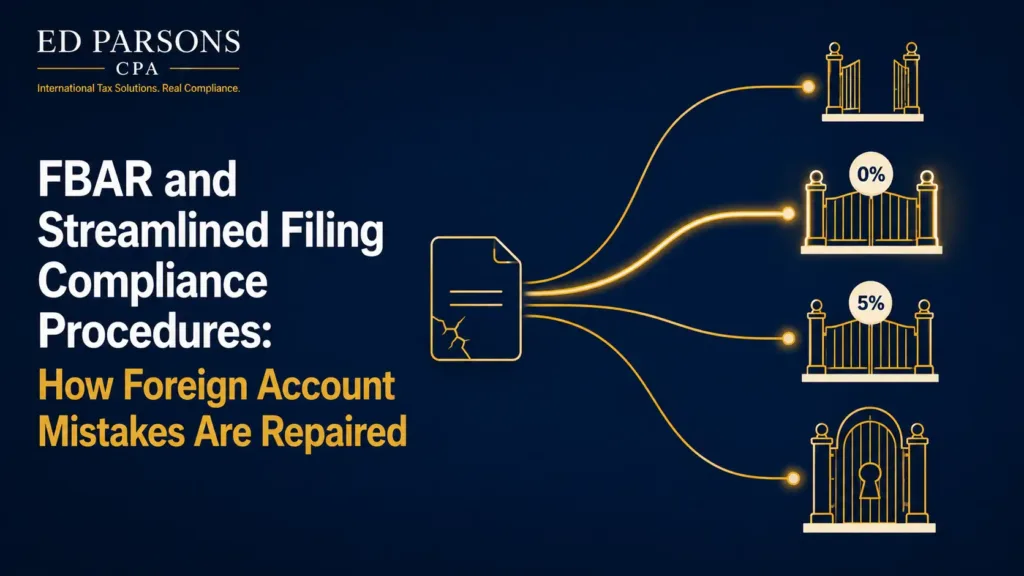
The four correction lanes, side by side
Every foreign account repair runs through one of four doors. The delinquent FBAR submission procedures serve the narrowest fact pattern; the voluntary disclosure practice serves the most dangerous one. Streamlined, foreign or domestic, covers the wide middle.
Read the table as a diagnosis, not a menu. The lane is a legal conclusion produced by your facts: what was reported, where you lived, and how the record reads. Preferring a lane does not qualify you for it.
| Delinquent FBAR submission | Streamlined Foreign (SFOP) | Streamlined Domestic (SDOP) | Voluntary Disclosure Practice | |
| Built for | All income reported and tax paid; only the FBARs are missing | Non-willful taxpayers who meet the foreign residency test | Non-willful taxpayers living in the United States | Facts with willfulness risk or criminal exposure |
| You file | 6 years of FBARs with a reasonable cause statement | 3 amended returns, 6 FBARs, Form 14653 | 3 amended returns, 6 FBARs, Form 14654 with the penalty computation | Preclearance, then full disclosure and cooperation, counsel-led |
| Measurement | $0 penalty, ordinarily | 0% offshore penalty | 5% of the highest year-end value of the covered foreign assets | Negotiated outcome; the willful penalty framework applies |
| Signed under perjury | The explanation statement | The Form 14653 certification | The Form 14654 certification | The full disclosure package |
| Closes when | The IRS opens an exam or makes contact first | Contact, examination, or facts that read willful | Contact, examination, or facts that read willful | Timeliness rules apply; the door narrows once the IRS has the information |
The residency line between the two streamlined tracks is mechanical and unforgiving: for citizens and green card holders, the foreign track requires at least 330 days outside the United States, with no U.S. abode, in at least one of the three covered years. Miss the test and the 0% penalty was never yours.
What one repair actually contains
Here is the coordinated correction in practice. A taxpayer holds a foreign brokerage account and an old employer pension abroad, with reinvested fund income that never reached the returns.
The streamlined package that repairs it contains three amended returns, each carrying a Form 8938 and a Form 8621 for every fund with activity that year; six FBARs listing the brokerage and the pension at verified maximum values; a Form 14653 narrative dated to the discovery; and payment of the tax and interest the amendments produce.
Every document in that stack has to agree with every other one. That agreement is the product, and it is the part a portal upload can never manufacture.
The numbers that define the framework
- 3 + 6: three years of amended returns and six years of FBARs, filed together with the certification.
- 0% or 5%: the offshore penalty, decided entirely by the residency test, not by negotiation.
- $0: the ordinary delinquent-procedures outcome when every dollar of income was already reported.
- 330 days: the non-residency threshold that separates the foreign track from the domestic one.
- 1 certification: Form 14653 or Form 14654, signed under penalty of perjury, and the IRS keeps it whether or not it accepts your submission.
What the 3 + 6 framework actually builds
The three amended returns are not just income corrections. Each one carries every international form the facts require for that year, reconciled to the account statements: the return, the forms, and the FBARs must tell one consistent story.
The six FBARs cover every reportable account at its true maximum value, including the categories people miss: pensions, insurance cash value, entity accounts, and accounts held only through signature authority.
The certification then explains, in signed detail, why the whole failure was non-willful. That document is the submission’s spine, and it is the piece least suited to improvisation.
Nothing travels alone
In practice, missed FBARs almost never arrive by themselves. The same facts that produced them usually produced a missing Form 8938, unfiled Forms 8621 for foreign funds, a Form 3520 for the family trust, a Form 5471 or 8858 for the company abroad, or income that never reached the return. The full account map lives in our advanced FBAR reporting guide.
This coupling is why the upload fantasy fails. Filing six FBARs while those forms stay missing does not shrink the problem; it documents it, under your name, while leaving the assessment windows open.
The coupling also runs through the numbers. Each missing form carries its own penalty family and its own open assessment window, so the true exposure is the stack, not the FBAR line alone.
Eligibility is the whole game
Streamlined is only available to taxpayers whose conduct was non-willful: negligence, mistake, or a good-faith misunderstanding of the law. Whether your facts actually read that way is the analysis we built a separate guide for: is that non-willful, covering what courts weigh and which facts cut against you.
Two more gates matter. The program closes the moment the IRS opens an examination or makes contact first, and it was never open for facts that read reckless: false Schedule B answers under your signature, secrecy arrangements, warnings ignored.
That is the honest meaning of the guardrail you will hear from any careful professional: this is a conditions-based program, not amnesty. The conditions are eligibility, truthful certification, complete filings, and full payment of the tax, interest, and penalty the math produces.
On the domestic track, the 5% penalty base deserves respect before anyone commits. It reaches every foreign financial asset that belonged on an FBAR or Form 8938 during the covered period, not just the bank accounts, so pensions, funds, and insurance values can inflate it well past expectations.
Eligibility really is the whole game, and it is why I keep the email version of this short. Five go out on streamlined filing. One works the two tracks and the residency test that assigns you to one of them, one stays on the certification and what a reviewer needs to find in it, and another is about what a rejection costs, which is not a second attempt through the same door. None of it reads your file for you. It is the shape of the decision, in pieces you can get through in a minute each. Send me the five streamlined emails. Answer the confirmation email or the series never begins. Unsubscribe any time.
The certification you sign, and what an untrue one costs
Form 14653 and Form 14654 are signed under penalty of perjury, and the IRS keeps everything you submit whether or not the submission survives review. There is no formal acceptance letter, and no appeal path if the certification fails.
Review works like an audit in slow motion. Streamlined submissions close with no acknowledgment and no closing agreement, and they remain examinable like any return. Internal consistency, every number traceable to a statement, is the only durable defense.
An untrue or careless certification converts a civil cleanup into something worse: the statement becomes evidence, the willful penalty framework comes back into view, and the friendlier lanes are gone because you already used one.
This is why the narrative must be factual, specific, and conservative, matched line by line to the returns and statements it describes.
When tax counsel belongs in the room
A CPA-led streamlined engagement fits clean non-willful facts. Counsel belongs in the room before anything is filed when the record carries willfulness markers: the Schedule B answers and signature facts that decided Williams and Kimble, the secrecy arrangements that decided Horowitz, structured transfers, prior warnings, or an incomplete FBAR already on file.
In those cases the sequencing changes: an attorney evaluates the exposure first, privilege protects the analysis, and the voluntary disclosure practice stays on the table as the counsel-led lane. Choosing streamlined to avoid that conversation is how civil problems become criminal ones.
The practical trigger is simple. If you would hesitate to show any document in the file to an examiner, counsel sees it first.

Common mistakes in the repair
- Uploading late FBARs cold, with no eligibility check and no statement behind them.
- Choosing the domestic track when the foreign track applied, or the reverse, and paying 5% that was never owed.
- Certifying non-willfulness over facts that read reckless on paper.
- Fixing the FBARs while leaving Forms 8938, 8621, 3520, 5471, or 8858 missing.
- Treating streamlined as amnesty and skipping the tax, interest, and penalty math it requires.
- Starting any lane after the IRS letter has already arrived.

The IRS Streamlined Filing CPA Package from Ed Parsons CPA builds the complete submission: eligibility analysis, three amended returns with every required international form, six FBARs at verified maximum values, the penalty computation where the domestic track applies, and a certification drafted to survive review. Where only the account reports are missing, the FinCEN Form 114 FBAR CPA Filing service handles the delinquent-procedures lane.
Reach us through our streamlined filing page. The right lane, chosen once, with the whole file on the table: that is what repair means.