1. The IRS Collections Process

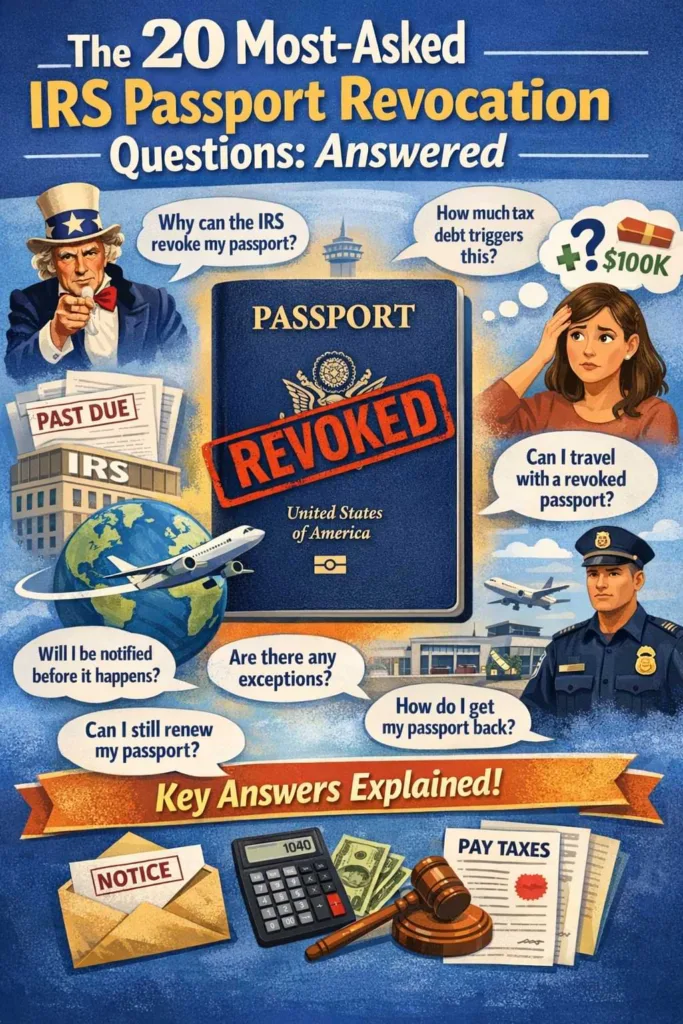
Infographic titled "The 20 Most-Asked IRS Passport Revocation Questions: Answered," featuring a revoked passport, Uncle Sam, a woman with questions, and a border patrol officer, illustrating key concerns about IRS passport revocation and tax debt implications.

IRS Passport Revocation: Definitive Guide, Part 1 – FAQ

The IRS passport revocation program blindsides more Americans every year. People show up at airports and consulates abroad only to discover their travel privileges are frozen over an unresolved tax debt. The 20 questions below are drawn from real community discussions on Reddit, Quora, and taxpayer forums. If you received a CP508C notice or a […]

IRS Passport Revocation: Definitive Guide, Part 1 – FAQ Read More »

Desk with calendar marking October 14, urgent IRS tax notice, clock, and lamp, emphasizing tax deadlines and IRS collections process.

Federal Tax Lien Response Timeline: Deadlines You Can’t Miss

After the IRS files a federal tax lien, you have 30 days from the date of Letter 3172 to request a Collection Due Process (CDP) hearing. Miss that window and you lose your strongest appeal rights, including the ability to petition the Tax Court. The underlying debt remains enforceable for 10 years from the date

Federal Tax Lien Response Timeline: Deadlines You Can’t Miss Read More »

Woman smiling at a service counter holding a document marked "RELEASED," with a staff member assisting in a public office setting, relevant to IRS tax lien release processes.

How to Get a Federal Tax Lien Removed: Release vs. Withdrawal

There are four ways to remove or reduce the impact of a federal tax lien: release (debt paid in full), withdrawal (public notice removed entirely), discharge (lien removed from a specific property), and subordination (another creditor moves ahead of the IRS). A release ends the lien. A withdrawal erases it from the public record. The

How to Get a Federal Tax Lien Removed: Release vs. Withdrawal Read More »

Woman reading IRS letter at kitchen table with tax documents and laptop, illustrating concerns about federal tax lien and tax resolution.

I Just Received a Federal Tax Lien – Now What?

A federal tax lien is the IRS’s legal claim against all your property, including real estate, bank accounts, and future assets. If you just received one, you typically have 30 days from the date of Letter 3172 to request a Collection Due Process (CDP) hearing. Act immediately: verify the notice, gather your tax records, and

I Just Received a Federal Tax Lien – Now What? Read More »

Man looking stressed at a desk with tax documents and a calculator, featuring text overlay "IRS USING AI TO SPEED UP WAGE GARNISHMENTS," highlighting IRS's use of AI for tax enforcement.

IRS Is Using AI to Speed Up Wage Garnishments in 2026: What You Need to Know?

The IRS is now using artificial intelligence to accelerate wage garnishment decisions and enforcement actions in 2026. After losing 27% of its workforce, the agency deployed AI systems that identify delinquent taxpayers faster, prioritize collection cases automatically, and trigger levy notices with minimal human review. This means the timeline from unpaid tax debt to wage

IRS Is Using AI to Speed Up Wage Garnishments in 2026: What You Need to Know? Read More »

Frustrated man with glasses surrounded by tax documents and coffee cups, emphasizing the urgency of filing taxes and IRS compliance.

How the IRS Uses AI to Accelerate Wage Garnishments in 2026

If you haven’t filed taxes in years, you need to act now before the IRS takes enforcement action. The agency can file substitute returns that overstate your tax liability, impose penalties up to 25% of what you owe, and levy your bank accounts or wages without further warning. Filing voluntarily before the IRS contacts you

Haven’t Filed Taxes in Years? Your Step-by-Step Guide to Getting Right With the IRS in 2026 Read More »

Got a CP504 Notice? You Have 30 Days Before the IRS Levies Your Bank Account

A CP504 notice is the IRS’s final balance-due reminder and a formal notice of intent to levy. It means the IRS plans to seize your bank accounts, wages, or other assets if you do not pay your outstanding tax debt or make arrangements within approximately 30 days. This is not a routine reminder. It is

Got a CP504 Notice? You Have 30 Days Before the IRS Levies Your Bank Account Read More »

Person reading CP504 IRS notice letter while on hold on phone, emphasizing urgent tax resolution issues amidst IRS workforce reduction.

IRS Lost 27% of Its Workforce: Why Your Tax Problem May Take Longer to Resolve in 2026?

The IRS entered the 2026 filing season with roughly 74,000 employees, down from 102,000 at the start of 2025. That 27% workforce reduction is already affecting how the agency handles everything from phone calls to collections cases. If you’re currently dealing with an IRS problem, whether it’s an unpaid balance, an audit, or a pending

IRS Lost 27% of Its Workforce: Why Your Tax Problem May Take Longer to Resolve in 2026? Read More »

2025 IRS Collection Financial Standards infographic detailing national standards for expenses, housing, utilities, six-year rule, and guidelines for preparing financial packages for IRS forms 433-A/F, IA, CNC, and OIC.

Everything You Need to Know About the IRS Collection Financial Standards (2025)

A practitioner’s guide to the 2025 IRS Collection Financial Standards—how the PCE update affects allowances, what counts under national vs. local rules, and when smart deviations stick. We cover housing, transportation, health care, the six-year rule, and Form 433 strategy. Need help modeling IA vs. CNC vs. OIC? Ed Parsons, CPA can review your numbers and package the exhibits.

Everything You Need to Know About the IRS Collection Financial Standards (2025) Read More »

Yes, I can Meet In
I am Available to Represent You in