
1. The IRS Collections Process

IRS document on wooden bench in courthouse, symbolizing federal tax liens and bankruptcy discussions.

Federal Tax Lien and Bankruptcy: What Survives Chapter 7 and Chapter 13

Filing bankruptcy can eliminate your personal obligation to pay a tax debt. But the federal tax lien attached to your property is a separate legal claim, and it does not automatically disappear when the debt is discharged. In a Chapter 7 case, the lien remains on any property you owned at the time of filing. […]

Federal Tax Lien and Bankruptcy: What Survives Chapter 7 and Chapter 13 Read More »

IRS tax documents with "LIEN" stamped, clock indicating urgency, representing federal tax lien implications in bankruptcy.

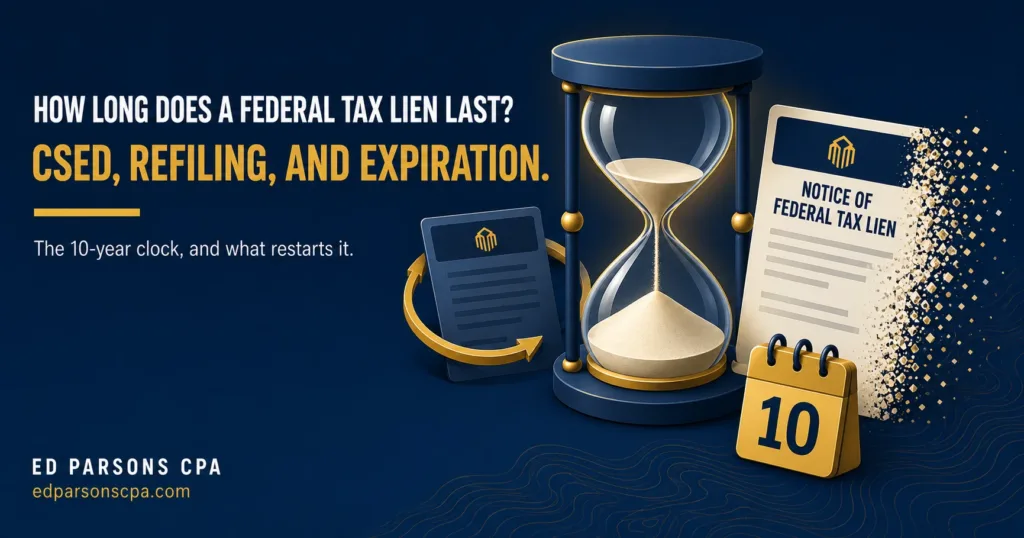
How Long Does a Federal Tax Lien Last? CSED, Refiling, and Expiration.

A federal tax lien generally lasts 10 years from the date the IRS assesses your tax liability, not from the tax year itself and not from the date you filed your return. This 10-year window is governed by the Collection Statute Expiration Date (CSED) under IRC Section 6502. However, the actual duration can be shorter

How Long Does a Federal Tax Lien Last? CSED, Refiling, and Expiration. Read More »

Two individuals signing documents related to federal tax lien subordination and discharge, with house keys and folders on a wooden table, emphasizing tax resolution services.

How Federal Tax Liens Survive Bankruptcy: Chapter 7 & 13

A federal tax lien subordination allows another creditor (typically a mortgage lender) to move ahead of the IRS in priority, making it possible to refinance. A federal tax lien discharge removes the lien from a specific piece of property, making it possible to sell with a clear title. These are two separate IRS mechanisms with

Federal Tax Lien Subordination and Discharge: Selling or Refinancing With a Lien Read More »

IRS Form 12277, Application for Withdrawal of Filed Form 668(Y), for removing a Notice of Federal Tax Lien, with visible sections for taxpayer information and withdrawal reasons.

IRS Form 12277: How to Request a Federal Tax Lien Withdrawal

IRS Form 12277, officially titled “Application for Withdrawal of Filed Form 668(Y),” is the form you use to request that the IRS withdraw a Notice of Federal Tax Lien from public records. A withdrawal is different from a release. A withdrawal removes the lien filing entirely, as if it were never recorded, while a release

IRS Form 12277: How to Request a Federal Tax Lien Withdrawal Read More »

Credit report showing a score of 579 labeled as "Poor," with account summary details and a laptop displaying credit score analytics in the background, illustrating the impact of federal tax liens on credit scores.

Does a Federal Tax Lien Affect Your Credit Score?

A federal tax lien no longer appears on your credit report. In April 2018, the three major credit bureaus (Equifax, Experian, and TransUnion) stopped including tax liens on consumer credit reports as part of a data accuracy initiative called the National Consumer Assistance Plan. This means a federal tax lien will not directly lower your

Does a Federal Tax Lien Affect Your Credit Score? Read More »

IRS documents on a porch railing with a house and "For Sale" sign in the background, symbolizing the impact of federal tax liens on property.

Can the IRS Put a Lien on Your House, Bank Account, or Business?

Yes. A federal tax lien attaches to your home, bank accounts, business assets, vehicles, investments, and any property you acquire in the future. The lien is not limited to one asset. Once the IRS files a Notice of Federal Tax Lien, it creates a legal claim against virtually everything you own and everything you will

Can the IRS Put a Lien on Your House, Bank Account, or Business? Read More »

Notice of Federal Tax Lien document on a wooden desk with reading glasses and a pen, relevant to IRS tax resolution services and implications for credit scores.

What Is a Federal Tax Lien and Why Did the IRS File One Against You?

A federal tax lien is the government’s legal claim against your property when you fail to pay a tax debt. The IRS files a Notice of Federal Tax Lien (NFTL) after assessing a tax balance, sending you a bill, and receiving no response. The lien attaches to all of your assets, including real estate, vehicles,

What Is a Federal Tax Lien and Why Did the IRS File One Against You? Read More »

Desk with U.S. passport, tax documents, and lamp, overlooking rainy Brussels, highlighting IRS tax resolution services for Americans abroad.

IRS Tax Resolution Services in Belgium: What Americans Abroad Must Know in 2026

If you are a U.S. citizen or green card holder living in Belgium, the IRS still requires you to file U.S. taxes every year regardless of where you earn your income. Falling behind, underreporting foreign income, or missing FBAR deadlines can trigger audits, passport revocation, or collection actions from thousands of miles away. A U.S.-based

IRS Tax Resolution Services in Belgium: What Americans Abroad Must Know in 2026 Read More »

Person in business attire holding IRS tax documents with Sydney skyline and harbor in the background, symbolizing IRS tax resolution services for Americans living in Australia.

IRS Tax Resolution Services for Americans Living in Australia

Americans living in Australia are still required to file US tax returns every year, regardless of where they earn their income. If you’ve fallen behind, owe back taxes, or never knew you had to file, IRS tax resolution services can help you get compliant often without penalties through programs like the Streamlined Foreign Offshore Procedure.

IRS Tax Resolution Services for Americans Living in Australia Read More »

Denied stamp on a United States passport, illustrating IRS passport revocation implications for Americans abroad.

IRS Passport Revocation: Definitive Guide, Part II – Advanced FAQ

Part I of this guide covered the fundamentals every taxpayer needs to know: the $64,000 certification threshold, the CP508C notice, how installment agreements protect your passport, and the expedited decertification timeline. If you have not read Part I yet, start there first. Part II is for the taxpayer whose situation does not fit the standard

IRS Passport Revocation: Definitive Guide, Part II – Advanced FAQ Read More »

Yes, I can Meet In
I am Available to Represent You in