Skip to content

If you are a U.S. citizen holding a Colombian investment fund, the IRS almost certainly treats it as a passive foreign investment company, or PFIC. That label triggers one of the harshest regimes in the tax code. By default, your gains are spread across your whole holding period, taxed at the highest ordinary rates, and hit with an interest charge that compounds back to the year you bought in. Each fund is reported on its own Form 8621, and the elections that soften the rules are usually not available for Colombian funds.
You opened an account at a Colombian comisionista or fiduciaria and put some money into a local fund or ETF. That is ordinary, sensible investing. For a U.S. citizen, though, that everyday Colombian fund is a U.S. tax problem with a specific name, and it is one of the costliest items in the whole expat landscape. For the wider picture, see our guide to U.S. taxes for digital nomads and the tax issues of working remotely from Colombia.
Quick Facts on Colombian Funds and PFICs
- Most Colombian funds and ETFs are PFICs for U.S. tax purposes.
- The default regime taxes gains at the highest ordinary rates, not the capital gains rate.
- An interest charge compounds on the deferred tax, back to the year you bought in.
- Form 8621 is required for each PFIC, every year you hold it.
- The QEF and mark-to-market elections that soften the rules are usually unavailable for Colombian funds.
- Funds inside a pension voluntaria or a local brokerage count too.
Why a Colombian Fund Is Almost Always a PFIC
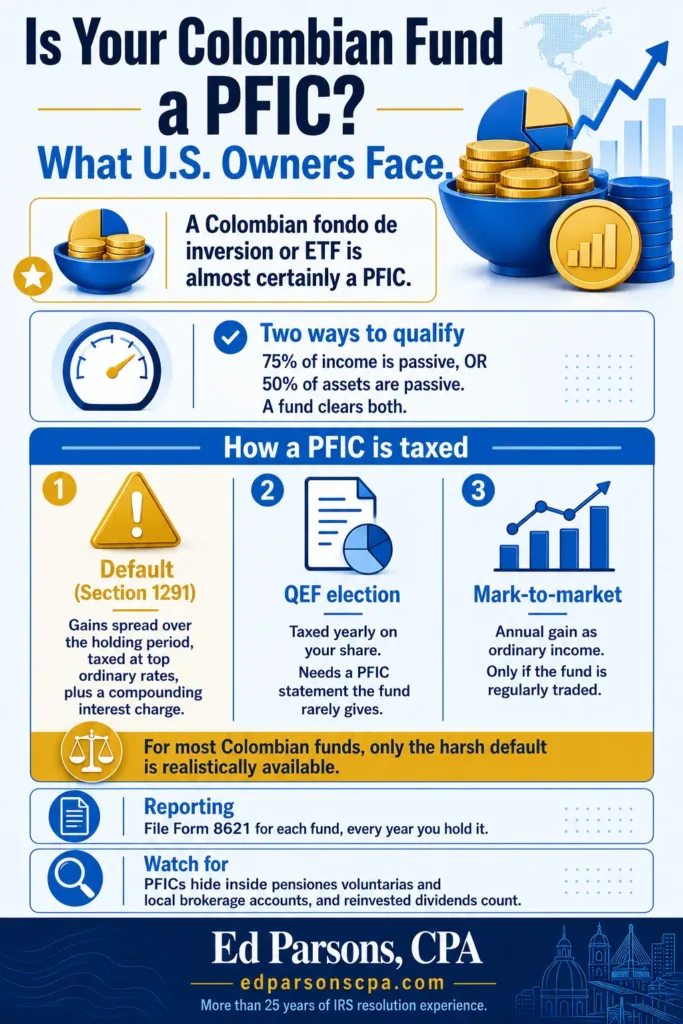
A foreign company is a PFIC if most of its income or most of its assets are passive, meaning dividends, interest, and capital gains rather than an active business. An investment fund exists precisely to hold passive, income-producing assets, so it lands inside the definition almost automatically.
The rule has two triggers, and meeting either one is enough. A fund is a PFIC if at least 75 percent of its income is passive, or if at least 50 percent of its assets are held to produce passive income. A typical fund clears both lines with room to spare.
That sweeps in the everyday options a Colombian investor uses: a fondo de inversion colectiva at a fiduciaria, a local mutual fund, or an ETF listed on the Bolsa de Valores de Colombia. Held outside a U.S. brokerage, these are foreign corporations full of passive assets, which is the textbook PFIC.
The Default Regime Is Built to Hurt
When you make no election, the default PFIC rules under Section 1291 apply, and they are punishing by design. Gains and large distributions are spread across your entire holding period, each slice is taxed at the highest ordinary rate in effect for that year, and an interest charge is added on top as if the tax had been owed all along. The same treatment also hits what the rules call an excess distribution, which can include an unusually large payout from the fund, not only a sale.
Suppose you bought a Colombian fund eight years ago and sold at a gain. Instead of one clean capital gains calculation, the default method splits that gain across all eight years, taxes each slice at the top ordinary rate, and layers compounding interest on the result. A modest gain can lose a large share to tax and interest combined, which is what people mean when they call PFIC treatment confiscatory.
The Elections That Could Help Usually Are Not Available
There are two ways to escape the default, but both depend on something Colombian funds rarely provide. The Qualified Electing Fund election lets you include your share of the fund’s earnings each year at more normal rates, but it requires the fund to issue a PFIC Annual Information Statement, and local Colombian funds almost never produce one.
The mark-to-market election lets you report annual gains as ordinary income, but it is only available when the fund is regularly traded on a qualified exchange. Many Colombian funds are not, which leaves most U.S. holders stuck with the harsh default. Even when an election is technically possible, it generally has to be made early and cannot fully undo years already taxed under the default. This is why what looked like a simple local investment becomes a genuine planning problem.
| Default (Section 1291) | QEF election | Mark-to-Market | |
| How it taxes you | Gains spread over the holding period, then taxed | Your share of fund earnings, taxed yearly | Annual gain marked to market |
| Measurement (when it applies) | The fallback if you make no election | Only if the fund gives a PFIC statement | Only if the fund is regularly traded |
| Tax rate | Highest ordinary rate, per prior year | Ordinary and capital gains, current year | Ordinary, current year |
| Interest charge? | Yes, compounding to year one | No | No |
| Realistic for Colombian funds? | Usually the fallback | Rarely available | Sometimes, if marketable |
The gold row is the whole game. Your election options are decided by what the fund provides and how it trades, not by what you would prefer.
Form 8621: One Form Per Fund, Per Year
PFIC holdings are reported on Form 8621, and you file one for each PFIC, for each year you hold it. Three Colombian funds can mean three forms annually, each with its own calculations and elections.
There is a narrow filing exception when your total PFIC value is small and you took no distributions, but it relieves only the form, not the tax. The same funds may also surface as foreign securities on Form 8938, which we cover alongside accounts in our guide to reporting Colombian accounts on the FBAR and Form 8938.
Where Colombian Funds Hide
You do not have to buy a fund directly to own a PFIC. They often sit inside other wrappers. A pension voluntaria is typically invested in pooled funds, and a brokerage account at a local comisionista can hold them by default. Reinvested dividends inside a fund count as well, quietly enlarging the position you never thought of as an investment. Many U.S. holders only discover the exposure when they finally list out every Colombian account and product they hold.
If You Already Hold One
Time makes PFIC problems worse, because the interest charge keeps compounding the longer a fund goes unreported. If that describes you, there is usually a clean way forward. Non-willful taxpayers can often catch up through Streamlined Filing, and a proper submission folds the PFIC forms and calculations into the same package rather than leaving them for later. Acting sooner also caps the interest that would otherwise keep accruing on each unreported year.
Common Mistakes Investors Make
- Assuming a Colombian fund is taxed like a U.S. mutual fund. The default is far harsher.
- Not realizing a local fund or ETF is a PFIC at all.
- Missing Form 8621, which is required per fund, per year.
- Assuming you can elect QEF. Colombian funds rarely provide the statement it requires.
- Letting an unreported fund ride for years while the interest charge compounds.
- Forgetting that reinvested dividends inside the fund still count.
- Overlooking funds held inside a pension voluntaria or a comisionista account.

Get the PFIC calculation done right
PFIC math is unforgiving, and the elections have strict conditions. Ed Parsons, CPA prepares Form 8621 and the underlying calculations for Colombian funds, and identifies whether any election is actually open to you.Get help with Form 8621 PFIC CPA Filing