Skip to content

You can owe an FBAR on money that was never yours. Signature or other authority, the ability to control the disposition of an account’s funds by communicating directly with the institution, creates the filing requirement with zero ownership. Treasurers, controllers, foreign subsidiary signers, trustees, and family members holding account powers get caught. Read-only access, bookkeeping, and approval-only roles usually do not, because direct control over disposition is the key. Signers on a company account who were never told about the FBAR are the situation I take up in FBAR and foreign company accounts.
The rule nobody warned you about
The FBAR reaches two kinds of people. Owners are the obvious ones. The second group is everyone with signature or other authority, which 31 C.F.R. 1010.350 defines as the power to control the disposition of the account’s assets by direct communication, alone or with others, to the institution that maintains it.
Read that definition twice, because every word does work. It is about control, not benefit. It is about the institution, not your employer’s software. And it needs no ownership at all.
The logic is the Bank Secrecy Act’s, not the tax code’s. The statute cares about who can move the money, because the person who can move it is the person the government wants on record, whoever eventually benefits.
The discovery usually sounds like one of these:
“I am the treasurer and I can sign on the company’s foreign account. Is that my FBAR?”
“I have online access to my mother’s account overseas. Do I file?”
“Our bookkeeper sees every foreign account. Does she have to report them?”
Short answers: quite possibly yes, and it is personal to you. It depends on what that access lets you do, not what you have done with it. And usually no, if seeing is all the access allows. The line between those answers is this entire article.
The people this rule catches
Treasurers and controllers. If the bank will act on your instruction, alone or with a co-signer, you hold authority over that account. Titles do not matter; the signature card does.
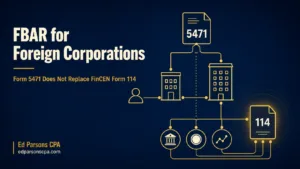
Foreign subsidiary signers. The U.S. executive added to the local subsidiary’s accounts for convenience is the classic surprise filer. The company’s own reporting runs separately, on rules covered in our guide to foreign corporations and the FBAR.
Trustees. A U.S. person serving as trustee can direct the trust’s accounts by definition of the role, which is authority whether or not a dollar of the trust is theirs.
Family account powers. The adult child added to a parent’s account abroad, or holding a power of attorney over it, often has exactly the control the definition describes. Helping with mom’s banking can be a filing obligation.
One contrast keeps this section honest: a joint owner walks in through the financial interest door, not this one. Different doors, same destination, and the joint owner reports the full account value too.
The people it usually does not catch
The definition draws its line at direct control over disposition, and three common roles usually fall on the safe side of it.
Read-only access sees balances and statements and can move nothing. Bookkeeping records what happened after it happened. And approval inside an internal workflow, where your click authorizes a colleague to instruct the bank, is not direct communication with the institution.
That last one is also where the guardrail lives: never assume that every employee with accounting access holds FBAR authority. The question is always whether the institution itself would act on that person’s instruction, and the signature card, mandate, or power of attorney answers it. When the paper is ambiguous, the facts need review, not a guess in either direction.
One account, three FBARs
Watch the rule work on a single account. A foreign subsidiary holds an operating account that peaked at $480,000 during the year.
The U.S. parent company reports it through majority ownership: financial interest, the first door. The CFO in Miami is on the signature card: authority, the second door, and a personal FBAR. The country manager abroad, if a U.S. person, signs too: a third report, same account, same $480,000.
Two-signature requirements change nothing, because the regulation reaches control exercised alone or in conjunction with others. Three filers, one account, and each missed report is its own violation with its own penalty clock.
Authority vs access, side by side
| Creates the duty: signature or other authority | Usually does not: access without control | |
| The test | You can direct the disposition of funds by communicating directly with the institution | You can see, record, or recommend, but cannot move money by contacting the bank |
| Typical people | Treasurer, controller, foreign subsidiary signer, trustee, holder of a family account power | Read-only viewer, bookkeeper, approver inside an internal workflow |
| Measurement | The account reports at its full maximum value, on your own FBAR | Nothing to file from access alone |
| The paper trail | Signature cards, bank mandates, powers of attorney | Software permissions and internal approval policies |
| Relief available | Narrow exceptions for officers of certain listed or regulated companies | Not needed |
The numbers that make people take this seriously
- $0: ownership required. Authority alone opens the filing duty.
- 100%: of the account’s maximum value reports on your FBAR, even though none of it is yours.
- 3: signers on one account can mean three separate FBARs for the same money.
- $16,536: the current non-willful penalty per missed report, and it applies to authority-only filers too.
- 5 years: how long the supporting records get kept, for money you never owned.
Reporting money that was never yours feels wrong until you see how many people it catches, and the second surprise is usually worse: the accounts you merely sign on push your own aggregate over the line as well. My five FBAR emails walk that scope out, then the harder question behind a missed year, which is whether the failure reads as an oversight or as something worse, because the two carry very different consequences. Answering the confirmation note is what starts them, and nothing comes before that. Send me the five FBAR emails. Every one has an unsubscribe link.
What filing actually means for you
Reporting an account you control but do not own changes nothing about your taxes. The FBAR is a disclosure, not an income statement, and listing your employer’s account creates no income, no deduction, and no ownership claim.
It is also personal. The company’s FBAR, or its parent’s consolidated filing, reports the entity’s interest; your authority is your own obligation with its own report. Appearing as a signer on someone else’s filing is not filing.
Mechanically, authority-only accounts get their own section of the form, and it asks for the owner’s information alongside the account’s. Gathering those details from an employer, a trust, or a parent is the conversation to have early, not in the week the filing is due.
Narrow relief exists, and it is genuinely narrow: the IRS examination manual describes exceptions for officers and employees of certain publicly listed or federally regulated entities who hold authority but no financial interest. Most private-company signers, trustees, and family power holders get none of it.
One more clean rule: giving up the authority stops the clock going forward and erases nothing behind you. The years you held signing power remain reportable years.

Common mistakes with authority-only accounts
- Confusing ownership with authority. They are separate doors into the same report.
- Assuming every employee with accounting access holds authority. Direct control over disposition is the key.
- Skipping the report because the money was never yours. The rule does not ask.
- Relying on the company’s FBAR to cover the signers. Each obligation is personal.
- Forgetting the power of attorney over a parent’s account abroad.
- Resigning the authority and assuming the past years disappeared with it.

What to do with this discovery
Start with an inventory: every foreign account where a bank would act on your word, whether through a signature card, a mandate, a trusteeship, or a family power. Then run each one through the categories, thresholds, and valuation rules mapped in our advanced FBAR reporting guide.
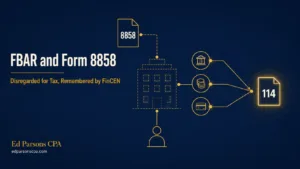
Entity structures add layers this article only opens. Accounts under foreign disregarded entities and branches carry their own pairing of forms, covered in FBAR and Form 8858, and ownership chains run rules of their own.
At Ed Parsons CPA, authority questions get answered from the documents, not the job title. The FinCEN Form 114 FBAR CPA Filing service covers current-year filings for owners and signers alike, and when the discovery comes with missed years attached, the IRS Streamlined Filing CPA Package exists for exactly that conversation.