Skip to content

Form 5471 reports a foreign corporation to the IRS: ownership, earnings, and transactions, under the Internal Revenue Code. It never reports the corporation’s bank accounts to FinCEN. The FBAR is the separate report for those accounts, and it reaches U.S. persons three ways: indirect financial interest through majority ownership, signature authority for officers who can sign, and U.S. parent entities that are U.S. persons in their own right. If the company’s accounts were left off your FBARs for years, I deal with that in the page on foreign company accounts and non-willful conduct.
Two systems, one company
A foreign corporation with U.S. owners lives under two reporting systems at once. The Internal Revenue Code asks about the company: who owns it, what it earned, what moved between it and its shareholders. Title 31 asks about the money: which accounts exist, where, and at what maximum value.
Form 5471 answers the first set of questions. The FBAR answers the second. Neither form collects the other’s information, so completing one leaves the other exactly as unfiled as before.
The gap is also visible from the outside. A filed 5471 names the corporation and shows cash on its balance sheet, FATCA feeds from foreign banks name the corporate accounts and their U.S.-connected signers, and the missing FBAR behind both is simple arithmetic. This is not a mismatch that hides well, and it is usually found on the government’s timeline rather than yours.
The confusion usually sounds like this:
“My company files Form 5471. Doesn’t that cover the bank accounts?”
“I own 60% of a foreign company. Are its accounts mine to report?”
“I can sign on the corporate account but own nothing. Do I file?”
Short answers: no, and that assumption is the most expensive one in this area. Often yes, through indirect financial interest. And quite possibly yes, because signature authority alone can create the duty.
The two forms, side by side
| Form 5471 | FBAR (FinCEN Form 114) | |
| Reports | The corporation: ownership, earnings, transactions, and schedules | The accounts: institution, account number, and maximum annual value |
| Filed with, under | The IRS, with your tax return, under the Internal Revenue Code | FinCEN, through the BSA E-Filing System, under Title 31 |
| Who files | U.S. shareholders and officers across five filing categories | Any U.S. person with financial interest or signature authority |
| Measurement | Ownership and control tests: the 10% and 50% shareholder thresholds | $10,000 combined maximum account value at any time in the year |
| Penalty family | $10,000 per form per year, continuation to $50,000, and an open statute of limitations | Up to $16,536 per report non-willful; greater of $165,353 or 50% of the balance if willful |
The numbers that frame it
- 2: legal systems asking about the same company: the Internal Revenue Code and the Bank Secrecy Act.
- 50%: the ownership line, by vote or value, that makes the company’s accounts your indirect financial interest.
- $10,000 and $16,536: the base Form 5471 penalty and the current per-report FBAR penalty. They are separate exposures for the same oversight.
- 1 signature: officer signing rights alone can create the FBAR duty, with no ownership at all.
- 0: account numbers anywhere on Form 5471. The balance sheet shows cash as a line item; FinCEN never sees the accounts.
Indirect financial interest: the 50% chain
Under 31 C.F.R. 1010.350, a U.S. person who owns more than 50% of an entity, by vote or by value, holds a financial interest in the accounts that entity owns. The foreign corporation itself files nothing with FinCEN; its majority owner reports its accounts as if the interest were direct.
The rule runs through tiers. Own more than half of a company that owns more than half of another, and the chain carries the financial interest down to you, level by level.
It is not corporate-only, either. The same section runs the test for partnerships by profits or capital interest, and for trusts by beneficial interest, so mixed structures get the chain analysis at every link, whatever each link is.
Put it in one picture. Maria owns 100% of a Florida LLC, which owns 100% of a foreign trading company holding three bank accounts. The foreign company files no FBAR. The LLC, a U.S. person, reports the three accounts through its majority ownership. And Maria reports them too, because the chain runs through the LLC to her.
Notice what her tax return did not change: the LLC may be disregarded for income tax, but tax-disregarded is not FinCEN-disregarded. A legal entity organized under U.S. law is a U.S. person with its own FBAR, whatever the 1040 absorbed.
Officers with signing rights
Signature authority is the second path in, and it needs no ownership. An officer, controller, or country manager who can direct the disposition of the corporate account by dealing with the bank holds signature or other authority, and the FBAR reaches it.
Narrow exceptions exist for officers of certain publicly listed or federally regulated companies who hold no financial interest. Most private-company signers get no relief, and the executive who signs on the foreign subsidiary’s accounts usually files, even though the money was never theirs.
The analysis is individual. Three signers on one corporate account can mean three separate FBAR obligations, each reporting the same account at the same maximum value.
And the entity’s filing never discharges the signer’s. The corporation or its U.S. parent reports its financial interest; each officer’s authority is a personal obligation with its own report. Appearing as a signer on the company’s FBAR is not the same as filing your own.
U.S. parent entities are U.S. persons
The third path is the one holding companies miss. A U.S. corporation, partnership, or LLC that owns the foreign company is a U.S. person under Title 31, with its own filing obligation covering the accounts it holds directly and the foreign accounts it reaches through the 50% rule.
Groups get one piece of relief: a U.S. entity that owns more than 50% of other entities can file a consolidated report covering the whole chain. The consolidation is an option about paperwork, not a change in who owes what, and the individual owners’ obligations sit on top of it either way.
What Form 5471 actually reports
The Form 5471 instructions organize filers into five categories built on the 10% and 50% shareholder thresholds, each category dragging its own schedules: ownership, earnings and profits, related-party transactions, and more. It is one of the heaviest information returns in the Code, which is exactly why people assume it covered everything.
It did not. The balance sheet schedule shows cash as a number; it names no institution, lists no account, and reports nothing to FinCEN. The company-side repair for missed 5471 years is its own subject, covered in our guide to unreported foreign corporations and streamlined filing, and it travels separately from the account-side repair.
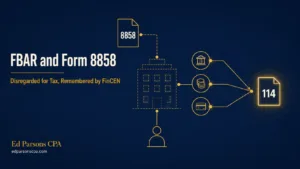
One more entity layer sits next to this one: foreign disregarded entities and branches under the corporation trigger Form 8858, and their accounts run the same Title 31 analysis. That pairing is covered in FBAR and Form 8858.
What five missed years actually cost
Stack the exposures for one foreign company, one U.S. owner, five missed years, and the coordination argument makes itself.
The 5471 side: $10,000 per unfiled form, $50,000 base across the five years, with continuation penalties running each year toward $50,000 more after IRS notice. Worse, the unfiled forms hold the statute of limitations open on the entire return for every one of those years.
The FBAR side, if the facts stay non-willful: up to $16,536 per missed report, roughly $82,680 across five years, assessed separately from everything above. If the facts read willful, the framework shifts to the greater of $165,353 or half of each account’s balance, per account, per year.
Two penalty families, one oversight, and neither repair pauses the other. That is why the corporate file and the account file get fixed together, in one sequence, or the second problem matures while the first one is being solved.

That arithmetic is only the corporate half of the picture, and the corporate half is what my email series covers. Two of its points are the ones that move the numbers: the penalty runs per form and per year without anybody having to audit you, and an unfiled form holds the assessment window open on the whole return, not just the foreign part of it. Start the series. A confirmation request arrives on its own first and the rest waits for it. Each email has an unsubscribe link. The account reporting side is a different conversation.
Common mistakes with corporate accounts
- Assuming the 5471 balance sheet told FinCEN about the accounts. It shows cash, not accounts.
- Stopping the analysis at direct ownership, when the 50% chain carries interest through tiers.
- Forgetting the U.S. holding entity is a U.S. person with its own report.
- Officers skipping the FBAR because the money was never theirs.
- Treating the consolidated option as erasing the individual owners’ obligations.
- Repairing the 5471 while the FBARs stay missing, or the reverse. The penalties run separately.

File both sides of the company
The account categories, thresholds, and control rules behind all of this live in our advanced FBAR reporting guide, and when prior years are missing on either side, the correction lanes are compared in how foreign account mistakes are repaired.
At Ed Parsons CPA, corporate files get both systems at once: the Form 5471 CPA Filing service carries the Code side, categories, schedules, and earnings, while the FinCEN Form 114 FBAR CPA Filing service maps the accounts through ownership chains and signing rights, so the company and its money tell the same story to both systems. The sequencing of the two repairs is part of the engagement, not an afterthought.