Skip to content

Florida’s voluntary disclosure program lets a business that owes back sales tax come forward before the Department of Revenue makes contact, in exchange for a look-back generally limited to three years and a waiver of penalties. There is one exception: if you collected tax and never remitted it, a reduced 5% penalty applies instead of a full waiver, and the three-year limit is not guaranteed. Interest is always due. The program only works if you apply before the Department contacts you about the liability.
If you have fallen behind on Florida sales tax, the instinct is to quietly fix it going forward and hope no one notices. That can backfire, because changing how you file can itself draw attention. Voluntary disclosure is the structured way to come clean on far better terms than waiting for the Department to find the problem. This article explains how it works, what it can save, and why the collected-but-unremitted situation is the most urgent of all. For the wider context, see our complete guide to Florida sales and use tax.
Voluntary Disclosure at a Glance
- It lets you come forward before the Department of Revenue makes contact.
- The look-back is generally limited to three years from your written request.
- Penalties are waived once tax and interest are paid, with one exception.
- If you collected tax and never remitted it, a reduced 5% penalty applies instead.
- It only works if you apply before any contact or audit on that liability.
What Voluntary Disclosure Is?
Florida’s voluntary disclosure program is a structured way for a business to admit it owes back tax and resolve it on agreed terms before the Department of Revenue finds the problem on its own. In exchange for coming forward, the Department generally limits how far back it will look and waives penalties. It is not amnesty, you still pay the tax and the interest, but it sharply reduces the total exposure.
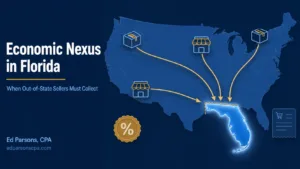
The program covers the taxes the Department administers, including sales and use tax, and it is open to both registered and unregistered businesses. The one firm condition is that you have not already been contacted about the liability. It is a common path for out-of-state sellers who crossed the economic nexus threshold without registering, and for in-state businesses that simply fell behind.
What It Can Save You
The savings come from two places: the look-back and the penalties. The Department generally agrees to look back only three years from the postmark date of your written request, rather than the longer period it could otherwise reach. For an unregistered business there is normally no statute of limitations at all, so that difference can be many years of tax.
On top of the shorter look-back, penalties are waived once the tax and interest are paid. Florida’s standard late penalty runs 10% per month and can reach 50% of the tax due, so the waiver by itself can be a large number. Interest is the one thing the program never forgives. For a business several years behind, the combination of a capped look-back and waived penalties can cut the total bill substantially, even though the underlying tax and interest still have to be paid.
| Coming forward (voluntary disclosure) | Waiting for the DOR | |
| Look-back | Generally limited to three years | Three years, or longer if unregistered |
| Measurement (what sets the terms) | You apply before any contact | The Department opens an audit |
| Penalties | Waived (5% if tax was collected, not remitted) | Up to 50% of the tax due |
| Criminal exposure | Presumption of no criminal intent | Possible referral for collected, unremitted tax |
The Catch: Timing
The program has one hard limit: it works only if you apply before the Department contacts you about the liability. Once you receive an audit notice or any inquiry about that tax, the door closes, and you are left to work through the audit on the Department’s terms.
That is why timing matters so much. The moment you realize you have a back-tax problem is the moment the clock starts, because the Department uses data analysis, cross-state information sharing, and marketplace reporting to find unregistered and underreporting businesses on its own. Coming forward first is what preserves the better terms; being found first removes them. There is one narrow point worth knowing: a prior audit on a different period does not automatically disqualify you, as long as that audit did not cover the periods you now want to disclose.
How the Process Works
Voluntary disclosure starts with a written request to the Department, not an online registration. The request states the tax type and the periods you are disclosing, confirms that the Department has not already contacted you about the liability, and notes how much tax, if any, was collected and not remitted. You do not need to know the full amount at the start; once the Department accepts the request, it asks for the records to calculate it, typically a schedule of taxable sales and collections for the look-back period.
Many businesses make the request through a representative, which keeps the business anonymous until eligibility is confirmed and the terms are settled. Only then is the identity disclosed and the agreement finalized, which is part of why the program is far less daunting than a knock on the door from an auditor.
If You Collected Tax but Never Remitted It
This is the most urgent situation, and the program treats it differently. If you collected sales tax from customers and never sent it to the state, the full penalty waiver does not apply. Instead, a reduced 5% penalty is imposed, unless you can show reasonable cause. That is still far better than the standard penalty, but it is not a clean waiver.
Two things make professional handling essential here. First, the Department’s position is that the three-year look-back does not automatically apply to tax that was collected and not remitted, because that money was the state’s all along, so limiting it to three years is something that has to be negotiated. Second, and more important, coming forward through the program creates a statutory presumption that you had no criminal intent. For an owner who collected tax and used it to keep the business afloat, that presumption can be the difference between a civil resolution and a criminal one. It is the act of disclosing on the program’s terms, rather than quietly amending returns or registering, that triggers both the presumption and the reduced penalty, which is one more reason the step is worth doing correctly.

Disclosure only works while the Department has not contacted you, which makes it the last of five doors rather than the first. The four ahead of it are where the liability was built: the economic nexus threshold that starts an obligation you never registered for, the use tax on purchases nobody charged you for, the resale and exemption certificates that leave you holding the bill, and the reporting patterns that select a business for audit in the first place. I cover each one in a short email series. Send it to my email. A confirmation email comes first; click the link in it and the series begins, one at a time. Unsubscribe whenever you want to.
Why This Is Not a DIY Form
Voluntary disclosure looks like a letter you could write yourself, and the first step is in fact a written request. But the details decide the outcome. The request has to be worded correctly, you generally should not register online first because doing so can undercut the disclosure, and the look-back, the penalty treatment, and the exposure calculation are all negotiated, often anonymously through a representative until eligibility is confirmed.
Getting any of that wrong can cost the very protection the program is meant to provide. If you are behind on Florida sales tax, the right move is to act before the Department does. A Business CPA Tax Resolution Case Analysis reviews your exposure and how voluntary disclosure would apply to your situation. You can also or reach out through the sales-tax audit help page to start.
For official guidance, the Florida Department of Revenue’s voluntary disclosure page and its sales and use tax pages set out the program and the filing rules, though neither replaces advice on your own situation.

Behind on Florida Sales Tax?
Voluntary disclosure works only while you are still ahead of the Department of Revenue. Ed Parsons, CPA helps Florida and out-of-state businesses come forward on the best available terms, before an audit notice arrives.
Start with a Business CPA Tax Resolution Case Analysis, which explicitly covers sales tax exposure and resolution. Prefer to talk it through first? Book a Business IRS Tax Debt Coaching Call, or reach us through the sales-tax audit help page.