Skip to content

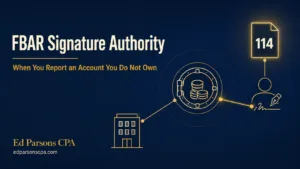
Yes. A U.S. person who is not the tax owner of a foreign non-grantor trust can still owe FBARs through signature or other authority over the trust’s accounts: bank mandates, online banking rights, and powers the institution will act on. Giving assets to the trust does not always give away the FBAR. The answer lives in three documents, the trust deed, the signature cards, and the e-banking permissions, and this analysis carries the strongest caveats in our FBAR series. What it costs if the trust’s accounts were never reported is compared in non-willful vs willful FBAR penalties.
The comfortable assumption this article tests
The pattern is always the same. Years ago, a U.S. person moved assets into a foreign trust, took care to make it non-grantor, and was told the structure now stood apart from them. The reporting, they understood, belonged to someone else.
For income tax, that may be exactly right. This article is about the other system, the one that never asked who owns the trust, and about the threads of control that quietly keep the account reports attached to the person who thought they had let go.
The question arrives in three voices:
“I gave the money to a foreign trust years ago. Why would the FBAR still be mine?”
“I’m the protector. I can fire the trustee. Is that authority over the accounts?”
“The trust is non-grantor for tax. Doesn’t that end it?”
Short answers: because control, not ownership, is the FBAR’s question. Maybe, and honest professionals will not answer that from a title alone. And no: non-grantor is a tax conclusion, and the FBAR was never asking a tax question.
Two systems, restated for trusts
Non-grantor status settles who pays tax on the trust’s income. Title 31, through 31 C.F.R. 1010.350, asks something narrower and harder to escape: which U.S. persons can control the disposition of the trust’s account assets by communicating, alone or with others, directly with the institutions holding them.
The full actor-by-actor framework, grantors, beneficiaries, trustees, protectors, and signers, starts from the trust’s own reporting on Form 3520. This article goes one layer deeper, into the settlor who kept threads, because that is where the expensive surprises live.
The pressure is not theoretical. The trust’s banks report U.S.-connected controlling persons under FATCA, and a settlor still named on a mandate is precisely who those feeds name. The government’s picture of your control can be more current than your own.
The five threads that keep the FBAR attached
Bank mandates. The bluntest thread. If your name sits on the account’s signature card, or the mandate lists you as an authorized instructor, the institution will act on your word, and the authority analysis is essentially over before it starts.
The trustee role. Some settlors become trustees, or directors of the private trust company that serves as trustee. Legal title and instruction rights follow the role, and with them, the accounts.
Protector powers. Here the honest debate lives. A power to remove and replace the trustee runs to a person, not a bank, and usually does not create account authority by itself. But a protector whose consent the bank requires for transfers, or who holds standing instruction rights, has crossed into different territory, and a removal power exercisable at will can be argued as control one step removed. Nobody should accept a blog’s answer to that question, including this one; the documents and counsel answer it.
Retained powers. Investment direction the custodian executes on your instruction, distribution powers the bank recognizes, or veto rights wired into the account agreements can all amount to the control the definition describes, whatever the deed calls them.
Direct communication rights. The modern thread. Online banking credentials with transfer rights, a security token in your drawer, a standing arrangement where the relationship manager takes your calls: these are direct communication with the institution, kept for convenience and legally heavier than they feel.
Powers that reach the bank, and powers that do not
| Can create FBAR authority | Usually does not, alone | |
| The test | The institution would act on your instruction, alone or with others | Your power runs to people or papers, not to the bank |
| Examples | Bank mandate signer; e-banking credentials with transfer rights; investment instructions the bank executes on your word | Power to remove and replace the trustee; a veto exercised through the trustee; advisory letters the trustee may ignore |
| Measurement | Every reachable account reports at full maximum value, on your own FBAR | No account value reports from the power alone |
| Where it hides | Signature cards, e-banking permission matrices, custody agreements | The trust deed’s governance clauses |
| What changes it | Adding or removing your name at the bank | Amending the deed changes the powers, not necessarily the accounts |
The numbers that frame the decision
- 0: tax ownership needed. Authority is its own door into the FBAR, and non-grantor status never closes it.
- 3: documents that decide most cases: the trust deed, the signature cards, and the online banking permissions.
- 100%: of each reachable account’s maximum value reports on your FBAR, whatever the trust owns for tax purposes.
- $16,536 vs $165,353 or 50%: the non-willful ceiling against the willful floor, and a settlor with kept powers and missed years can be argued toward either.
- 1 sequencing rule: documents first, conclusions second, filings third. Every shortcut runs through a certification signed under penalty of perjury.
How the threads actually surface
A composite from real files. A U.S. settlor funded a foreign non-grantor trust a decade ago, stepped away in the deed, and stopped thinking about it. A review this year reads all three layers.
The deed is clean: no retained powers, a professional trustee, a protector who is not him. The signature card at the custodian tells a different story: he was added as second signer during the funding transition and never removed. And his e-banking profile still carries initiate and release rights, unused for years, active the whole time.
The analysis writes itself from there. The accounts were reachable, so the authority years are exposed; the deed and the bank paperwork disagree, so counsel reads the removal history and whether it was ever effective; and the correction lane waits on that conclusion, because the certification depends on it.
Nothing in that file was exotic. It was one transition-era signature card and one forgotten login, which is what kept powers usually look like in practice.
A forgotten login is the ordinary version of this, and it is why authority rather than ownership is the thread I keep pulling on. Accounts you can direct without owning, a business account, an employer’s account, one you manage for a relative, get their own email in the five I send, and the rest deal with what a missed year costs and how the correction gets characterised. Nothing goes out until you answer the confirmation note. Send me the five FBAR emails. Every email after that has an unsubscribe link at the foot.
The document review that answers it
The trust deed maps the powers on paper: who serves, who removes, who consents, what the settlor kept. It is where the analysis starts and where it least often ends, because deeds describe governance, not bank access.
The signature cards and account mandates map the powers in fact. Banks act on their own paperwork, and it is common to find a settlor still listed years after the deed said they stepped away, or a protector added for convenience during a transition and never removed.
The e-banking permission matrix maps the powers nobody remembers. View-only, initiate, approve, release: those settings are the modern signature card, and the IRS examination manual trains examiners to ask for exactly this kind of record. The review that protects you gathers all three layers and reads them against each other, because the FBAR answer lives in their disagreements.
The caveat that keeps this honest
Now the guardrail, stated as plainly as the rest. A CPA reading these documents can identify reporting risk: which accounts look reachable, which years look exposed, which powers need a harder look. That is real, valuable, and the right first step.
What a CPA cannot responsibly do is conclude whether a trust is valid, whether a power was effective under the trust’s governing law, or whether an ambiguous protector clause creates authority. Those are legal conclusions, they depend on the trust documents and the law behind them, and they belong to counsel.
The sequencing matters most when years are already missing. A settlor with kept powers who certifies past non-willfulness before the power map is built is signing a legal conclusion under penalty of perjury, and the conduct cases, Williams and Horowitz among them, show how courts read signatures against documents. When the record carries ambiguity, counsel reads it first, privilege protects the analysis, and the filings come after the conclusions, never before.
Two timing rules complete the picture. If authority exists today, the current-year filing is straightforward and should simply happen. If it existed in past years, the lane analysis begins, and resigning the authority now erases nothing behind you; the years you could reach the accounts remain reportable years.

Common mistakes with non-grantor structures
- Treating non-grantor for tax as invisible for Title 31.
- Reading the deed and skipping the signature cards, or the reverse. The answer lives in their disagreements.
- Assuming protector powers are always safe, or always authority. The documents decide, case by case.
- Keeping online banking tokens for convenience and forgetting what they legally are.
- Certifying past non-willfulness before the power map exists.
- Accepting conclusions about trust validity from anyone except counsel holding the documents.

This is precisely why the first engagement here is an analysis, not a filing. The Personal CPA Tax Resolution Case Analysis builds the power map as a written deliverable: deed, signature cards, and e-banking permissions read together, reachable accounts identified, exposed years counted, and a sequencing memo stating what gets filed, what gets asked of counsel, and in which order. Where the trust’s transaction reporting also needs repair, the Form 3520 CPA Filing service carries that regime, and the correction lanes for missed account years are compared in how foreign account mistakes are repaired.
The account rules underneath everything here live in our advanced FBAR reporting guide. ED Parson CPA or reach us through our streamlined filing page, and let the documents answer the question before anyone signs anything that assumes the answer.