Skip to content

Kwong Protective Claims, Form 843, and IRS Transcript Review
By Ed Parsons, CPA [Updated May 2026]
Short answer: A Kwong-related review usually starts by identifying whether the IRS assessed or collected penalties or interest during the COVID-era period, then determining whether a refund claim, protective refund claim, or abatement request may be appropriate. In many cases, taxpayers may need to act before July 10, 2026, but the right next step depends on the IRS account history.
If you have not read the first guide yet, start with What Is Kwong, and Why Prior IRS Penalties May Need a Second Look. That article explains why the Kwong issue may matter and why relief is not automatic.
This article goes one level deeper.
The key point is not simply, “file Form 843.”
The key point is this: before filing anything, you need to know what the IRS account actually shows.
That means reviewing tax periods, penalty assessments, interest charges, payment dates, filing history, prior notices, and whether the issue involves income tax, employment tax, international information penalties, or another category.
For taxpayers with international tax history, this can matter even more. Late or missing Forms 5471, 5472, 3520, 3520-A, 8865, 8938, FBAR-adjacent issues, Streamlined Filing history, and foreign-owned U.S. LLC filings can create large penalties that are easy to misunderstand if you look only at one return or one IRS notice.
Why a protective claim may matter after Kwong
The National Taxpayer Advocate has explained that many taxpayers may need to file refund claims or protective claims to preserve possible Kwong-related rights before the deadline. The Advocate has also warned that relief will not be automatic.
A protective claim is generally used when a taxpayer may have a refund claim, but the final legal result is still uncertain. In the Kwong context, the taxpayer may be trying to preserve the right to a refund or abatement while the legal issue continues to develop.
This is why timing matters. Waiting until every legal question is finally resolved may be too late if the refund claim deadline has already passed.
But that does not mean the taxpayer should file a vague or careless claim.
A claim should be tied to the correct tax periods, type of tax, penalty or interest issue, payment history, and account facts.
This is also why the next step after understanding the rules is usually not a form. It is a careful review of the IRS record. The follow-up article, Why a CPA-Led Kwong Penalty Review Starts With IRS Transcripts, Not Guesswork, explains what that review should accomplish before a taxpayer decides whether to pursue a claim.
Refund claim, protective refund claim, or abatement request?
One of the first distinctions is whether the taxpayer is asking for money back or asking the IRS to remove an unpaid amount.
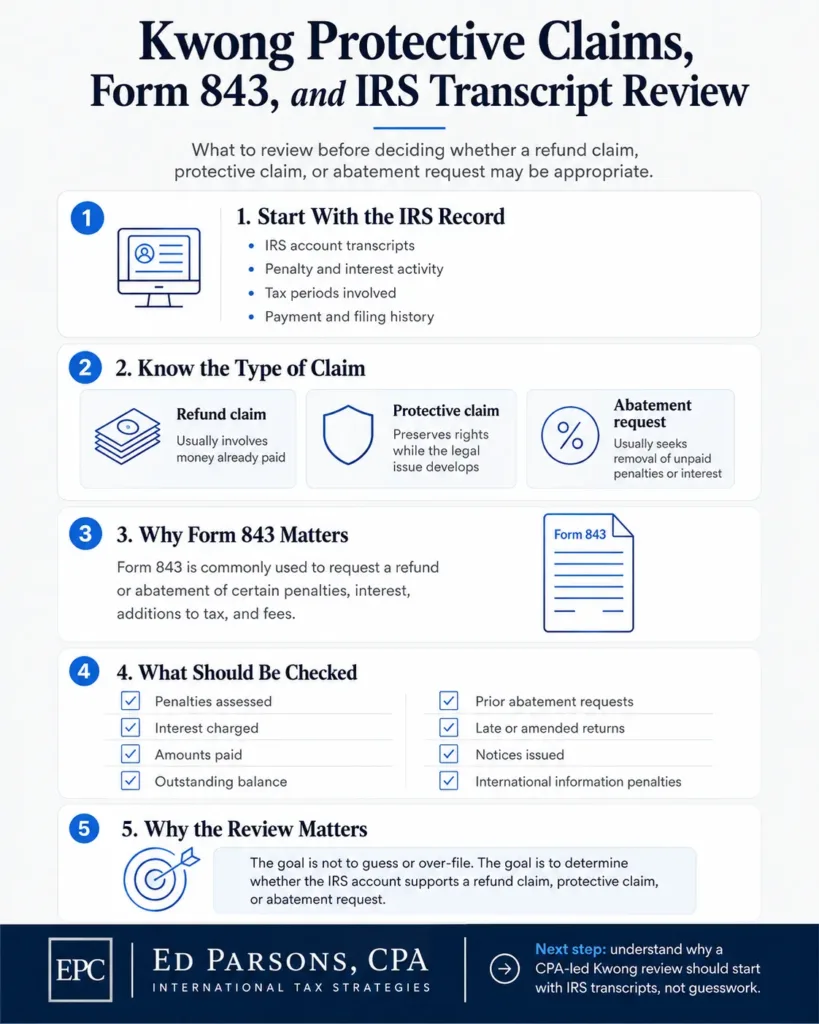
A refund claim generally asks the IRS to return money that has already been paid. A protective refund claim may preserve the taxpayer’s right to a refund when the amount or entitlement depends on a future legal development. An abatement request generally asks the IRS to remove or reduce an amount that has been assessed but not yet paid.
That distinction matters because a paid penalty and an unpaid penalty may require different analysis.
For example, a taxpayer who paid penalties in full may be looking at a refund claim. A taxpayer who still has penalties or interest sitting on the IRS account may be looking at abatement. A taxpayer whose exact refund amount cannot yet be determined may need to consider whether a protective claim is the safer way to preserve rights.
This is why a focused review should start with the IRS record, not assumptions.
Where Form 843 fits into a Kwong review
IRS Form 843 is used to claim a refund or request an abatement of certain taxes, penalties, additions to tax, interest, and fees.
In Kwong-related situations, Form 843 may be relevant when the taxpayer is not changing the underlying tax liability, but is instead addressing penalties, interest, or additions to tax.
The National Taxpayer Advocate has stated that taxpayers will generally need to file Form 843, write language such as “Protective Refund Claim Pursuant to Kwong Case” or similar language across the top, and include as much detail as possible. The Advocate has also stated that, in most cases, taxpayers should file a separate Form 843 for each tax period and each type of tax.
This article is not a line-by-line Form 843 filing guide. The form is only one part of the analysis.
The larger question is whether the IRS account supports filing a claim at all, and if so, what type of claim should be considered.
Why IRS transcripts matter before filing anything
A taxpayer may remember filing late, paying a balance, receiving a notice, or resolving a penalty. But memory is not enough for a Kwong review.
IRS transcripts can show account activity that may not be obvious from the taxpayer’s own copy of a return. That may include filing dates, payment dates, penalty assessments, interest charges, adjustments, reversals, balances, and other transaction history.
For more background, read how IRS transcripts reveal refunds, penalties, and filing issues.
A proper review may need to connect the transcript record to:
- the tax return filed for that period
- the date the return was filed
- the date the tax was paid
- the date penalties or interest were assessed
- the type of penalty involved
- whether the amount was paid or remains unpaid
- whether an IRS notice was issued
- whether a prior abatement request was made
- whether international information returns were involved
This is why a transcript-only review can be incomplete. A CPA may need to compare the IRS transcript activity with the actual notices, returns, forms, payment records, and filing history. See what a CPA can find in your IRS transcripts.
What should be checked before deciding whether a claim makes sense?
A focused Kwong review should answer several basic questions before anyone decides whether to file a claim.
- Which tax periods are potentially affected?
- Were penalties assessed during the relevant period?
- Was interest charged during the relevant period?
- Were the penalties or interest paid?
- Does the IRS still show a balance?
- Was the issue income tax, employment tax, estate tax, gift tax, excise tax, or an international information return penalty?
- Was there a late filing, late payment, amended return, or payment plan?
- Were any international forms late, missing, incomplete, or penalized?
- Were prior abatement requests filed?
- Is the taxpayer asking for a refund, abatement, or both?
These questions matter because Kwong is not a blanket answer. It is a reason to review the account.
If the review shows there is no meaningful penalty or interest issue, the taxpayer may avoid filing a weak or unnecessary claim. If the review shows a real issue, the next step can be considered with better facts.
Why international tax history can complicate the review
International tax penalties are often separate from the income tax shown on a return. A taxpayer may have had no additional income tax due, but still received a large penalty because a foreign reporting form was filed late, missed, or considered incomplete.
The IRS lists international information reporting penalties connected to forms such as Form 5471, Form 5472, Form 8865, and other foreign reporting obligations. For example, a Form 5472 failure may trigger a $25,000 penalty.
That is why taxpayers with foreign entities, foreign trusts, foreign gifts, foreign bank accounts, foreign investment accounts, or Streamlined Filing history should be careful before assuming Kwong does or does not apply.
If you previously dealt with foreign accounts, review how FBAR and Form 8938 can create separate reporting issues. If your prior issue involved foreign trusts, gifts, or distributions, see the guide on Form 3520 penalties and foreign trust reporting.
International filing history can affect the review because the IRS account may show penalties or interest, but the reason for those amounts may be buried in notices, forms, filing dates, or prior correspondence.
Common mistakes to avoid with a Kwong review
The biggest mistake is assuming the issue is simple because Form 843 exists.
Other common mistakes include:
- filing a claim without reviewing IRS transcripts
- using the wrong tax period
- combining unrelated years or tax types without support
- failing to distinguish paid penalties from unpaid penalties
- ignoring interest because the penalty is the obvious item
- forgetting prior abatement requests
- missing international information penalties
- using vague language that does not identify the issue clearly
- waiting until the legal issue is fully resolved and missing the claim window
The goal is not to over-file. The goal is to identify whether the taxpayer has a real issue worth preserving.
When professional review becomes important
Professional review becomes important when the taxpayer has penalties, interest, international filings, multiple tax years, old IRS notices, or uncertainty about what the IRS account actually shows.
It is especially useful when the taxpayer does not know:
- whether penalties were assessed
- whether penalties or interest were paid
- which years are affected
- whether the issue is income tax, employment tax, or international reporting
- whether the IRS still shows a balance
- whether a protective claim should be considered
The purpose is not to guarantee a refund or promise penalty removal. The purpose is to identify what the IRS record shows and whether a claim, abatement request, or follow-up strategy may be worth considering.
For a trust-focused explanation of what should happen before a taxpayer moves from research to action, read Why a CPA-Led Kwong Penalty Review Starts With IRS Transcripts, Not Guesswork.
What this review is not
A Kwong penalty review is not a promise that the IRS owes you money.
It is not a guarantee that penalties or interest will be refunded or removed.
It is not a substitute for IRS action, court developments, or a complete review of the taxpayer’s facts.
It is a focused review of the IRS account history to determine whether there is a penalty, interest, refund, abatement, or protective-claim issue worth pursuing.
That distinction matters. The right conclusion may be that a claim should be considered. It may also be that no claim appears worthwhile based on the account history.
The practical next step
If you had IRS penalties, interest, late filings, international reporting penalties, foreign forms, old IRS notices, or unresolved account activity during the COVID-era period, do not guess from memory.
Review the IRS account record first.
The right review should identify the affected years, penalty and interest activity, payment history, filing history, international form issues, and whether a refund claim, protective refund claim, or abatement request may be appropriate.
If the account shows a real issue, the next step can be considered before the deadline. If it does not, you avoid filing a weak or unnecessary claim.
Either way, the next step is not guessing. The next step is understanding why a CPA-led Kwong penalty review should start with IRS transcripts, not guesswork.
Frequently Asked Questions About Kwong Protective Claims, Form 843, and IRS Transcript Review
These answers explain how Kwong-related review, Form 843, protective claims, abatement requests, and IRS transcripts fit together before a taxpayer decides whether further action may be appropriate.
Is a Kwong protective claim the same thing as a refund claim?
Not always. A refund claim generally asks the IRS to return money already paid. A protective refund claim may preserve a taxpayer’s right to a refund when the legal issue or final amount is still uncertain.
In a Kwong review, the first question is whether the IRS account shows paid penalties, paid interest, unpaid assessments, or a combination of issues.
Official source: National Taxpayer Advocate protective claim guidance
When does Form 843 matter for Kwong?
Form 843 may matter when the taxpayer is seeking a refund or abatement of certain penalties, interest, additions to tax, fees, or related amounts. In a Kwong-related review, Form 843 may be relevant if the IRS account shows penalty or interest activity tied to the affected period.
The form itself is not the analysis. The analysis starts with the IRS account record.
Official source: IRS About Form 843
Do I need IRS transcripts before deciding whether to file a Kwong claim?
In most cases, yes. IRS transcripts can show filing dates, payment dates, penalty assessments, interest charges, adjustments, balances, and other account history that may not be obvious from the taxpayer’s own copy of a return.
For more context, read how IRS transcripts reveal refunds, penalties, and filing issues .
What should be checked before filing anything?
A focused review should check the tax periods involved, whether penalties or interest were assessed, whether amounts were paid, whether a balance remains, what type of tax or penalty is involved, and whether international information forms or prior abatement requests are part of the history.
The goal is to determine whether there is a real issue worth preserving, not to file a claim based on guesswork.
Can one Form 843 cover every year and every issue?
Not necessarily. The National Taxpayer Advocate has explained that, in many cases, taxpayers may need separate Forms 843 for each tax period and each type of tax. That is one reason the account history should be reviewed before deciding what to file.
This article does not provide a filing recipe. The correct approach depends on the taxpayer’s IRS account history and facts.
Official source: National Taxpayer Advocate Form 843 discussion
What is the difference between refund and abatement?
A refund generally involves asking the IRS to return money that was already paid. Abatement generally involves asking the IRS to remove or reduce an amount that was assessed, such as a penalty or interest charge that may still be unpaid.
In a Kwong review, this distinction matters because the taxpayer’s next step may depend on whether the penalty or interest was already paid, still unpaid, or partly paid.
Why can international tax history make a Kwong review more complicated?
International tax penalties may be separate from the income tax shown on a return. A taxpayer may owe no additional income tax but still receive a large penalty for a late, missing, or incomplete foreign reporting form.
This can involve Forms 5471, 5472, 3520, 3520-A, 8865, 8938, FBAR-related issues, PFIC reporting, or Streamlined Filing history.
Official source: IRS international information reporting penalties
What mistakes should taxpayers avoid with Kwong-related claims?
Common mistakes include filing without reviewing IRS transcripts, using the wrong period, failing to separate paid and unpaid amounts, ignoring interest, missing international penalties, relying only on memory, or waiting until the legal issue is resolved and missing the claim window.
The better approach is to understand the IRS record first, then decide whether a claim or abatement request should be considered.
Does a CPA review guarantee a Kwong refund or penalty removal?
No. A CPA review does not guarantee a refund, abatement, or IRS outcome. The purpose of the review is to determine what the IRS account history shows and whether a claim, protective claim, abatement request, or no action appears appropriate based on the facts.
For the next article in this mini-cluster, read why a CPA-led Kwong penalty review starts with IRS transcripts, not guesswork .
What should I read next if I am still unsure?
If you are still trying to understand the issue, start with the awareness article: What Is Kwong, and Why Prior IRS Penalties May Need a Second Look .
If you already understand the basics and want to know why review quality matters, read Why a CPA-Led Kwong Penalty Review Starts With IRS Transcripts, Not Guesswork .