Skip to content

A Passive Foreign Investment Company (PFIC) includes most foreign mutual funds, ETFs, and investment funds held outside the U.S. If you sold or received distributions from one without filing Form 8621, the IRS applies the excess distribution method: all gains are taxed at the highest ordinary income rate of up to 37%, plus a compounding interest charge applied back to the first year you owned it. No long-term capital gains rate applies. The IRS Streamlined Filing Compliance Procedures offer a legal path to resolve unreported PFIC positions and reduce total tax exposure before the IRS discovers the holding.
Priya moved from India to the United States for work. She kept her Indian mutual fund portfolio worth $85,000, invested since her mid-twenties. She paid taxes in India on whatever income arose. She reported her U.S. income honestly every year. How the tax on a sale like hers is computed is in the PFIC excess distribution regime.
Eight years later, she sold the funds and deposited the proceeds. A CPA reviewing her return told her the funds were classified as PFICs. The default IRS tax method applied gains across all eight years of ownership, taxed each slice at 37%, and added compounding interest charges going back to year one.
The tax bill was more than the gain itself. This is not a hypothetical. It is exactly how the PFIC default method works, and it is why this area of U.S. tax law is considered one of the most punishing in the entire code.
What Is a PFIC and Why Does the IRS Care?
A Passive Foreign Investment Company is any foreign corporation that meets either of two tests set by the IRS:
- Income test: 75% or more of the corporation’s gross income is passive, such as dividends, interest, rents, or royalties
- Asset test: 50% or more of the corporation’s assets produce or are held to produce passive income
Most foreign mutual funds, foreign ETFs, and foreign-domiciled investment vehicles automatically meet one or both tests. The fund does not need to be marketed as a PFIC. The IRS classification is based entirely on the income and asset composition.
U.S. persons who hold shares in a PFIC at any point during the tax year are required to file Form 8621, the Information Return by a Shareholder of a Passive Foreign Investment Company or Qualified Electing Fund. The form is required annually, even if no distributions were received and no shares were sold.
Which Foreign Investments Are Classified as PFICs?
This is the part most immigrants and expats get wrong. They assume mutual funds in their home country work like U.S. mutual funds for tax purposes. They do not.
Common investments classified as PFICs include:
- Foreign mutual funds based outside the United States
- Foreign ETFs and index funds not listed on a U.S. exchange
- Foreign hedge funds and private equity vehicles
- Certain foreign insurance products with investment components
- Foreign money market funds
- Foreign holding companies where the primary assets are passive investments
If your foreign bank account holds investment funds alongside savings, and those funds are domiciled outside the U.S., each one may be a separate PFIC requiring its own Form 8621. This compounds the problem when combined with unreported FBAR obligations and Form 8938 FATCA requirements, which cover the same accounts under different rules.

The Three PFIC Tax Methods: Why the Default Is So Damaging
The IRS offers three ways to calculate PFIC tax. The method that applies depends on elections made at the time of investment or filing. If no election is made, the default method applies automatically.
| Measurement | Default / Excess Distribution | QEF Election | Mark-to-Market |
| Tax rate on gains | Up to 37% ordinary rate | Ordinary + capital gain rates | Ordinary income rate |
| Interest charge | Yes, back to year 1 of ownership | No | No |
| When income is taxed | On distribution or sale | Annually | Annually |
| Long-term capital gain rate? | No | Yes (on capital gain portion) | No |
| Complexity | Very high — retroactive calculation | High — annual inclusion required | Medium — annual mark-to-market |
The default method, called the Excess Distribution Method, is the most punishing. It takes all gains and distributions exceeding 125% of the average distributions over the prior three years and allocates them back proportionally across every year of ownership. Each slice is taxed at the highest ordinary rate for that year. Then a compounding interest charge is applied to each slice, calculated from the midpoint of that year to the current filing date.
The result is a tax bill that often exceeds what a U.S. investor would pay on the same investment held in a U.S. fund, sometimes by a significant margin. Long-term capital gains rates, which top out at 20%, do not apply to PFIC gains under the default method.
What the Default Method Looks Like in Practice?
Using Priya’s example: $30,000 in gains after eight years of holding Indian mutual funds classified as PFICs.
| Measurement | Default Method (No Election) | With QEF or MTM Election |
| $30,000 gain after 8 years | Gain allocated across all 8 years | Taxed in year it is recognized |
| Tax rate applied | 37% ordinary rate per year slice | Applicable ordinary or capital rate |
| Interest charge | Compounded from each prior year | None |
| Long-term capital gain benefit | None | Available under QEF |
The interest charge alone, compounded over eight years, can add thousands of dollars to the tax bill. For investors who held foreign funds for ten or more years, the interest charge sometimes rivals the tax itself. For the full technical framework, the IRS Form 8621 instructions detail how the excess distribution calculation is performed.
People reread Priya’s numbers. If you are sitting with a similar holding and no idea yet how bad it is, you do not have to decide anything today. I keep a short email series on PFICs for exactly that stage. Across five emails it covers how a fund earns the label to begin with, what the default regime does to a long-held position, the two elections and the timing rules that govern them, and what catching up looks like when the forms were never filed. Send an email address and a confirmation note arrives first. The emails only begin once you click that, and any of them will unsubscribe you.
What Form 8621 Actually Requires
Form 8621 must be filed for each PFIC separately. One form per fund, per tax year. If you held five foreign mutual funds, you file five Form 8621s.
Each form requires:
- The name and address of the PFIC
- Your cost basis and the number of shares held
- Whether a QEF or mark-to-market election is being made
- All distributions received and gains recognized during the year
- The excess distribution calculation if the default method applies
Form 8621 is not part of the standard tax return workflow. Most tax software does not handle it correctly, and many general practice accountants are unfamiliar with the calculations. This is different from the situation with Form 3520 for foreign trust distributions or Form 3520-A for foreign trust owners, where the penalty is explicit. With PFICs, the damage comes from the tax regime itself, not a separate penalty line.
That gap is the reason I built the PFIC Calculator. It starts from the transactions a broker already records, the purchases, sales and distributions, checks each fund’s status for every year, and works out a sale like Priya’s under the default rules, with the deferred tax and interest for every earlier year. What comes out is one finished Form 8621 per fund per year, plus workpapers you or a CPA can trace line by line. If those years are heading into a streamlined submission, the workpapers are also what a CPA should check before the amended returns go in.
How Streamlined Filing Helps Resolve Unreported PFIC Positions
The IRS Streamlined Filing Compliance Procedures address the full range of unreported foreign financial positions, including PFICs. If your failure to report PFIC holdings and file Form 8621 was non-willful, the program offers a structured path to compliance that limits the damage.
Streamlined filing for PFIC cases typically involves:
- Filing or amending three years of federal income tax returns with all required Form 8621s attached
- Choosing the correct PFIC tax method going forward, either QEF or mark-to-market, where allowed
- Calculating any excess distribution tax and interest for the covered years under professional oversight
- Filing six years of FBARs if the PFIC accounts also triggered FBAR obligations
- Submitting a non-willful certification narrative explaining why the PFIC holdings were not previously reported
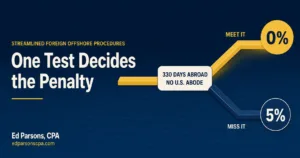
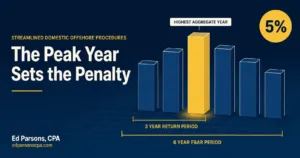
Under the Streamlined Domestic Offshore Procedures (SDOP), the additional penalty is 5% of the highest aggregate value of all unreported foreign financial assets. Under the Streamlined Foreign Offshore Procedures (SFOP), the penalty is zero for qualifying filers. A full submission has to carry the excess distribution calculations, the election analysis, and the non-willful narrative, and the mechanics behind each are set out in the PFIC guide.
Common Mistakes That Make PFIC Exposure Worse
- Selling PFIC shares and reporting the gain as a regular capital gain on Schedule D without applying the excess distribution rules
- Assuming that paying taxes in the foreign country eliminates U.S. reporting obligations for the same investment
- Filing Form 8938 for the PFIC account value but not filing Form 8621 for the PFIC itself
- Failing to make a QEF or mark-to-market election in the year of acquisition, which forces the default method retroactively
- Waiting until the IRS identifies the holding, which eliminates streamlined eligibility and forces the full excess distribution calculation without any penalty reduction
Unreported PFIC positions are one of the most complex areas in international tax. The calculations are retroactive, the interest charges compound, and the tax rates are punishing. The earlier you address this, the more options remain available. This is the situation the PFIC rules punish hardest. The work runs from the complete foreign investment history through every PFIC position, the correct election path, and the streamlined submission and Form 8621s the IRS requires.