Skip to content

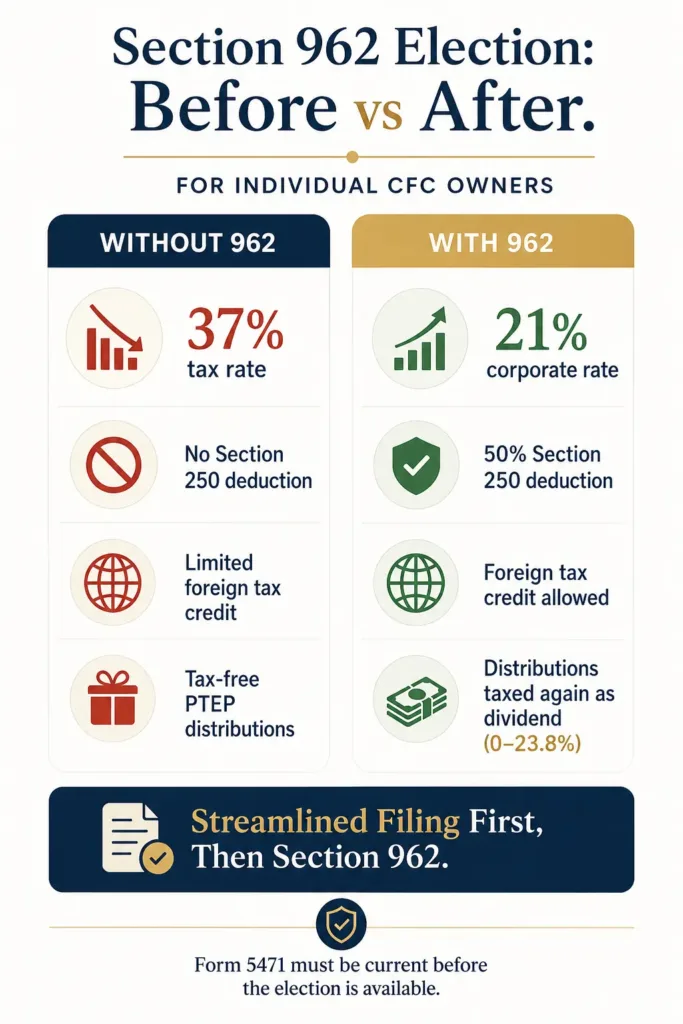
Section 962 is an election that lets individual U.S. shareholders of a Controlled Foreign Corporation (CFC) pay tax on GILTI and Subpart F inclusions at the 21% corporate rate instead of the 37% individual rate. The catch: when the CFC later distributes those earnings, you get taxed again as a qualified dividend. For prior unfiled years, Section 962 planning often runs through the Streamlined Filing Compliance Procedures to bring Form 5471 current without the full $10,000-per-year penalty stack.
Why GILTI Hits Individual CFC Owners So Hard?
GILTI (Global Intangible Low-Taxed Income) applies to U.S. shareholders who own 10% or more of a Controlled Foreign Corporation. The IRS taxes you on the CFC’s active income above a 10% return on its tangible assets, even if the company never sends you a dollar.
C corporations cut that pain roughly in half through the Section 250 deduction. Individuals do not get it by default. You pay ordinary income rates on phantom income, with limited foreign tax credit relief. That gap is what Section 962 was built to address.
What a Section 962 Election Actually Does?
Section 962 lets an individual U.S. shareholder of a CFC elect to be taxed as if they were a domestic C corporation, but only with respect to GILTI and Subpart F inclusions from that CFC.
Three things change when you make the election:
- The 21% corporate rate replaces the 37% individual rate on the inclusion
- You can claim a foreign tax credit for taxes the CFC paid abroad
- C corporations get the 50% Section 250 deduction on GILTI; the election extends that benefit to you
The result: a 37% individual hit can drop to an effective rate near 10.5% before foreign tax credits, depending on the facts.
The Tax Rate Arbitrage at a Glance
| Item | Without 962 Election | With 962 Election | Measurement |
| Tax rate on GILTI inclusion | Up to 37% | 21% corporate rate | Marginal rate |
| Section 250 deduction (50% of GILTI) | Not available | Available | Deduction |
| Foreign tax credit on CFC’s foreign taxes | Limited | Allowed | Credit |
| Tax on later distribution from CFC | Treated as PTEP, no second tax | Dividend (0 to 23.8%) | Effective rate |
| Annual election required | N/A | Yes | Filing burden |
The arbitrage looks clean on paper. The execution is where it falls apart.
The Distribution Trap Nobody Warns You About
Here is the part most DIY filers miss.
Without a 962 election, your GILTI inclusion creates “previously taxed earnings and profits” (PTEP). When the CFC distributes that money later, it comes out tax-free as a return of already-taxed income.
With a 962 election, the PTEP balance is limited to the U.S. tax actually paid at the corporate rate. The rest of the distribution is taxed again as a dividend (0%, 15%, or 23.8% depending on treaty status and holding rules).
You trade a 37% upfront hit for a 21% upfront hit plus a backend hit. The election pays off when foreign taxes are high enough that the foreign tax credit absorbs most of the corporate-rate tax, or when distributions are deferred long enough for time value to matter.
What This Looks Like in Real Numbers?
Assume a CFC earns $500,000 in tested income, holds $200,000 in tangible assets, and pays foreign tax at 15%.
- QBAI return (10% of $200K): $20,000
- GILTI inclusion: $480,000
- Without 962: $480,000 at 37% equals $177,600 federal tax. No foreign tax credit. No Section 250 deduction.
- With 962: $480,000 minus 50% Section 250 deduction equals $240,000 at 21%, or about $50,400. Subtract roughly $57,600 in foreign tax credit. Net U.S. tax: near zero in year one.
The math reads like a no-brainer. Five years later the CFC distributes the earnings, and the dividend is taxed again at up to 23.8%. The comparison shifts. The right answer depends on distribution timing, foreign tax rate, and state exposure.
Common Mistakes That Wreck a 962 Election
- Making the election without modeling the future distribution tax
- Forgetting that the election must be made annually on a timely filed return with a complete Section 962 statement attached
- Skipping the E&P pool tracking the election creates (a separate PTEP account just for 962 earnings)
- Assuming the election covers Subpart F automatically without including it in the statement
- Missing state-level treatment (most states do not conform to Section 962, so you may still pay full state tax on the inclusion)
- Making the election on a delinquent return without first resolving prior-year Form 5471 noncompliance
That last one is where streamlined filing enters the picture.
Where Streamlined Filing Fits In?
If you owned a CFC for years and never filed Form 5471, you cannot just attach a Section 962 election to a current-year return and call it done. The $10,000-per-year penalty sits on every open year, and the statute of limitations on those tax returns never started running because the form was never filed.
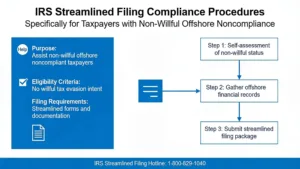
The Streamlined Filing Compliance Procedures provide a structured way to file the missing 5471s for the prior three years, amend or file the corresponding 1040s, and pay any tax due, without the automatic $10,000 penalty stack. Domestic or foreign track depends on your residency during the noncompliance period.
For background on how the streamlined penalty framework actually works, see our breakdowns on streamlined domestic penalties, FBAR penalty exposure under streamlined, and Form 8938 streamlined treatment. If a foreign trust sits anywhere in the structure, Form 3520 penalty exposure is a separate analysis you cannot skip.
Once the prior years are cleaned up through streamlined, the 962 election becomes available going forward on a current, compliant return.

Conversational Queries This Article Answers
- “I own a foreign company and just learned about GILTI. Can I cut the tax?”
- “Should I make a Section 962 election for my CFC?”
- “Does a 962 election still help if I plan to take distributions in a few years?”
- “I never filed Form 5471. Can I make a 962 election retroactively?”
- “Do states honor the Section 962 election?”
If any of those sound like questions you have asked yourself, the answer almost always involves multi-year modeling, not a single-year snapshot.
Bringing the Filing Current
A Section 962 election is a planning tool, not a cleanup tool. It cannot fix unfiled 5471s. It cannot reduce penalties already assessed. And it does not work in isolation. The E&P tracking, PTEP accounts, foreign tax credit pools, and Section 250 deduction all interact.
If you have unfiled CFC reporting, the sequence is clear: resolve back-year noncompliance first through the streamlined procedures, then evaluate Section 962 for current and future years. A Form 5471 CPA filing engagement handles that sequencing, including the schedule preparation, E&P reconstruction, and 962 modeling that must happen before the election decision is made.