Skip to content

GILTI (Global Intangible Low-Taxed Income), renamed NCTI under the 2026 One Big Beautiful Bill Act, taxes U.S. shareholders on their share of a Controlled Foreign Corporation’s income above a deemed return on tangible assets, even when no distribution is made. Individual shareholders face the full ordinary income rate (up to 37%) on this phantom income. For taxpayers with unreported GILTI inclusions tied to prior year CFC ownership, the IRS Streamlined Filing Compliance Procedures may allow correction at substantially reduced penalty exposure compared to standard delinquent filing under Section 6038(b). If a foreign accountant kept the company’s books and never raised GILTI, whether that reliance holds up is the question I would look at next.
What GILTI Actually Is?
GILTI is a U.S. tax on income a CFC earned but never distributed to the U.S. shareholder.
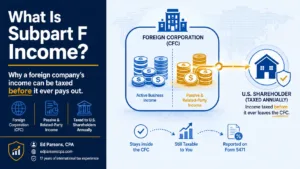
When the Tax Cuts and Jobs Act of 2017 created GILTI, it ended indefinite deferral on most active foreign income. U.S. shareholders are now taxed annually on CFC earnings whether or not the CFC pays a dividend.
The mechanics matter. GILTI is not a tax on dividends. It is a tax on income the U.S. shareholder is deemed to have received whether or not the CFC sent any cash.
The Math: Why a 100% Owner Owes Tax on $480K of Phantom Income
Consider a U.S. taxpayer who owns 100% of a software company in Estonia.
- CFC tested income: $500,000
- CFC’s qualified business asset investment (QBAI): $200,000
- 10% return on QBAI: $20,000
- GILTI inclusion: $500,000 – $20,000 = $480,000
That $480,000 is taxed to the U.S. shareholder in the current year. No distribution required. No cash needed to leave Estonia.
For an individual without a Section 962 election, federal tax at the top rate runs roughly $480,000 x 37% = $177,600, plus state tax in many jurisdictions. The Estonian corporation has not paid a dividend. The U.S. shareholder owes the IRS regardless. The election that can bring an individual’s rate down is weighed in the Section 962 election, and the older anti-deferral rule GILTI sits beside is explained in what Subpart F income is.
Why Individuals Get Hit Harder Than C Corporations?
The rate gap is built into the statute.
A C corporation claims the Section 250 deduction (50% through 2025; 40% from 2026 under OBBBA), bringing the effective rate to 10.5%, rising to 12.6% in 2026. C corporations also claim a foreign tax credit for 80% of foreign taxes paid (90% from 2026).
Individuals get none of that by default. They pay full ordinary rates with no Section 250 deduction and no direct FTC on GILTI. The Section 962 election lets individuals elect corporate rates (21%) and claim the deduction and FTC, but distributions of the previously-taxed E&P later become taxable again as dividends.
Why does a person pay more on the same income than a company would? It is the question I get most from individual shareholders, and one of my five emails answers it properly: the deduction that softens this for a corporation does nothing for an individual by default, and the election that fixes that brings costs of its own. The rest of the series is about how the inclusion gets measured before any rate is applied to it. Start the series. Confirm your address and it begins. Unsubscribe on every email.
How the 2026 NCTI Changes Affect the Calculation?
The One Big Beautiful Bill Act renamed GILTI to NCTI (Net CFC Tested Income) for tax years beginning in 2026.
| Item | GILTI Through 2025 | NCTI From 2026 | Measurement |
| QBAI deduction | 10% return on tangible assets | Eliminated | $0 QBAI shelter |
| Section 250 deduction | 50% | 40% | 10-point reduction |
| Effective C corp rate | 10.5% | 12.6% | 2.1-point increase |
| FTC haircut on foreign taxes | 20% | 10% | More FTC usable |
| Individual default rate (no 962) | Up to 37% | Up to 37% | Unchanged |
Pre-2026 GILTI inclusions follow the old rules. Post-2026 NCTI inclusions follow the new rules. Old PTEP layers retain their character.
Conversational Questions From CFC Owners
- “My CFC earned $300K but I took zero distributions. The IRS still wants tax on that?”
- “I file as a sole proprietor. Does GILTI apply to me even though I am not a corporation?”
- “Why did my accountant skip Schedule I-1 every year? Was that wrong?”
- “I paid Estonia 20% in corporate tax. Can I use that against my U.S. GILTI tax?”
Common GILTI Mistakes That Create Penalty Exposure
- Treating GILTI as something only C corporations deal with, ignoring it as an individual CFC shareholder
- Skipping Schedule I-1 entirely and reporting only the CFC’s distributions
- Calculating QBAI off book value rather than adjusted basis at U.S. tax depreciation rates
- Missing the Section 962 election in years where it would have substantially reduced the tax
- Failing to track GILTI inclusions as PTEP on Schedule J for future distribution sheltering
- Ignoring the high-tax exception election under Reg. 1.951A-2(c)(7) where applicable
- Filing Form 8992 without the supporting Schedule I-1 detail from each CFC
Why Schedule I-1 Errors Compound?
Schedule I-1 of Form 5471 calculates each CFC’s contribution to your GILTI inclusion. Form 8992 then aggregates those numbers across all CFCs you own.
When Schedule I-1 is wrong, Form 8992 is wrong. When Form 8992 is wrong, your Form 1040 GILTI inclusion is wrong. The error rolls into Schedule J’s PTEP layers, and future distributions get characterized incorrectly.
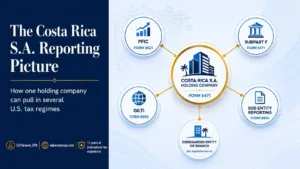
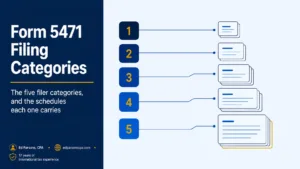
For how Schedule J tracks PTEP from GILTI, see Unreported CFC Earnings and Profits Problems and Streamlined Filing. For how wrong category filings cascade across schedules, see Filed the Wrong Form 5471 Category? Streamlined Filing May Help. For the underlying Section 6038(b) penalty structure, see Unreported Foreign Corporation Ownership and Streamlined Filing.
How Streamlined Filing Helps With Unreported GILTI?
For taxpayers whose GILTI inclusions were not reported in prior years and whose non-compliance was non-willful, the Streamlined Filing Compliance Procedures allow corrected returns and Form 5471s to be submitted as a coordinated package covering three years of returns and six years of FBARs.
Unreported GILTI is added to taxable income for each covered year, with tax and interest assessed but the Section 6038(b) penalty waived. SFOP carries no miscellaneous offshore penalty. SDOP applies 5% on the highest year-end aggregate balance.
Without streamlined relief, the standalone Form 5471 penalty runs $10,000 to $60,000 per form per year, before tax, interest, and accuracy-related penalties on the unreported income.
For a structured engagement, see Form 5471 CPA Filing or the broader Streamlined Filing CPA Package.

GILTI and Streamlined Filing FAQs

Next Step
If your prior returns missed GILTI inclusions and the facts support non-willful failure, a streamlined correction usually produces the lowest total exposure. The starting point is a CFC-by-CFC tested income rebuild, QBAI calculation for pre-2026 years, and a Section 962 analysis.
For a complete engagement, see Form 5471 CPA Filing. For the broader streamlined package, see Streamlined Filing CPA Package.
External references: IRS Instructions for Form 8992 (GILTI) and IRS Instructions for Form 5471.