Skip to content

By Ed Parsons, CPA [Updated May 2026]
Short answer: Kwong is a recent federal court decision that may affect certain IRS penalties and interest tied to the COVID-era federal disaster period. The National Taxpayer Advocate has warned that relief will not be automatic and that many taxpayers may need to file a timely claim, generally by July 10, 2026, often using IRS Form 843.
If you paid IRS penalties or interest, received an IRS penalty notice, filed late returns, or dealt with older IRS account problems during the COVID-era period, your tax history may deserve a second look.
That does not mean the IRS automatically owes you money.
It means there may be a limited window to review whether prior penalties, interest, or abatement opportunities should be preserved through a formal claim.
For taxpayers with international tax history, the issue can be even more important. Foreign reporting penalties, late international forms, Streamlined Filing issues, foreign trust filings, foreign-owned U.S. LLC filings, and foreign account reporting problems often create IRS penalties that are easy to forget about until a new development makes the old account history relevant again.
What is the Kwong issue?
Kwong is a recent federal court ruling involving how federal tax deadlines, penalties, and interest may have been affected by the COVID-era federal disaster period.
The practical issue is simple: some taxpayers may have been assessed or charged penalties or interest during a period when the court’s reasoning suggests certain deadlines may have been postponed.
The National Taxpayer Advocate has stated that if the Kwong decision ultimately holds up, affected taxpayers may be entitled to refunds of penalties or interest already paid, or abatements of penalties or interest that have not yet been paid.
That is why the issue matters.
But it is also why taxpayers should be careful. A court ruling does not automatically clean up your IRS account. Your actual IRS transcript history, penalty codes, payment timing, tax periods, and filing history still need to be reviewed.
Why July 10, 2026 may matter
The National Taxpayer Advocate has warned that many taxpayers may need to file claims by July 10, 2026, generally using Form 843, Claim for Refund and Request for Abatement. The Advocate has also stated that relief will not be automatic.
In a later update, the National Taxpayer Advocate explained that taxpayers may generally need to file Form 843, write language such as “Protective Refund Claim Pursuant to Kwong Case” across the top, and in many cases file separate Forms 843 for each tax period and each type of tax.
That does not mean every taxpayer should rush to file a form without review.
It means the deadline should not be ignored if you had IRS penalties, interest, or older account activity during the affected period.
Why this may matter for international taxpayers
International tax filings can create large IRS penalties when forms are filed late, filed incorrectly, or missed entirely.
The IRS lists international information reporting penalties connected to forms such as Form 5471, Form 5472, Form 8865, and other foreign reporting obligations. For example, Form 5471 failures may trigger a $10,000 penalty, while Form 5472 failures may trigger a $25,000 penalty.
That is why Kwong may be especially relevant for taxpayers with a history involving:
- foreign corporations
- foreign-owned U.S. LLCs
- foreign partnerships
- foreign trusts
- foreign gifts or inheritances
- foreign bank or brokerage accounts
- missed FBAR or Form 8938 reporting
- PFIC or foreign fund issues
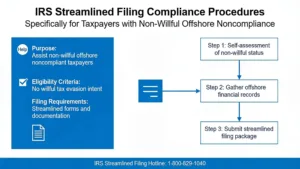
- Streamlined Filing Compliance Procedures
- prior IRS international penalty notices
If you previously had foreign accounts, you may also want to review how FBAR and Form 8938 can create separate reporting issues. If your history involved foreign trusts or foreign distributions, a missed Form 3520 foreign trust filing may create a separate penalty concern.
Kwong does not replace those rules. It simply creates a reason to look again at the IRS account history.
What needs to be reviewed before assuming anything
The starting point is usually not your memory of what happened.
The starting point is the IRS record.
IRS transcripts may show filing history, payments, refund activity, penalties, interest, adjustments, notices, balances, and other IRS account activity. That matters because a taxpayer may remember filing a return, but the IRS account may show penalty assessments, interest activity, late filing indicators, payments, reversals, or unresolved balances.
For a broader explanation, see how IRS transcripts can reveal refunds, penalties, and filing problems.
A proper Kwong review should generally consider:
- which tax periods are involved
- whether penalties or interest were assessed
- whether penalties or interest were paid
- whether the issue involves income tax, employment tax, international penalties, or another category
- whether a prior abatement request was filed
- whether the IRS account still shows a balance
- whether the taxpayer filed late, paid late, amended, or entered a payment plan
- whether any international forms were filed late, missing, or penalized
- whether a protective claim may be appropriate
This is also why a transcript-only review is not always enough. A CPA may need to connect the IRS transcript activity to the actual returns, notices, foreign reporting forms, and prior filing history. See what a CPA can find in your IRS transcripts – or Understand Kwong Protective Claims, Form 843, and IRS Transcript Review

What Kwong does not mean
Kwong does not mean:
- every taxpayer qualifies
- every penalty is refundable
- every interest charge can be removed
- the IRS will automatically issue refunds
- taxpayers should file claims without checking the account
- old international tax problems disappear
- a protective claim guarantees a result
The IRS says Form 843 is used to claim a refund or request an abatement of certain taxes, penalties, additions to tax, interest, and fees.
That makes Form 843 relevant, but it does not answer the taxpayer’s real question: does my specific IRS account history support a claim?
That question requires review.
Why old IRS penalties can become relevant again
Many taxpayers move on after an IRS penalty is paid, abated, denied, or left sitting in the account.
But old IRS history can matter again when there is a legal development, refund claim window, abatement opportunity, or transcript issue that changes the analysis.
This is especially true for international taxpayers because the IRS account may not tell the whole story by itself. The return, the forms attached to the return, the date the forms were filed, the IRS notice history, and the type of penalty all matter.
For example, a taxpayer who previously dealt with late Form 5472, Form 5471, Form 3520, Form 8938, FBAR-related issues, or Streamlined Filing may not know whether the IRS account contains penalty or interest activity that should now be reviewed.
That is the point of a second look.
Not panic. Not a promise. A review.
What should you do if this may apply to you?
If you had IRS penalties, interest, late filings, international forms, or foreign reporting issues during the COVID-era period, do not assume you qualify.
Also do not assume you do not qualify.
The safer first step is to review the IRS account history, identify whether penalties or interest appear in the relevant periods, and determine whether a protective refund or abatement claim should be considered before the applicable deadline.
For past international tax clients, this is the practical question:
Did your prior filing history include penalties, interest, late international forms, or IRS notices that may be worth reviewing before July 10, 2026?
If yes, the next step is not guessing – Understand Kwong Protective Claims, Form 843, and IRS Transcript Review
Frequently Asked Questions About Kwong and IRS Penalty Reviews
These answers explain why Kwong may matter, why relief is not automatic, and why prior IRS penalties, interest, transcripts, and international filings may need a focused review before the claim window closes.
What is Kwong in simple terms?
Kwong is a recent federal court ruling that may affect how certain IRS penalties and interest were handled during the COVID-era federal disaster period. For taxpayers, the practical issue is whether prior penalties, interest, or IRS account activity should be reviewed before a possible refund or abatement claim window closes.
This does not mean every taxpayer qualifies. It means older IRS account history may deserve a second look.
Official source: National Taxpayer Advocate discussion of Kwong
Does Kwong mean the IRS automatically owes me money?
No. Kwong does not create an automatic refund. Even if the ruling may be relevant, the IRS account still has to be reviewed to determine whether penalties or interest were assessed, whether they were paid, what tax periods are involved, and whether a claim may be appropriate.
The safer approach is to review the IRS record before assuming you qualify or do not qualify.
Official source: National Taxpayer Advocate Kwong update
Why is July 10, 2026 important?
The National Taxpayer Advocate has warned that many taxpayers may need to file a protective refund or abatement claim by July 10, 2026. That does not mean every taxpayer qualifies, but it does mean taxpayers with prior IRS penalties or interest should not ignore the deadline.
If you had IRS penalties, interest, late filings, or international tax penalties during the COVID-era period, the deadline is a reason to review the account history now.
Official source: National Taxpayer Advocate July 10 discussion
What is a protective refund claim?
A protective refund claim is generally used when a taxpayer may have a refund claim, but the final legal or administrative outcome is still uncertain. In the Kwong context, a protective claim may help preserve a taxpayer’s rights while the issue continues to develop.
A protective claim still needs to be connected to the correct taxpayer, tax period, tax type, penalty, interest, and IRS account history.
Official source: National Taxpayer Advocate protective claim guidance
What is Form 843 used for?
IRS Form 843 is used to claim a refund or request an abatement of certain taxes, penalties, additions to tax, interest, and fees. For Kwong-related reviews, Form 843 may be relevant if prior penalties or interest appear in the IRS account history.
The form itself is not the strategy. The key issue is whether the IRS record supports filing a claim for the correct period and issue.
Official source: IRS About Form 843
Does Kwong apply only to international tax penalties?
No. Kwong is not limited to international tax penalties. However, taxpayers with international filing history may have larger or more technical penalty issues, including late or missing Forms 5471, 5472, 3520, 3520-A, 8865, 8938, or related foreign reporting problems.
If your prior tax history involved foreign accounts, entities, trusts, gifts, inheritances, or foreign-owned U.S. companies, the IRS account may deserve closer review.
Official source: IRS international information reporting penalties
Why do IRS transcripts matter for a Kwong review?
IRS transcripts can show filing history, penalty assessments, interest charges, payments, adjustments, balances, and other account activity. A taxpayer may not remember every IRS penalty or interest charge from prior years, so the transcript record is usually the starting point for a focused review.
For more context, read how IRS transcripts reveal refunds, penalties, and filing issues .
Can I just file Form 843 myself?
Some taxpayers may choose to file on their own, but the risk is filing for the wrong tax period, wrong type of tax, wrong penalty category, or without reviewing the full IRS account history. That risk increases when international filings, old notices, multiple years, or prior abatement requests are involved.
Before filing anything, it may be worth reviewing what a CPA can identify in the IRS account record. Read what a CPA can find in your IRS transcripts .
Official source: IRS Instructions for Form 843
What kinds of taxpayers should pay closer attention?
Taxpayers should pay closer attention if they had IRS penalties, interest, late returns, missing international forms, foreign entity reporting, foreign trust reporting, Streamlined Filing issues, foreign account reporting problems, or prior IRS notices during the COVID-era period.
This may include taxpayers with prior Form 5471, Form 5472, Form 3520, Form 3520-A, Form 8865, Form 8938, FBAR, PFIC, or Streamlined Filing history.
Official source: IRS international information reporting penalties
What should I do if I think Kwong may apply to me?
Do not assume you qualify, and do not assume you do not qualify. The safer first step is to review your IRS account history, identify any relevant penalties or interest, and determine whether a protective claim or abatement request may be worth considering before the deadline.
If you want a focused review, start with the penalty review .