Skip to content

By Ed Parsons, CPA [Updated May 2026]
Short answer: A CPA-led Kwong penalty review should start with the IRS account record, not assumptions from memory, old tax returns, or a single IRS notice. Before deciding whether a refund claim, protective claim, or abatement request may be appropriate, the review should identify the tax periods involved, penalty assessments, interest charges, payment history, filing dates, prior notices, and whether international information penalties are part of the account history.
If you are still learning the basics, start with What Is Kwong, and Why Prior IRS Penalties May Need a Second Look.
If you already understand the general issue and want to know how protective claims, Form 843, and transcripts fit together, read Kwong Protective Claims, Form 843, and IRS Transcript Review.
This article explains the next question: why the quality of the review matters before a taxpayer decides whether to act.
Kwong is not a magic phrase. Form 843 is not a shortcut. A deadline is not a substitute for analysis.
The real issue is whether the IRS account history supports a claim, abatement request, or no action at all.
Why guessing is risky in a Kwong penalty review
A taxpayer may remember receiving an IRS notice, paying a penalty, filing late, or resolving an old balance. But memory is not enough to determine whether a Kwong-related review makes sense.
IRS account activity can be more complicated than the taxpayer remembers. A penalty may have been assessed in one period, paid in another, adjusted later, partially abated, or mixed with interest and other account activity.
That is why guessing can create two opposite problems.
The taxpayer may fail to file a claim when the IRS record shows a real penalty or interest issue worth preserving. Or the taxpayer may file a weak claim that does not match the right period, tax type, or account facts.
Neither outcome is good.
A focused review should reduce both risks.
What the IRS transcript can reveal
The IRS transcript is often the starting point because it can show account activity that may not appear clearly on the taxpayer’s own copy of a return.
In a Kwong-related review, the transcript may help identify:
- when the return was filed
- when payments were posted
- whether penalties were assessed
- whether interest was charged
- whether the IRS later adjusted or reversed amounts
- whether a balance remains unpaid
- whether notices were issued
- whether the account shows refund activity
- whether a prior resolution or payment plan affected the account
For a broader explanation, see how IRS transcripts reveal refunds, penalties, and filing issues.
The transcript is not the whole answer, but it is usually where the review should begin.
Why Form 843 should not be treated as the strategy
IRS Form 843 is used to claim a refund or request an abatement of certain taxes, penalties, additions to tax, interest, and fees.
That makes Form 843 important in many Kwong-related situations.
But Form 843 is not the strategy.
The strategy is determining whether the account history supports a refund claim, protective refund claim, abatement request, or no claim at all.
The National Taxpayer Advocate has explained that taxpayers generally may need to file Form 843, include language such as “Protective Refund Claim Pursuant to Kwong Case,” and, in many cases, file separate Forms 843 for each tax period and each type of tax.
That is exactly why the review matters. The taxpayer needs to know which period, which amount, which tax type, and which account issue is being addressed before filing.
What a CPA should connect before recommending next steps
A good Kwong penalty review should not look at one item in isolation.
The CPA should connect the transcript record to the taxpayer’s broader filing history.
That may include:
- tax returns filed for the affected years
- IRS notices and letters
- payment history
- penalty and interest assessments
- prior abatement requests
- amended returns
- installment agreements or collection activity
- international information returns
- foreign reporting forms and filing dates
This is where professional judgment matters.
The question is not merely, “Was there a penalty?”
The better question is:
Does the IRS account history show a penalty, interest charge, payment, or unresolved assessment that should be evaluated before the claim window closes?

Why international tax history makes the review more sensitive
International tax penalties can be large, technical, and separate from the income tax shown on the return.
A taxpayer may have had no additional income tax due but still received a penalty for a late, missing, incomplete, or disputed foreign information return.
The IRS lists international information reporting penalties connected to forms such as Form 5471, Form 5472, Form 8865, and related filings. The IRS states that Form 5471 failures may trigger a $10,000 penalty and Form 5472 failures may trigger a $25,000 penalty. IRS international information reporting penalties
That is why taxpayers with prior international tax issues should be especially careful before assuming Kwong does or does not matter.
Relevant history may include:
- foreign corporations
- foreign-owned U.S. LLCs
- foreign partnerships
- foreign trusts
- foreign gifts or inheritances
- foreign bank or brokerage accounts
- Form 5471, Form 5472, Form 3520, Form 3520-A, Form 8865, or Form 8938 issues
- FBAR-adjacent problems
- PFIC or foreign fund reporting
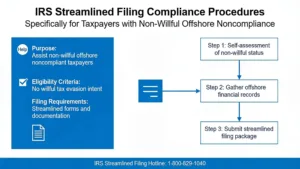
- Streamlined Filing Compliance Procedures
If your foreign account history involved both FBAR and FATCA issues, review how FBAR and Form 8938 can create separate reporting duties. If your history involved foreign trusts, foreign gifts, or distributions, see the guide on Form 3520 penalties and foreign trust reporting.
These issues can affect how the IRS account should be interpreted.
What a focused CPA review should accomplish
A focused CPA review should not promise an outcome before the account is reviewed.
It should answer practical questions:
- Did the IRS assess penalties during a potentially relevant period?
- Did the IRS charge interest connected to those penalties or balances?
- Were those penalties or interest paid?
- Does the IRS still show an unpaid balance?
- Which tax years and tax types are involved?
- Were any international information penalties involved?
- Were prior abatement requests filed?
- Are there notices or transcript entries that require deeper review?
- Is a refund claim, protective claim, abatement request, or no action more appropriate?
The purpose is clarity.
A taxpayer should come away understanding whether there appears to be a claim worth considering, whether more work is needed, or whether the account does not appear to support action.
Why this should not feel like a tax relief sales pitch
A legitimate Kwong review should not sound like “the IRS owes you money.”
It should not promise a refund.
It should not imply that every old penalty qualifies.
It should not treat Form 843 as a one-size-fits-all solution.
The better framing is more careful:
Your IRS account history may deserve review before the claim window closes.
That is a trust issue. Taxpayers with old penalties, international filings, or multiple years of IRS activity need sober analysis, not hype.
When a CPA-led Kwong review is especially worth considering
A CPA-led review is especially worth considering if any of the following apply:
- you paid IRS penalties or interest during the COVID-era period
- the IRS assessed penalties that remain unpaid
- you received IRS penalty notices
- you filed late returns
- you entered a payment plan
- you had prior penalty abatement requests
- you filed amended returns
- you had international reporting penalties
- you used Streamlined Filing Compliance Procedures
- you are not sure what your IRS account transcripts show
This does not mean you qualify.
It means the account may be worth reviewing before the deadline.
What happens after the review?
A proper review should lead to one of several possible conclusions.
One possibility is that the IRS account shows a potential refund claim, protective claim, or abatement issue worth considering.
Another possibility is that more information is needed, such as IRS notices, return copies, payment records, or foreign reporting forms.
A third possibility is that the account does not appear to support a meaningful claim.
That last outcome still has value. It helps the taxpayer avoid filing unnecessary or unsupported paperwork.
The review should not manufacture a claim. It should identify whether the account history supports one.
The next step: start with the record
Start With the IRS Account Record
Before deciding whether a Kwong-related claim, abatement request, or follow-up strategy may be worth considering, the first step is reviewing what the IRS account actually shows.
If you had IRS penalties, interest, late filings, old IRS notices, international forms, or foreign reporting issues during the COVID-era period, do not decide based only on memory.
A focused review starts with IRS transcripts, penalty and interest activity, payment history, filing records, and the surrounding tax context.
Frequently Asked Questions About CPA-Led Kwong Penalty Reviews
These answers explain why a Kwong-related penalty review should begin with IRS transcripts, account history, penalty and interest records, and international filing context before deciding whether a claim or abatement request may be appropriate.
Why should a Kwong penalty review start with IRS transcripts?
IRS transcripts can show account activity that may not be obvious from a taxpayer’s own copy of a return. That may include filing dates, payment dates, penalty assessments, interest charges, adjustments, reversals, balances, notices, and other IRS transaction history.
For more context, read how IRS transcripts reveal refunds, penalties, and filing issues .
Does a CPA-led Kwong review guarantee a refund?
No. A CPA-led Kwong review does not guarantee a refund, penalty removal, interest abatement, or IRS outcome. The purpose of the review is to identify what the IRS account history shows and whether a refund claim, protective claim, abatement request, or no action appears appropriate based on the facts.
A legitimate review should not promise that the IRS owes you money before the account is reviewed.
What can a CPA see in IRS transcripts that I might miss?
A CPA may identify penalty assessments, interest charges, payments, reversals, amended return activity, balances, filing gaps, prior adjustments, and notice history. The CPA can also connect transcript entries to returns, IRS notices, foreign reporting forms, and prior abatement requests.
For a deeper explanation, read what a CPA can find in your IRS transcripts .
Why not just file Form 843 myself?
Some taxpayers may choose to file on their own, but Form 843 is not the strategy by itself. The issue is whether the IRS account supports a refund claim, protective claim, abatement request, or no claim at all.
Filing without reviewing the account can lead to the wrong tax period, wrong tax type, wrong penalty category, or an unsupported claim.
Official source: IRS About Form 843
What does a focused Kwong penalty review check?
A focused review should check which tax periods are involved, whether penalties were assessed, whether interest was charged, whether amounts were paid, whether a balance remains, whether prior abatement requests were filed, and whether international information penalties or foreign reporting issues are part of the history.
The goal is clarity before deciding whether any further action is worth considering.
Why does international tax history make the review more sensitive?
International information penalties can be large and separate from the income tax shown on the return. A taxpayer may have no additional income tax due but still receive a penalty for a late, missing, incomplete, or disputed foreign information return.
This may involve Form 5471, Form 5472, Form 3520, Form 3520-A, Form 8865, Form 8938, FBAR-adjacent issues, PFIC reporting, or Streamlined Filing history.
Official source: IRS international information reporting penalties
What happens if the review shows no useful Kwong claim?
That outcome still has value. If the IRS account does not appear to support a meaningful claim, the taxpayer may avoid filing unnecessary or unsupported paperwork.
The purpose of the review is not to manufacture a claim. It is to determine whether the account history supports one.
What happens if the review shows a possible claim?
If the review shows a possible claim, the next step may be to evaluate whether a refund claim, protective refund claim, abatement request, or additional professional work is appropriate. The exact next step depends on the tax periods, tax type, amount paid or unpaid, IRS notices, and account history.
A review should help identify the path, but it should not promise a result before the IRS responds.
When is a CPA-led Kwong review especially worth considering?
A CPA-led review is especially worth considering if you paid IRS penalties or interest, had unpaid penalty assessments, received IRS penalty notices, filed late returns, entered a payment plan, requested prior abatement, filed amended returns, had international reporting penalties, used Streamlined Filing Compliance Procedures, or are unsure what your IRS transcripts show.
This does not mean you qualify. It means the account may deserve review before the claim window closes.
What should I read before requesting a CPA-led review?
If you are new to the issue, start with What Is Kwong, and Why Prior IRS Penalties May Need a Second Look .
If you want to understand how claims, Form 843, and transcripts fit together, read Kwong Protective Claims, Form 843, and IRS Transcript Review .