 Skip to content
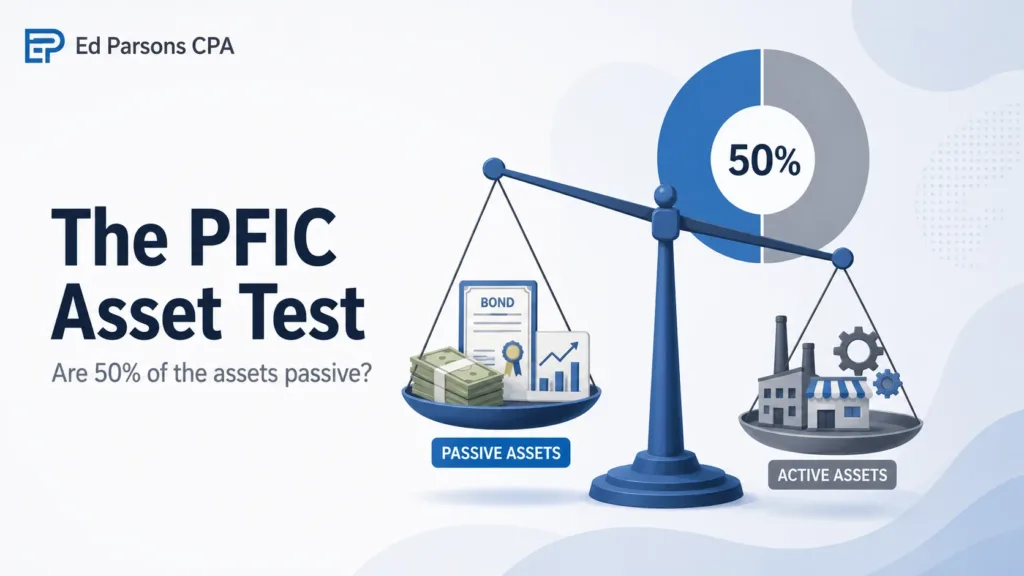
The PFIC asset test asks whether, on average across the year, at least 50% of a foreign corporation’s assets are passive, meaning they produce passive income or are held to produce it. Cash, stocks, bonds, and similar holdings count as passive. If the answer is yes, the company is a PFIC, even if it would pass the separate income test.
The asset test is the second of the two ways the IRS classifies a foreign company as a PFIC. The income test looks at the income statement, while the asset test looks at the balance sheet, and meeting either one alone is enough.
If you have not seen the bigger picture yet, the overview of what a PFIC is sets the stage, and the PFIC income test covers the other half of the analysis.
The 50% threshold sounds forgiving, but the way assets are valued and averaged is where companies get caught. The cash on a balance sheet is often the deciding factor.
What the Asset Test Measures
The test compares passive assets to total assets, measured as an average across the year. The numerator is the average value of passive assets, and the denominator is the average value of all assets.
Two points shape everything that follows. The threshold is 50%, and the figure is an average, not a single snapshot, because assets are measured at several points during the year.
- Threshold: 50% of average assets.
- Measured: at quarter-end dates, then averaged.
- Tested: each tax year on its own.
- Effect: meeting this test alone makes the company a PFIC.
The Calculation, Step by Step
- Value the company’s assets at each measuring date during the year.
- Identify which of those assets are passive.
- Average the passive assets and the total assets across the measuring dates.
- Divide average passive assets by average total assets, then compare to 50%.
On paper it is one division again. The difficulty lives in the first two steps, because the valuation method is not always your choice, and the definition of a passive asset is broader than most people expect.
For a listed foreign company, those first two steps start from numbers that are already public. The PFIC Analyzer works from the company’s public filings and runs the asset test, with the income test beside it, for each fiscal year you held the shares, which is a quick way to see whether a stock you own sits anywhere near the 50% line. A private company is a different job, especially one that is also a CFC and must use adjusted basis: its balance sheet is not public, and the valuation rule below can flip the answer.
Fair Market Value or Adjusted Basis?
The valuation method is not optional. It depends on the company, and it can flip the result. The Form 8621 instructions set out the rule:
- Publicly traded foreign corporation: fair market value.
- Not publicly traded and a CFC: adjusted basis is required.
- Not publicly traded and not a CFC: fair market value by default, with an option to elect adjusted basis.
Why this matters: the same balance sheet can pass under one method and fail under the other. Self-created intangibles often carry little or no tax basis, so under the adjusted-basis method an active company’s real value can disappear from the math, leaving cash and investments to dominate and tip the company into PFIC range.
What Counts as a Passive Asset, and the Cash Trap
A passive asset is one that produces passive income or is held to produce it. The category is wider than it sounds:
- Cash and cash equivalents, the most common surprise.
- Stocks, bonds, and other securities held for investment.
- Assets held to earn interest, dividends, rents, or royalties.
- Holdings that produce no income but are kept for future passive use.
Cash is the classic trap. A startup or holding company sitting on a recent funding round can meet the asset test purely because that cash counts as passive, no matter how the company intends to spend it later.
The 25% Look-Through Rule
The same look-through rule from the income test applies to the balance sheet. If the company owns at least 25% by value of another corporation, it counts its proportionate share of that company’s assets.
A holding company with an active operating subsidiary can stay out of PFIC status this way, while a passive subsidiary pulls it in. The table below places the asset test next to the income test so the two are easy to compare.
| Feature | Asset Test | Income Test |
| What it measures | Share of assets that are passive | Share of gross income that is passive |
| Threshold to meet | 50% of average assets | 75% of gross income |
| Measuring basis | Fair market value or adjusted basis | Gross income for the year |
| How measured | Quarterly values, then averaged | Total income for the year |
| Measurement: result if this test alone is met | Classified as a PFIC | Classified as a PFIC |
Either test is enough on its own, so passing the income test does not protect a cash-heavy company under the asset test.
Most people who land on this page are not testing a company balance sheet, they are trying to work out whether an ordinary foreign fund they own is caught. If that is you, my PFIC email series answers the question from the investor’s side rather than the accountant’s. It runs to five emails and asks only for an email address: both tests, why they are measured on the fund’s numbers and not yours, what the default regime costs a long-held position, and how the QEF and mark to market elections are constrained by timing and by what the fund will hand you. A confirmation email arrives before any of it, and the series waits until you click. Unsubscribe whenever.
Common Mistakes
- Treating cash as a neutral asset rather than a passive one.
- Using a single year-end snapshot instead of the quarterly average.
- Applying fair market value when adjusted basis is required.
- Overlooking self-created intangibles that carry little or no basis.
- Skipping the 25% look-through for subsidiaries.
- Stopping at the income test and assuming the asset test agrees.
Questions People Ask
“We are a real operating company, mostly cash from a funding round. Are we safe?”
Often not. A large cash balance counts as a passive asset, so it can push the average past 50% even for a company with active operations and clear plans for the money.
“Can we just measure our assets at year-end?”
No. The test uses an average of values taken during the year, so one clean date does not control the answer.
“Does fair market value always apply?”
No. A foreign corporation that is not publicly traded and is a CFC must use adjusted basis, which can change the result and is easy to get wrong.
Getting the Asset Test Right
Between the valuation method, the quarterly averaging, and the cash trap, the asset test is one of the easiest places to reach the wrong conclusion. The cost of a wrong answer is not abstract, because it decides whether years of filing were required.

Have the balance sheet reviewed. A CPA tax resolution case analysis can confirm whether a company meets the asset test and whether Form 8621 filing is required for the years at issue.
Want a quick first read? Run the holding through the PFIC Analyzer to see how the asset and income tests apply, then return to the PFIC overview for how this fits the full picture.
