Skip to content

By Edward Parsons, CPA | Ed Parsons CPA, Doral, Florida | Representing taxpayers nationwide |
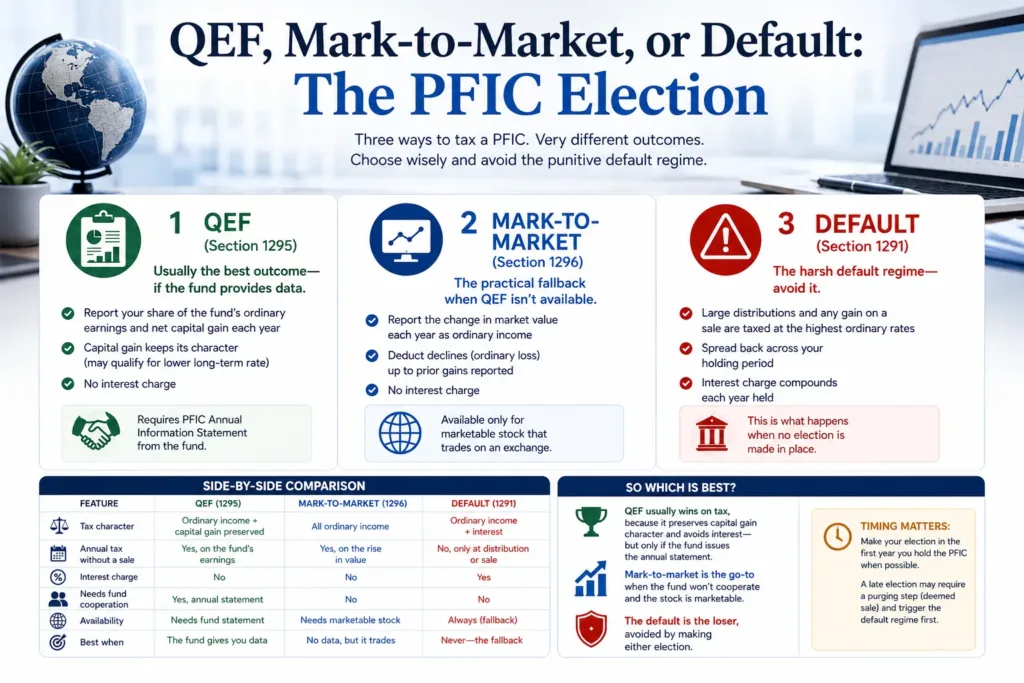
A PFIC can be taxed three ways. The default Section 1291 regime is the harsh fallback. A QEF election usually gives the best result, taxing you each year on the fund’s earnings while preserving capital gain character, but it needs the fund to provide an annual statement. A mark-to-market election taxes the yearly change in value as ordinary income and works when the fund will not cooperate but trades on an exchange. There is no single best choice. It depends on your fund.
If you own a PFIC, you have a choice to make, or one will be made for you. Do nothing and you land in the harsh default regime. Make an election and you can change how the fund is taxed for the better.
This guide compares the three paths and explains which tends to fit which situation. For the underlying classification, start with the overview of what a PFIC is.
The Default (Section 1291): The One to Avoid
The default is not really a choice. It is simply what happens when no election is in place. It taxes large distributions and any gain on a sale at the highest ordinary rates, spread back across your holding period, with an interest charge layered on top.
There is no capital gains rate anywhere in it, and the interest grows the longer you held the fund. The full mechanics are in the guide on the PFIC excess distribution regime. For most people, the goal is to elect out of it.
QEF (Section 1295): Usually Best, If You Can
A Qualified Electing Fund election is the closest thing to normal investment taxation. You include your share of the fund’s ordinary earnings and net capital gain in income each year, and the capital gain part keeps its character, so it can be taxed at the lower long-term rate. There is no interest charge.
The catch is cooperation. QEF depends on the fund giving you a PFIC Annual Information Statement with the figures you need, and many foreign funds simply do not produce one. No statement, no QEF. It is the best result on paper, but only available when the fund supplies the data.
There is also a cash-flow tradeoff. You are taxed on your share of the fund’s income each year even if the fund distributed nothing, so the tax can arrive before the cash does. For a fund that reinvests rather than pays out, that can mean writing a check for income you have not actually received yet.
Mark-to-Market (Section 1296): The Practical Fallback
A mark-to-market election taxes the change in the fund’s market value each year. If the value rose, you report the increase as ordinary income; if it fell, you can deduct the decrease as an ordinary loss, but only up to the gains you previously reported.
Its big advantage is independence. It does not need the fund to hand you anything, only reliable year-end values, so it works when QEF is off the table. It is available for marketable stock, the kind that trades regularly on an exchange, which covers most foreign ETFs and listed funds.
The downside is character. Everything is ordinary income, with no capital gains rate, and like QEF it taxes you annually even without a sale. It avoids the default regime’s interest charge, which is usually the point. For a fund that climbs steadily, that yearly ordinary-income bill is simply the price of staying out of the far worse default treatment.
Side by side, the three line up like this:
| Feature | Default (1291) | QEF (1295) | MTM (1296) |
| Tax character | Ordinary, plus interest | Ordinary plus capital gain preserved | All ordinary income |
| Annual tax without a sale | No, only at distribution or sale | Yes, on the fund’s earnings | Yes, on the rise in value |
| Interest charge | Yes | No | No |
| Needs fund cooperation | No | Yes, annual statement | No |
| Availability | Always, the fallback | Needs fund statement | Needs marketable stock |
| Measurement: best when | Never, it is the fallback | The fund gives you data | No data, but it trades |
Both elections tax you each year and avoid the interest charge. The default taxes you only when something happens, then punishes the delay.
So Which Is Best?
There is no universal winner, which is why the honest answer is that it depends on your fund. A few rules of thumb hold most of the time.
- QEF usually wins on tax, because it preserves capital gain character and avoids interest, but only if the fund issues the annual statement.
- Mark-to-market is the go-to when the fund will not cooperate and the stock is marketable.
- The default is the loser, avoided by making either election.
Timing matters as much as the choice. Both elections work best when made in the first year you hold the fund. A late election generally requires a purging step, a deemed sale that runs the old default tax first, before the cleaner treatment can begin. Which years are still open, and whether filing was already required, shape what is realistic.
Choosing the Right PFIC Tax Election for Your Situation
Two investors, similar funds, two different best answers.
Anna’s fund issues a PFIC Annual Information Statement. She makes a QEF election, reports her share of the fund’s income each year, and keeps the capital gain portion at the lower long-term rate.
Ben holds a foreign ETF that trades on an exchange but provides no such statement. QEF is not available to him, so he makes a mark-to-market election and reports the yearly rise in value as ordinary income, stepping out of the default regime and its interest charge.
Same kind of investment, opposite elections. What the fund provides, and whether it is marketable, decided it for each of them.
Common Mistakes
- Drifting into the default Section 1291 regime by never choosing.
- Assuming QEF is available without checking whether the fund issues the annual statement.
- Trying a mark-to-market election on a fund that is not marketable.
- Missing the first-year window and triggering a costly purging election later.
- Forgetting that both elections tax you each year, even with no sale and no distribution.
Questions People Ask
“Which PFIC election is best?”
Usually QEF, because it keeps capital gain character and avoids the interest charge, but only if the fund gives you the annual statement. If it does not and the fund is marketable, mark-to-market is the practical choice.
“My fund won’t give me any tax data. What are my options?”
QEF is likely out, since it depends on the fund’s statement. If the stock is marketable, a mark-to-market election is usually the way to step out of the default regime.
“Can I elect now for a fund I’ve held for years?”
You can, but a late election generally requires a purging step that runs the default tax on the built-up gain first, so the timing carries a cost.
Make the Choice on Purpose
Doing nothing is itself a decision, and usually the most expensive one. Choosing between QEF and mark-to-market, and getting the timing right, is where most of the value is won or lost.

Decide with the numbers in front of you.
A CPA tax resolution case analysis can compare the elections for your specific funds and handle the Form 8621 filing that makes the choice official.
Not sure a fund is even a PFIC?
Run it through the PFIC Analyzer first. The IRS covers the elections in the Form 8621 instructions and describes the form on its About Form 8621 page.