Skip to content
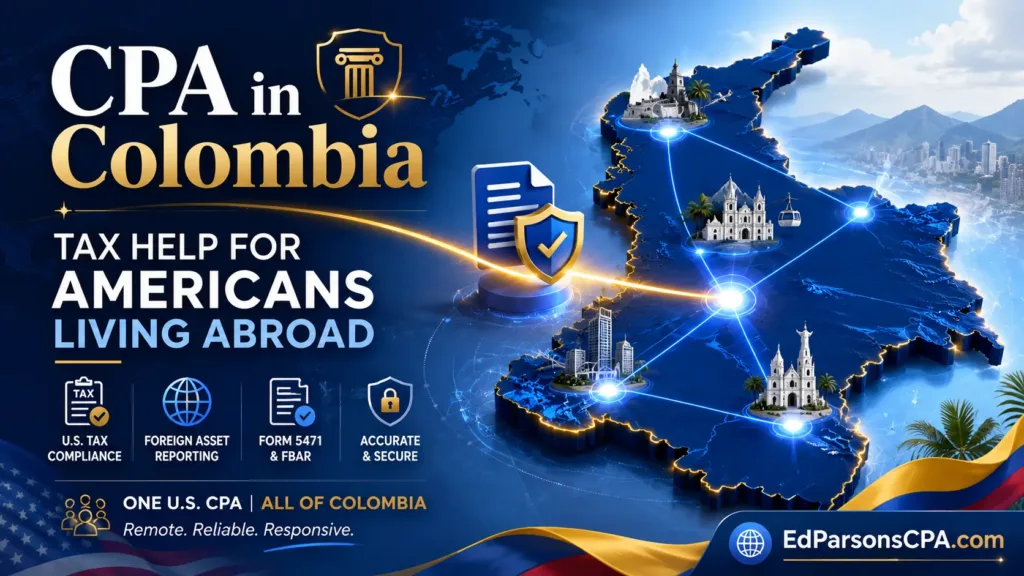
Wherever you live in Colombia, from Bogota to Medellin to the Caribbean coast, your U.S. tax obligations are the same. U.S. citizens and green card holders must keep filing federal returns and reporting foreign accounts no matter where they live, and IRS collections reach across borders. Ed Parsons, CPA represents Americans throughout Colombia remotely, handling the expat return, the FBAR and PFIC side, and IRS problems, nationwide and internationally, in English and Spanish.
Colombia draws Americans to very different places and lives: remote workers in Medellin, professionals in Bogota, retirees along the coast, dual citizens returning to family. The cities differ and the lifestyles differ, but the U.S. tax obligation does not. It follows your citizenship, not your neighborhood, as our guide to U.S. taxes for digital nomads lays out. That is the part that catches people: the move felt like leaving the U.S. tax system behind, when in fact it travels with them.
Quick Facts for Americans Anywhere in Colombia
- U.S. citizens and green card holders file federal returns no matter where in Colombia they live.
- The obligation is the same in Bogota, Medellin, Cartagena, or anywhere else.
- Foreign accounts trigger the FBAR and Form 8938 regardless of your city.
- IRS collections, including liens, levies, and passport revocation, reach you in Colombia.
- Representation is fully remote, nationwide and internationally, in English and Spanish.
- Colombia runs on U.S. Eastern time for much of the year, so scheduling is simple.
The Same U.S. Obligation, Wherever You Are in Colombia
The United States taxes its citizens and permanent residents on worldwide income regardless of where they live. That is the heart of it. Moving to Colombia, or moving between Colombian cities, does not change the federal duty to file and report.
So the three pillars of an American’s U.S. tax life in Colombia look the same from the coast to the capital: a federal return, reporting for foreign accounts, and extra forms if you own a Colombian company or receive from a trust. What changes from person to person is the detail inside each, not whether they apply.
It also does not matter whether you have been in Colombia for six months or six years. The duty begins the moment you have income to report and continues for as long as you hold U.S. citizenship or a green card.
| Your federal return | Foreign accounts | A Colombian company or trust | |
| What it is | Form 1040 with the exclusion or the credit | FBAR and Form 8938 | Form 5471 or Form 3520 |
| Measurement (what triggers it) | Having income while living abroad | Accounts above the reporting thresholds | Owning the company or receiving from the trust |
| Where it applies | Everywhere in Colombia | Everywhere in Colombia | Everywhere in Colombia |
| How it is handled | Remotely | Remotely | Remotely |
The gold row is what brings each pillar into play. Notice the bottom rows: the obligation applies everywhere in the country, and all of it is handled remotely.
Wherever You Live in Colombia
The specifics shift with the kind of life you are living, even though the framework holds. A few common patterns:
- Medellin: digital nomads and remote workers, often with self-employment and the exclusion-versus-credit question. See our U.S. CPA in Medellin page for the city-specific picture.
- Bogota: professionals and business owners, where a Colombian company can bring Form 5471 into the return.
- Cartagena and the Caribbean coast: retirees and second-home owners, with pensions, investments, and property in the mix.
- Cali, the coffee region, and beyond: dual citizens and long-term residents who often need to catch up on past filings.
One CPA as Your Life in Colombia Changes
Life in Colombia is rarely static. People start in Medellin and move to the coast, pick up a Colombian business, marry into a local family, or shift from remote work to retirement. Each of those changes touches the U.S. return in a different way, sometimes adding a form, sometimes changing which election makes sense.
A remote U.S. CPA who already knows your file can carry that continuity across cities and across years, rather than starting over with a new local preparer every time your situation shifts. That continuity is part of what keeps the reporting consistent, the elections coherent, and the history clean if the IRS ever looks back.
What a U.S. CPA Handles
The work is the same set of issues no matter which city you call home. It starts with the federal return and the choice between the exclusion and the foreign tax credit, a real decision in a high-tax country, then extends to the FBAR and Form 8938 for your accounts and PFIC reporting on Form 8621 for local funds.
If you own a Colombian S.A.S., Form 5471 enters the picture, and if there is an IRS balance or notice, the engagement includes the collections side: liens, levies, and passport certification. These forms carry steep penalties and interact with one another, which is why handling them together on one return matters far more than filing each in isolation. It is also work that benefits from the same hand each year, so the exclusion choice, the account reporting, and any company filings line up rather than drift apart over time.
Remote Representation Across Colombia
Here is the honest part. Ed Parsons, CPA is a U.S. CPA based in the Miami and Doral area, not a firm with offices in Colombia. There is no Bogota or Medellin location, and for U.S. tax work there does not need to be. Clients across Colombia and around the world are served the same way: remotely, securely, and completely.
The process is simple. Encrypted client portal (TLS in transit, encrypted at rest), maintained under my written information security plan. Colombia sits on U.S. Eastern time for much of the year, so scheduling a call is easy, and the entire engagement can run in English or Spanish.
If You Are Behind on U.S. Taxes
It is common for Americans in Colombia to realize, sometimes years in, that they have missed FBARs or returns they did not know they owed. There is usually a clean way back. Non-willful taxpayers can frequently catch up through the Streamlined Filing Compliance Procedures, bringing past years current with reduced or no penalties. Coming forward on your own generally puts you in a better position than waiting for the IRS to find the gap, and because the same remote CPA can handle both the catch-up and your future returns, the cleanup does not have to be a one-off scramble.
Before a call is worth scheduling, it helps to have the shape of your situation written down. Send me the details and you get a price rather than a conversation about a price. The things that move the number are the ones it asks about: how many years are open, whether you draw a salary here or run your own operation, which accounts you hold in Colombia and in the United States, and whether you are current or catching up. Colombia sits on Eastern time for most of the year, so once there is something to discuss, arranging it is the easy part.
Common Mistakes Americans in Colombia Make
- Assuming a Colombian accountant handles your U.S. federal return.
- Thinking the rules are different in a smaller city than in Medellin or Bogota. They are not.
- Treating the Foreign Earned Income Exclusion as permission to stop filing.
- Leaving Colombian bank accounts and investments off the FBAR and Form 8621.
- Assuming an IRS notice cannot reach you outside the United States.
- Putting off catch-up filing until a passport or levy problem forces it.
For the official overview of U.S. tax obligations while living abroad and the FBAR rules, the IRS publishes guidance, though neither replaces advice on your own situation.


Work with a U.S. CPA from anywhere in Colombia
Whether you are in Bogota, Medellin, on the coast, or anywhere in between, Ed Parsons, CPA represents Americans across Colombia remotely. Start with a Personal CPA Tax Resolution Case Analysis, or go straight to the Streamlined Filing package if you are catching up.
contact us to get started.
Personal CPA Tax Resolution Case AnalysisIRS Streamlined Filing CPA Package