Skip to content
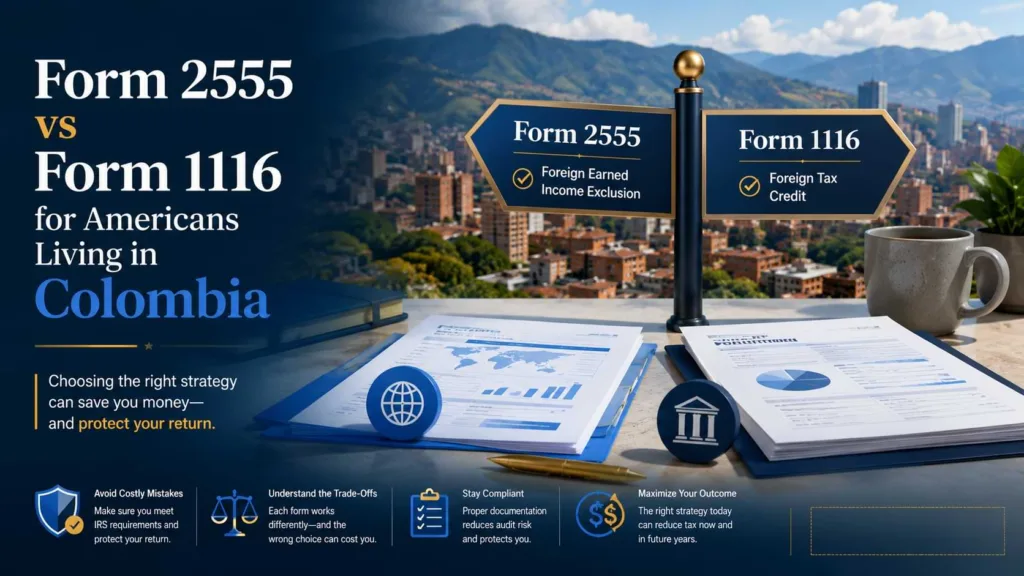
For Americans living in Colombia, choosing between Form 2555 (the Foreign Earned Income Exclusion) and Form 1116 (the Foreign Tax Credit) is not a cosmetic preference. The two work differently, and the wrong choice can do more than cost money. An exclusion claimed without meeting the residence tests, or revoked at the wrong time, is exactly the kind of issue IRS examiners are trained to look for, and a disallowed exclusion turns into back tax, penalties, and collections. Because Colombian tax rates are relatively high, the credit is often the stronger and safer position, but the right answer depends on your facts.
Most expats hear a single piece of advice, use the exclusion to wipe out your U.S. tax, and stop there. For Americans in Colombia that advice is incomplete and sometimes risky. The choice between the exclusion and the credit carries audit and collections exposure that a simple side-by-side misses. For the wider picture, see our guide to U.S. taxes for digital nomads and the tax issues of working remotely from Colombia.
Quick Facts on the Two Forms
- Form 2555 excludes foreign earned income. Form 1116 credits foreign income tax against your U.S. tax.
- The exclusion covers earned income only. The credit covers earned and passive income.
- The exclusion requires a tax home abroad and a residence test. The credit requires foreign tax actually paid.
- An exclusion claimed without meeting the tests can be disallowed on examination.
- Revoking the exclusion generally locks you out for five years without IRS consent.
- Because Colombian tax rates are relatively high, the credit is often the stronger position.
What Each Form Does
The exclusion lets a qualifying expat leave a capped amount of foreign earned income off the U.S. return entirely. The cap is adjusted each year for inflation, and it applies only to earned income such as wages and self-employment, never to dividends, rent, or pension income.
The credit takes a different route. Instead of removing income, it gives you a dollar-for-dollar credit for the foreign income tax you actually paid, against the U.S. tax on that same income. It works for both earned and passive income, and unused credit can carry forward, which matters in a high-tax country.
| Form 2555 (FEIE) | Form 1116 (FTC) | |
| What it does | Excludes foreign earned income up to a yearly limit | Credits foreign income tax against U.S. tax |
| Measurement (what you must prove) | A tax home abroad and a residence test | Foreign income tax actually paid or accrued |
| Income it covers | Earned income only | Earned and passive income |
| If you get it wrong | Disallowed if the tests fail; locked out for years if revoked | Reduced or denied if miscomputed or wrongly sourced |
| Where examiners look | Days abroad, a U.S. abode, and election validity | Proof of tax paid and the income category |
The gold row is the heart of it. The exclusion makes you prove where you lived; the credit makes you prove what you paid. Examiners test each differently.
Why This Is a Risk Decision, Not a Preference
The reason to treat this carefully is what happens when the choice is wrong. The IRS routes international returns and foreign tax credit claims to specialized review under its internal examiner guidance, so these are not returns that quietly slip through. When an exclusion is disallowed, the excluded income comes back onto the return, and the result is back tax, penalties, and interest.
From there it becomes a collections matter. An assessment that goes unpaid can lead to liens, levies, and, for larger balances, passport certification. A decision that felt like a tax-saving shortcut can end up driving the exact enforcement track this firm spends its time unwinding, which is why the choice deserves real analysis up front.
The Residence Tests Are Where It Breaks
The exclusion rests on a tax home abroad plus one of two residence tests: bona fide residence for an uninterrupted period that includes a full tax year, or physical presence for at least 330 full days in a 12-month period. Both sound simple and both trip people up.
In Colombia, the common failures are predictable. A digital nomad who travels often can fall short of 330 days. Someone who moved mid-year may not yet have a qualifying period. And the quiet killer is the U.S. abode: if you keep a home in the States and return to it between trips, examiners can find that your tax home never moved, which sinks the exclusion entirely. These are facts-and-circumstances tests, and they are stricter than the headline numbers suggest.
Understanding IRS Form 2555 vs. Form 1116 Mechanics
Switching strategies is not free. Once you claim the exclusion and then revoke it, you generally cannot elect it again for five years without the IRS’s consent. Taxpayers who flip between the exclusion and the credit year to year, chasing the lower number, can accidentally lock themselves out of the exclusion for years. The election is a commitment, not a setting you toggle, and the timing of a change is a decision in its own right.
Why the Credit Often Wins in Colombia
Colombia taxes residents at rates that are high relative to the U.S., and that single fact reshapes the analysis. When the foreign tax you paid exceeds the U.S. tax on the same income, the foreign tax credit can erase your U.S. tax on that income and leave a carryforward for later years, all without putting a residence test in front of an examiner.
The credit also plays better with the rest of an expat’s return. It covers passive income the exclusion cannot touch, and if you own a Colombian company, it interacts with the GILTI and Subpart F inclusions that a CFC creates. None of this makes the credit automatically correct, but in Colombia it is frequently both the lower-tax and the lower-risk path.
It Interacts With the Rest of Your Return
Neither form is an island. The exclusion does not reduce self-employment tax, a trap for freelancers who assume it wipes out everything. Passive income from Colombian pension and cesantias accounts and from local investment funds needs the credit, not the exclusion, and the same Colombian accounts can trigger the FBAR and Form 8938. The right choice is the one that fits your whole return, not just one line of it.
If You Already Filed It Wrong
If a past return claimed the exclusion without meeting the tests, or left a valuable credit on the table, the exposure is already there, and the open question is how to fix it cleanly. Depending on the facts, that can mean amended returns or, for non-filers, the Streamlined Filing Compliance Procedures. The point is to correct it on your terms, before an examiner reaches the same return first.
Common Mistakes Americans in Colombia Make
- Treating the choice as a simple preference rather than a compliance decision.
- Claiming the exclusion without truly meeting the bona fide residence or physical presence test.
- Keeping a home in the U.S. and assuming the tax home test is still met.
- Revoking the exclusion without realizing it locks you out for years.
- Using the exclusion and assuming it also reduces self-employment tax. It does not.
- Trying to credit foreign tax on income already excluded under the exclusion.
- Defaulting to the exclusion when the credit would both lower tax and reduce exam exposure.


Get the 2555 vs 1116 decision right
The exclusion and the credit are not interchangeable, and the wrong call carries exam and collections risk. Ed Parsons, CPA prepares both Form 2555 and Form 1116, and determines which one actually protects you in Colombia.
Form 2555 Foreign Earned Income Exclusion FilingForm 1116 Foreign Tax Credit Filing