Skip to content

A resale or exemption certificate lets a buyer purchase tax-free, but in Florida the burden of proof falls on the seller. Every sale is presumed taxable unless the seller obtains and keeps valid documentation, so if you accept a certificate that is expired, mismatched, or unverified, the Department can hold you, the seller, liable for the tax that should have been collected, plus penalties and interest. Florida gives sellers three approved ways to document an exempt sale, and using one of them in good faith is what protects you.
A resale certificate looks like the buyer’s document, but it really exists to protect the seller. When you accept one, you are claiming a sale was exempt, and Florida expects you to be able to prove it. Get that wrong and the tax becomes your problem, not the buyer’s. This article covers how the certificates work and the mistakes that put sellers on the hook. For the wider context, see our complete guide to Florida sales and use tax.
Certificates at a Glance
- In Florida, the seller carries the burden of proving a sale was tax-exempt.
- A sale is presumed taxable unless the seller documents the exemption.
- Resale certificates expire on December 31 each year and must be current.
- The Department gives sellers three approved ways to document a resale sale.
- An expired, mismatched, or unverified certificate can make the seller liable for the tax.
How Resale and Exemption Certificates Work?
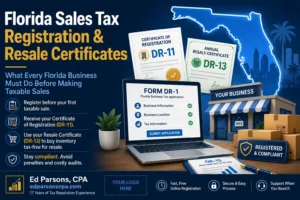
There are two related documents. A resale certificate, Florida’s Annual Resale Certificate (Form DR-13), lets a registered dealer buy goods tax-free when those goods will be resold. An exemption certificate covers items that are exempt for a different reason: because of how they are used, such as certain manufacturing or agricultural property, or because of who is buying, such as a nonprofit or government entity. Exempt entities use a Consumer’s Certificate of Exemption issued by the Department, which carries its own renewal cycle separate from the annual resale certificate.
A registered Florida dealer receives its resale certificate automatically when it registers as a dealer. The distinction between the two documents matters: a resale certificate is about reselling the item, while an exemption certificate is about a use or a buyer that the law exempts. A resale certificate also is not a free pass on anything a business buys, only on goods that will genuinely be resold. When a customer buys from you for resale, they present a copy of the certificate or its number; signatures are no longer required, but the certificate must be current and the details correct.
The Seller Bears the Risk
Here is the part that surprises sellers. In Florida, every sale is presumed to be taxable, and the burden of proving that a sale was exempt falls on the seller, not the buyer. If you make a tax-free sale and cannot produce valid documentation for it during an audit, the Department treats it as a taxable retail sale and holds you liable for the tax you did not collect.
A seller who accepts a certificate in good faith and documents the sale properly has met that burden and is protected, even if the buyer’s registration later turns out to have a problem. A seller who accepts an expired, mismatched, or unverified certificate, or keeps no record at all, has not, and the liability lands on the business along with penalties and interest. This is why real-time verification matters: confirming the certificate number at the time of sale is what locks in your protection, because a number that was valid then cannot be second-guessed later. The certificate also carries risk for the buyer: using it to buy something that is not resold means owing use tax on the item, with civil and criminal penalties for fraudulent use.
| Resale certificate (DR-13) | Exemption certificate | |
| What it covers | Goods the buyer will resell | Items exempt by use or buyer type |
| Measurement (what makes it exempt) | The buyer will resell the item | The use or the buyer qualifies under law |
| Who provides it | A registered dealer buying for resale | An exempt buyer, such as a nonprofit |
| The seller’s job | Verify it is current and document the sale | Obtain and keep the certificate on file |
How to Document an Exempt Sale
Florida gives sellers three approved ways to document a tax-exempt resale sale. Using any one of them, in good faith, is what protects you:
- Keep a copy of the customer’s current Annual Resale Certificate.
- Get a transaction authorization number for the individual sale, using the customer’s certificate number through the Department’s online system, the FL Tax-Verify app, or its toll-free line.
- Get an annual vendor authorization number that covers every resale sale to that customer for the calendar year.
Whichever method you use, keep the verification record. The purpose of all three is the same: to be able to show later that the exemption was valid at the time of the sale, not months afterward when an auditor asks.
What Trips Sellers Up
Auditors know exactly where exempt sales fall apart. A resale certificate from a car dealership should not be accepted for office furniture, and the same logic applies across industries. These are the failures auditors look for:
- Accepting an expired certificate; Florida resale certificates expire on December 31 each year.
- Never verifying the certificate number, so you cannot show it was valid at the time of sale.
- A business name on the certificate that does not match the Department’s records.
- Accepting a resale certificate for goods the buyer clearly will not resell, which is not good faith.
- Keeping no record at all, leaving an exempt sale with nothing to support it on audit.
- Relying on an out-of-state resale certificate, which Florida generally does not accept for an in-state sale.

The certificate rule is the clearest example of a pattern that runs through Florida sales tax: the obligation sits with you, and the proof is something you had to collect before anyone asked for it. The same shape shows up in the nexus threshold that starts collection duties you never registered for, the use tax on purchases nobody billed you for, the reporting patterns that select a business for audit, and the disclosure window that closes on contact. My email series takes them one at a time. Send it to my email. I send a confirmation first, so click that and the rest follows. Unsubscribe whenever it stops being useful.
Why This Becomes an Audit Problem
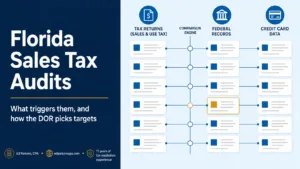
The Department routinely examines resale transactions and certificates as part of a Florida sales tax audit. It pulls your exempt sales and asks for the documentation behind each one. Any sale you cannot support, an expired certificate, a missing record, a name that does not match, is reclassified as taxable, and the tax is assessed against you. Florida’s standard audit look-back is three years, so a documentation gap can quietly compound across several years of exempt sales before it ever comes to light.
Because this happens across every exempt sale in the audit period at once, the assessment can be large, and it lands on the seller who never collected the tax to begin with. If you are facing a certificate-driven assessment, or you simply want to know whether your documentation would hold up, a Business CPA Tax Resolution Case Analysis reviews your exposure and the options for resolving it before the Department does the math for you.
For official guidance, the Florida Department of Revenue’s Annual Resale Certificate page and its resale certificate brochure explain the documentation rules, though neither replaces advice on your own situation.

Exempt Sales You Cannot Document?
In a Florida audit, an exempt sale without valid documentation becomes a taxable one, and the bill lands on the seller. Ed Parsons, CPA helps Florida businesses assess certificate exposure and defend against assessments. Start with a Business CPA Tax Resolution Case Analysis, which explicitly covers sales tax and audit exposure.