Skip to content

Subpart F income is certain income, mostly passive and related-party income, that a controlled foreign corporation (CFC) earns and that the U.S. taxes to its 10% U.S. shareholders in the year it is earned, even if the company never pays it out. It exists to stop U.S. owners from parking mobile income in a low-tax foreign company to defer U.S. tax. The main categories are passive income like dividends, interest, rents, and royalties, plus certain related-party sales and services income.
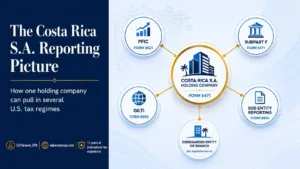
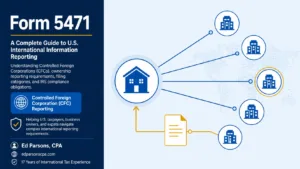
If you own part of a foreign company, Subpart F is the rule that can tax you on income you never actually received. It is one of the most misunderstood corners of U.S. international tax, partly because it taxes earnings that stay inside the company. This guide explains what Subpart F income is, the categories it covers, why it exists, and how it fits with GILTI, without the dense calculation that comes later. For the bigger picture of how all of this is reported, see our complete guide to Form 5471. Passive income is also where a company can fall under the PFIC rules at the same time, and I set the two regimes against each other in CFC versus PFIC.
What Subpart F Income Is
Subpart F income is a set of income categories that a controlled foreign corporation earns and that the United States taxes to its U.S. owners right away, in the year the income is earned, whether or not the company distributes a cent. It is one of the oldest of the anti-deferral rules, the provisions that stop U.S. taxpayers from parking income in a foreign company to put off U.S. tax.
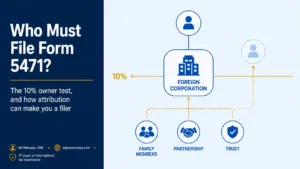
It applies only to a controlled foreign corporation, or CFC: a foreign corporation owned more than 50% by U.S. shareholders who each hold at least 10%. And only those 10% U.S. shareholders are taxed on it. Once income is taxed under Subpart F, it becomes previously taxed income, so it is not taxed again when the company finally distributes it.
Subpart F Income at a Glance
- It is taxed to U.S. shareholders in the year it is earned, with no deferral.
- It applies only to a controlled foreign corporation and its 10% U.S. shareholders.
- It mostly covers passive income: dividends, interest, rents, and royalties.
- It also covers certain related-party sales and services income.
- Once taxed, the same income is not taxed again when it is later distributed.
Why Congress Created Subpart F
Before Subpart F, a U.S. owner could move easily shifted income, things like interest, dividends, and royalties, into a corporation in a low-tax country and leave it there untaxed by the United States for years. Congress closed that door by requiring U.S. shareholders to report this income currently, the year it is earned. The courts have since upheld the principle that Congress can tax a shareholder on a foreign corporation’s undistributed earnings.
The Types of Subpart F Income
Subpart F income is not all of a foreign company’s income, only specific categories. The main ones are:
- Foreign personal holding company income: the largest category, covering passive income such as dividends, interest, rents, royalties, and annuities.
- Foreign base company sales income: profit from buying or selling goods through the CFC when the goods are produced and sold outside its home country and a related party is involved.
- Foreign base company services income: income from services the CFC performs for, or on behalf of, a related party outside its home country.
- Insurance income: income from insuring risks outside the CFC’s country of organization.
- A small set of “bad acts” categories: income tied to international boycotts, illegal bribes and kickbacks, and income from certain sanctioned countries.
The first three together make up what the law calls foreign base company income, and the passive category is the one most CFC owners actually run into.
| Subpart F | GILTI | |
| What it covers | Passive and related-party income | Active income above a routine return |
| Measurement (the dividing line) | Mobile or related-party income | Everything else the CFC earns |
| Deferral | None, taxed currently | None, taxed currently |
| Reported on | Form 5471, Schedule I | Schedule I-1, then Form 8992 |
How Subpart F and GILTI Fit Together?
The most common confusion is between Subpart F and GILTI. They are two different current-inclusion rules, and they divide a CFC’s income between them rather than overlapping.
Subpart F takes the mobile, passive, and related-party income. GILTI, a newer rule that Congress added and recently renamed Net CFC Tested Income, sweeps up most of the remaining active income above a routine return. Income that is Subpart F is carved out of the GILTI base, so the same dollar is not taxed under both, but a single owner can easily have both kinds of inclusion, and a Section 962 election can change the rate on each. Both are reported through Form 5471.
The Exceptions That Can Apply
Not every dollar in these categories ends up taxed. Several rules narrow Subpart F income, and they are part of why the calculation is rarely simple:
- A de minimis rule: if the CFC’s Subpart F income is below the lesser of $1 million or 5% of its gross income, none of it counts.
- A full inclusion rule: if it exceeds 70% of gross income, all of the company’s income is swept in.
- A high-tax exception: income already taxed abroad above a set rate can be elected out of Subpart F.
- Same-country and look-through rules that keep certain related-party payments from being caught.
Each of these has its own conditions, and they interact, which is how a clean-looking set of foreign financials can still produce a surprising inclusion.
Which of those exceptions applies to your company is not a question this page can answer, and the answer usually arrives with several others attached. Five emails from me work through the pair of rules behind them: passive earnings like interest, rents and royalties taxed in the year the company earns them, and the separate inclusion that reaches active income sitting above a routine return on tangible assets. Email me the series. Watch for the confirmation email, because the series holds until you click it. Unsubscribe any time. Which exception your own numbers reach is still a question for your books.
Common Misunderstandings
- Assuming no distribution means no tax; Subpart F is taxed whether or not the money ever comes home.
- Treating Subpart F and GILTI as the same thing; they are separate rules covering different income.
- Believing an active business has no Subpart F; related-party sales and services income can still be caught.
- Assuming all of the CFC’s income is Subpart F; only specific categories qualify, subject to the exceptions.
- Overlooking the reporting; Subpart F income still goes on Form 5471 even in a year with no distribution.
Questions CFC Owners Ask
I never took money out, so why am I taxed?
Because Subpart F is a current-inclusion rule. The tax is triggered by the income the company earns, not by a distribution to you.
Is Subpart F the same as GILTI?
No. They are separate regimes; Subpart F covers passive and related-party income, and GILTI covers most of the rest. You can have both.
Does a little interest income trigger it?
Possibly, but the de minimis rule can keep small amounts out. It depends on how the interest compares to the company’s total income.

Where Subpart F Gets Complicated?
Understanding what Subpart F income is, is the easy part. Sorting which of your CFC’s income falls into which category, applying the exceptions, deciding on elections, and reporting it all on Schedule I of Form 5471 is where it turns technical, and where small classification errors create real tax.
If you own a foreign corporation with passive or related-party income, or you suspect past years were reported wrong, Form 5471 CPA Filing handles the analysis and the schedules, and our guide on resolving unreported Subpart F income covers what to do when prior years were missed. This page is the map; the return is where it gets handled.
For the official rules, the IRS About Form 5471 page and the Instructions for Form 5471 cover how Subpart F income is reported, though neither replaces advice on your own corporation.

Have a Foreign Corporation With Subpart F Income?
Subpart F is taxed whether or not your company distributes the money, and the categories and exceptions are where errors turn into tax. Ed Parsons, CPA prepares Form 5471 and its schedules and helps U.S. owners sort and report Subpart F income correctly, including for prior years. Start with Form 5471 CPA Filing, which handles the Subpart F analysis and the schedules end to end.