Skip to content

You generally must file Form 5471 if you are a U.S. person who owns 10% or more of a foreign corporation’s vote or value, who controls one, or who is an officer or director when a U.S. person crosses that 10% mark. The threshold is low, and the constructive ownership rules can make you a 10% shareholder through stock held by family members, partnerships, or trusts, even if you do not directly own it. There is no exception for small or inactive companies.
The hardest part of Form 5471 is often just realizing you have to file it. The ownership thresholds are lower than most people expect, and the rules can treat you as an owner of stock you never bought. This guide walks through whether you are a filer, what counts as a foreign corporation, the 10% test, and the attribution rules that catch indirect owners. For the full picture of the form itself, see our complete guide to Form 5471.
Form 5471 Filing at a Glance
- The threshold is 10% of a foreign corporation’s vote or value.
- “U.S. person” is broad: citizens, residents, green card holders, and U.S. entities, wherever they live.
- There is no size exception; a dormant or tiny company still counts.
- Each foreign corporation requires its own separate form.
- Attribution can catch you through stock held by family or related entities.
Who Has to File: The Short Version
Form 5471 is filed by certain U.S. persons connected to a foreign corporation. In practice, four situations cover most filers:
- You own 10% or more of a foreign corporation, by vote or value.
- You control a foreign corporation, meaning more than 50% of its vote or value.
- You are a U.S. officer or director of a foreign corporation in which a U.S. person acquires a 10% stake.
- You acquire or dispose of stock that crosses the 10% line during the year.
Each of these maps to a filer category, and you can fall into more than one at the same time.
What Counts as a Foreign Corporation?
A foreign corporation is simply a corporation organized outside the United States, a German GmbH, a UK Ltd, a Mexican S.A. de C.V., and so on. It also includes a foreign entity treated as a corporation for U.S. tax purposes, such as a foreign company that elected corporate treatment or defaults to it. The label the foreign country uses matters less than how the entity is classified under U.S. rules.
The 10% U.S. Shareholder Test
The central trigger is being a “U.S. shareholder,” which has a specific meaning: a U.S. person who owns 10% or more of a foreign corporation’s total voting power or total value. Either one, vote or value, can put you over the line.
The phrase “U.S. person” does a lot of work. It covers U.S. citizens and lawful permanent residents no matter where they live, along with domestic partnerships, corporations, trusts, and estates. An American who has lived abroad for years and runs a local company is still a U.S. person, and still potentially a filer.
Constructive Ownership: The Trap
This is where most surprise filings come from. You do not have to own the shares directly to be treated as a 10% shareholder. Under the constructive ownership rules in IRC 958, stock owned by people and entities close to you can be attributed to you as if you held it yourself.
Family attribution is the most common version: stock held by your spouse, children, grandchildren, and parents can count as yours. Stock held through partnerships, trusts, estates, and other corporations can be attributed as well. The result is that someone who directly owns nothing, or less than 10%, can still cross the threshold and owe Form 5471. It is also how the IRS can reclassify a company as a controlled foreign corporation after the fact, years later. How each category changes what you file is mapped in Form 5471 filing categories.
| Direct ownership | Constructive ownership | |
| How you hold it | Shares in your own name | Shares held by others, attributed to you |
| Measurement (what counts toward 10%) | What you directly own | What the rules treat you as owning |
| Counts toward the test? | Yes | Yes, the same |
| Common source | Buying shares yourself | Family, partnerships, or trusts |
The Five Filer Categories at a Glance
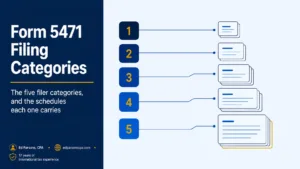
Once you know you have to file, your category determines which schedules you complete. There are five, and you can fall into more than one:
- Category 1: a 10% shareholder of a specified foreign corporation.
- Category 2: a U.S. officer or director tied to a U.S. person’s 10% acquisition.
- Category 3: a U.S. person acquiring or disposing of stock across the 10% line.
- Category 4: a U.S. person controlling the corporation, more than 50% of vote or value.
- Category 5: a 10% U.S. shareholder of a controlled foreign corporation.
Our breakdown of the Form 5471 filing categories explains each one and the schedules it carries. This page is about the prior question: whether you are in the system at all.
Attribution is the part of that test people fail without noticing, and one of my five emails spends its whole length there: a spouse’s holding, or a parent’s, read into your own total, which is how a minority owner becomes a filer without ever buying another share. The others work through what the categories actually pull in behind them once you are one. Email me the series. Before any of it you get a confirmation request, and clicking that is what starts the series. Unsubscribe on every email. What they will not do is map your own ownership chain, which is the only way to be certain either way.
When You Might Not Have to File?
There are exceptions, and they are narrower than people hope. You may not have to file separately if another U.S. person files a complete Form 5471 that already includes your information, and certain constructive owners are relieved when the related U.S. owner files. A genuinely dormant corporation may qualify for a simplified summary filing rather than the full form. None of these is automatic, and assuming one applies without confirming it is a common and costly mistake.
Common Mistakes
- Assuming a stake under 10% is safe without checking whether attribution pushes you over.
- Treating a dormant or tiny corporation as exempt; there is no size threshold.
- Assuming foreign taxes paid remove the U.S. filing obligation; they do not.
- Filing one Form 5471 for several corporations instead of one per corporation.
- Overlooking that an officer or director can be a filer even without owning shares.
Questions People Ask
I own exactly 10%, do I file?
Yes. The test is 10% or more, so exactly 10% counts.
My spouse owns the shares, not me, am I clear?
Probably not. Family attribution can treat your spouse’s stock as yours, which can make you a U.S. shareholder.
The company is dormant, do I still file?
Usually yes. There is no exemption for inactivity, though a simplified summary procedure may apply in narrow cases.

How to Know for Sure?
Working out whether you have to file is straightforward when you own shares outright, and genuinely tricky when attribution is involved, because you have to map the entire ownership chain, including family members and entities, before you know where you stand.
The stakes make it worth getting right. A missed Form 5471 carries a $10,000 penalty per corporation, per year, and keeps your whole return open to audit, as our guides on unreported foreign corporations and how unfiled 5471 penalties grow explain. If you think you might be a filer, or you are not sure how attribution affects you, our guide to Form 5471 walks through the ownership and attribution tests. Knowing whether you are in the system is the first step; this is how you confirm it.
For the official rules, the IRS About Form 5471 page and the Instructions for Form 5471 set out the categories and who must file, though neither replaces advice on your own ownership.

Not Sure if You Have to File Form 5471?
The 10% threshold is low, and attribution from family or related entities can make you a filer without direct ownership. Ed Parsons, CPA reviews your ownership chain, confirms whether you must file, and prepares Form 5471 and its schedules. Start with the Form 5471 guide, which sets out the ownership tests and the schedules that follow.