Skip to content

Form 5471 has five filer categories, and your category determines which schedules you complete. Category 2 (officers and directors) and Category 3 (people acquiring or disposing of stock) carry the lightest load, mostly Schedule O. Categories 1, 4, and 5 carry the financial and income schedules, with Category 4 (control) filing the most and Category 5 (shareholders of a CFC) reporting the Subpart F and GILTI detail. One filer can fall into several categories and files a single Form 5471 covering all of them.
The filer category is the organizing principle of Form 5471. It is the first thing you determine, and it decides everything that follows, which schedules you complete, how much financial detail you provide, and how much work the return takes. This guide maps all five categories in plain English: who each one captures, what schedules attach, and how they overlap. For the broader picture of the form and its penalties, see our complete guide to Form 5471. When a category mistake already sits on years you filed, the correction usually runs the way I describe in a late Form 5471 for income that was already reported.
How the Categories Work?
Form 5471 is less a single form than a shell with a stack of schedules behind it, and your filer category decides which of those schedules you have to complete. Some categories ask for little more than basic identifying information; others require the full financial picture of the foreign corporation.
Two things keep this manageable. You file one Form 5471 per foreign corporation no matter how many categories apply to you, and when you fall into more than one category, you complete every schedule any of them requires without duplicating information. The category is a sorting tool, not a separate filing. There is no size or activity exception that changes your category either, so a dormant corporation and a large operating one are sorted the same way.
The Five Categories at a Glance
Here is who each category captures:
- Category 1: a U.S. shareholder of a specified foreign corporation, a status tied to the section 965 transition rules.
- Category 2: a U.S. officer or director of a foreign corporation in which a U.S. person acquires a 10% stake.
- Category 3: a U.S. person who acquires or disposes of stock crossing the 10% line, or who becomes a U.S. person while already owning 10%.
- Category 4: a U.S. person who controls a foreign corporation, more than 50% of its vote or value, for at least 30 days in the year.
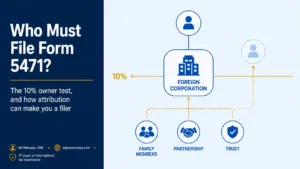
- Category 5: a U.S. shareholder who owns 10% or more of a controlled foreign corporation at any time during the year.
Several categories also split into sub-categories, such as 1a through 1c and 5a through 5c, which fine-tune the rules for related and unrelated owners. The five main categories are what most filers need to identify first.
If you are still working out whether you are a filer at all, start with who must file Form 5471 and who counts as a U.S. shareholder. This page assumes you are in the system and need to find your category.
Which Schedules Each Category Files
The schedule load is where the categories really diverge. At a high level:
- Every category files the identifying information plus Schedule A (the corporation’s stock) and Schedule B (its U.S. shareholders).
- Category 2 is the lightest: little beyond Schedule O, Part I, reporting the acquisition by officers and directors.
- Category 3 centers on Schedule O, Part II, reporting the stock acquisition or disposition that triggered the filing.
- Categories 1, 4, and 5 carry the financial and income schedules: the income statement, balance sheet, earnings and profits, Subpart F, and related items.
- Category 4, the control filer, generally files the most, including Schedule M for transactions with related parties, while Category 5 reports the Subpart F and GILTI detail.
That last group is where the work concentrates, and where filing under the wrong category does the most damage.
| Lighter load (Categories 2 and 3) | Heavier load (Categories 1, 4, and 5) | |
| Who they are | Officers, directors, and acquirers | Controllers and CFC shareholders |
| Measurement (the schedule load) | Mainly Schedule O | Financial, E&P, and income schedules |
| Typical trigger | A stock event or a board role | Owning or controlling the business |
| Effort | Limited | Substantial |
What the Main Schedules Do
It helps to know what the key schedules actually cover:
- Schedules A and B: the corporation’s stock and its U.S. shareholders, including constructive owners.
- Schedules C and F: the income statement and balance sheet, in the corporation’s functional currency.
- Schedule E: foreign income taxes paid or accrued, used for the foreign tax credit.
- Schedules H and J: current-year and accumulated earnings and profits, including previously taxed amounts.
- Schedules I and I-1: the shareholder’s Subpart F income and the corporation’s tested income for GILTI.
- Schedule M: transactions between the corporation and its U.S. owners or related parties.
- Schedule O: the organization or reorganization of the corporation and acquisitions or dispositions of its stock.
How the Categories Overlap
One filer routinely falls into more than one category. The most common pairing is Category 4 and Category 5: a U.S. person who controls a CFC is both a control filer and a 10% shareholder of a CFC at the same time.
When categories overlap, you still file a single Form 5471 and complete every schedule any category requires, without repeating the same information. The instructions even set priorities in places, so a filer who is both Category 4 and Category 5a checks only Category 4. The practical takeaway is that overlap usually means more schedules, not more forms. Mapping your ownership before you start, including any control position and any CFC status, is what tells you the full category set, and that set drives the entire schedule list.
Overlap is why category work is rarely finished in one pass, and it is also where a filing quietly turns incomplete. My email series carries that further. It sets out what the IRS does with a form that is missing a required schedule, which is to treat it as though it never arrived, and the earnings and profits calculation sitting under all of it, which has to run back to the year the company was formed. Have the series sent to your inbox. A confirmation email comes first and nothing follows until you click it. You can stop them any time.
Common Mistakes
- Identifying only one category when several apply, and omitting the extra schedules.
- Treating Category 2 or 3 as the end of it when a control or CFC-shareholder category also applies.
- Filing a schedule with blanks instead of zeros; a required schedule with all zero amounts still has to be filed.
- Assuming tax software handles the category logic; the chart has many sub-category variations.
- Leaving out Schedule O for a stock acquisition or disposition, which is the whole trigger for Category 3.

Questions People Ask
Can I be in more than one category?
Yes, and it is common. You file one Form 5471 and complete the schedules required by every category that applies.
Which category files the most schedules?
Category 4, the control filer, generally carries the fullest set, with Category 5 close behind for CFC shareholders.
Does my category ever change?
It can. If your ownership changes, for example you acquire control, you can move from one category to another from year to year.
Knowing Your Category Is Step One
Identifying your category is the easy part. The real work is completing the attached schedules correctly: reconstructing earnings and profits, sorting Subpart F from GILTI, translating currency, and tying every figure to the corporation’s financials. The IRS treats a return with missing or incorrect schedules the same as one never filed, which is why the category alone is never the finish line.
If you have filed under the wrong category before, our guide on filing the wrong Form 5471 category covers the exposure and the fix. And if you want the return prepared correctly the first time, across every category and schedule that applies, Form 5471 CPA Filing handles the full package. Knowing your category gets you to the starting line; the schedules are the race.
For the official mapping, the IRS About Form 5471 page and the Instructions for Form 5471 include the full filing-requirements chart by category, though it does not replace advice on your own facts.

Need Help With Your Form 5471 Category and Schedules?
Your category is only the starting point; the attached schedules are where errors turn into penalties. Ed Parsons, CPA confirms your category and prepares the full Form 5471 package, across every category and schedule that applies. Start with Form 5471 CPA Filing, which handles the category, the schedules, and the return end to end.