Skip to content

If you bought Costa Rica property through a Costa Rican corporation, such as a Sociedad Anónima or SRL, you almost certainly own or control a foreign corporation, which usually means you have to file Form 5471 with your U.S. tax return. The obligation applies whether or not the corporation earns a dollar, and the penalty for missing it is $10,000 per year. Many U.S. buyers create this filing requirement without realizing it, simply by using the standard local holding structure. If you closed years ago and nobody mentioned it, the question becomes which cleanup path fits the years already missed, and I walk through each one.
A Costa Rica vacation home sounds simple. You find the property, set up a local company to hold it the way nearly everyone does, and close the deal. What most U.S. buyers never hear is that the local company is a foreign corporation in the eyes of the IRS, and the moment it holds the title, a U.S. reporting obligation attaches to the house.
That obligation is Form 5471, and the penalty for missing it is $10,000 per year. This guide explains why the corporate-holding structure is so common in Costa Rica, when it is required and when it is merely chosen, and exactly how it creates a U.S. filing trap. For the full picture of the form, see our complete guide to Form 5471.
Why So Many Buyers Use a Costa Rican Corporation?
Holding Costa Rica property through a Costa Rican corporation, usually a Sociedad Anónima (S.A.) or a Sociedad de Responsabilidad Limitada (S.R.L.), is one of the most common structures in the market. There are two very different reasons for it.
The first is legal necessity, but only in one place: the coastal maritime zone, where the rules effectively require a corporation. The second, and far more common, is choice. For ordinary titled property, buyers use a corporation for liability protection, estate planning, privacy, and the convenience of closing without flying to Costa Rica to sign in person. In both cases the company, not the individual, holds the title, and the property can later change hands by transferring the company’s shares rather than re-deeding the land.
The Maritime Zone vs the Rest of the Country
This distinction decides whether you even had a choice. Costa Rica’s Maritime Zone Law governs the 200 meters of land measured from the high-tide line along the entire coast. The first 50 meters is public land that no one can own. The next 150 meters is the restricted zone, where what is sold is not title but a concession, a long-term government lease.
In that restricted zone, a foreigner without at least five years of residency cannot hold more than 49% of a concession, so buyers structure the holding through a corporation whose majority is held by a qualifying party. Outside the 200-meter zone, the picture flips: foreigners can own titled, fee-simple property outright, up to 100%, with the same rights as a Costa Rican citizen. They still routinely use a Sociedad Anónima, just for the liability and estate reasons above rather than out of necessity.
| Maritime zone (the 200m strip) | Titled property (the rest) | |
| What you get | A concession, a government lease | Fee simple, full ownership |
| Measurement (foreign ownership limit) | Max 49% foreign | Up to 100% foreign |
| Why a corporation | Often required for the concession | Chosen for liability and estate reasons |
| Form 5471 risk | Yes, if you own or control it | Yes, if you own or control it |
The Form 5471 Trap
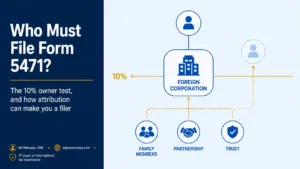
Here is where the U.S. side catches up with the structure. Whether the corporation was required or simply chosen, once a Costa Rican corporation holds your property and you own or control it, you are a U.S. shareholder of a foreign corporation.
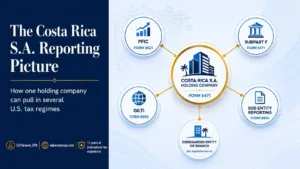
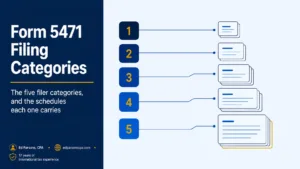
If you own more than half of the company, the usual case for a personal holding company, you are generally a Category 4 filer, and a Category 5 filer as well if the company is a controlled foreign corporation. Either way, Form 5471 is due with your U.S. tax return. Our guide to who must file Form 5471 and who counts as a U.S. shareholder covers the thresholds, but the point for Costa Rica buyers is blunt: the obligation does not depend on the company earning anything. A vacation home held in an S.A. that collects no rent and runs no business still triggers the form, every year, with a $10,000 penalty for each year missed and a statute of limitations that keeps the whole return open until you file. And if you hold more than one property through separate corporations, each company is its own filing, so two Costa Rican companies mean two Form 5471s every year.
It Gets More Complicated If You Rent It Out
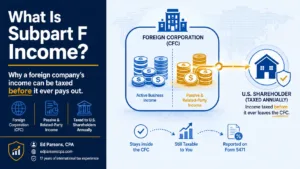
If the property earns rental income, more U.S. rules come into play. Rent is passive income, which can become Subpart F income taxed to you currently if the company is a controlled foreign corporation, and the company’s passive profile can raise passive foreign investment company (PFIC) questions on top of the Form 5471 filing. Even occasional or short-term rental through a booking platform can be enough to raise these questions, because what matters is the nature of the income, not how often it arrives. These layers interact, and getting them right is well beyond what a Costa Rican accountant handling the local books would typically address.
Renting it out does not create the obligation, it only adds to one that already existed, and getting that ordering backwards is the common failure. My email series follows the same ordering. It starts from the stake that makes you a filer regardless of income, then works through what the five filing categories actually pull in behind them, which is where the real workload lives. Start the series. A confirmation note goes out on its own first. Nothing else follows unless you answer it, and every email that does carries an unsubscribe link.
What This Means for U.S. Owners
- The Costa Rican corporation is a foreign corporation for U.S. tax purposes.
- Owning or controlling it generally makes you a Form 5471 filer.
- The form is due whether or not the company earns income.
- Each unfiled year carries a $10,000 penalty and keeps your return open to audit.
- Rental income adds Subpart F and PFIC questions on top.
Common Misunderstandings
- Assuming a vacation home with no income creates no U.S. filing; the form reports the company, not just its earnings.
- Believing that because the company and property are foreign, the IRS is not involved.
- Assuming the company is too small or inactive to matter; there is no size exception.
- Thinking the Costa Rican attorney or accountant who set up the S.A. handled the U.S. filings; they generally do not.
- Planning to sort it out later; the penalty and open statute compound every year it goes unfiled.

Questions U.S. Owners Ask
My Costa Rica company earns nothing, do I still file?
Usually yes. Form 5471 reports the company’s existence and your ownership, so a year with no income does not remove the obligation.
My lawyer in Costa Rica set up the S.A., didn’t they handle the U.S. side?
Almost never. Local counsel handles Costa Rican formation and compliance; the U.S. Form 5471 is a separate obligation on your U.S. return.
I’ve owned it for years and never filed, what now?
You may be able to catch up on the missed years, often before the IRS makes contact, which is far better than waiting. The right approach depends on your facts.
Untangling the Structure
The trap is easy to fall into and very fixable, but not on your own. Confirming your filer category, preparing Form 5471 and its schedules, and sorting out any rental income, Subpart F, or PFIC questions takes someone who works on both sides of the border, because the IRS treats a missed or incomplete filing the same as none at all.
If you own Costa Rica property through a corporation and have never filed, or you are not sure whether you should have, our guide on unreported foreign corporations and catching up covers the path, and Form 5471 CPA Filing handles the return and the back years end to end. The structure that made buying easy does not have to become a U.S. tax problem.
For the official U.S. rules, the IRS About Form 5471 page and the Instructions for Form 5471 set out who must file and the penalties, though neither addresses your specific Costa Rica structure.

Own Costa Rica Property Through a Corporation?
The Sociedad Anónima that made buying easy can quietly create a Form 5471 obligation, due every year whether or not the company earns a dollar. Ed Parsons, CPA confirms your filing requirement, prepares the return, and helps you catch up on unfiled years. Start with Form 5471 CPA Filing, which handles the return and the back years end to end.