Skip to content
A tax preparer’s failure to ask about foreign accounts does not by itself establish non-willful conduct. The IRS requires a streamlined certification claiming professional reliance to identify the advisor and summarize the advice received. What the taxpayer disclosed, what the engagement covered, and what other signals arrived all shape whether the explanation holds. Tell me what your preparer handled and what is still unfiled, and I will scope it.
“My CPA did my taxes for fifteen years and never once asked if I had accounts overseas. How was I supposed to know?”
“I gave my accountant everything, every statement, every year. The FBAR still never got filed. Whose fault is that?”
“My bank in Bogota sent me a FATCA letter, but my preparer said not to worry about it. Does that count as advice?”
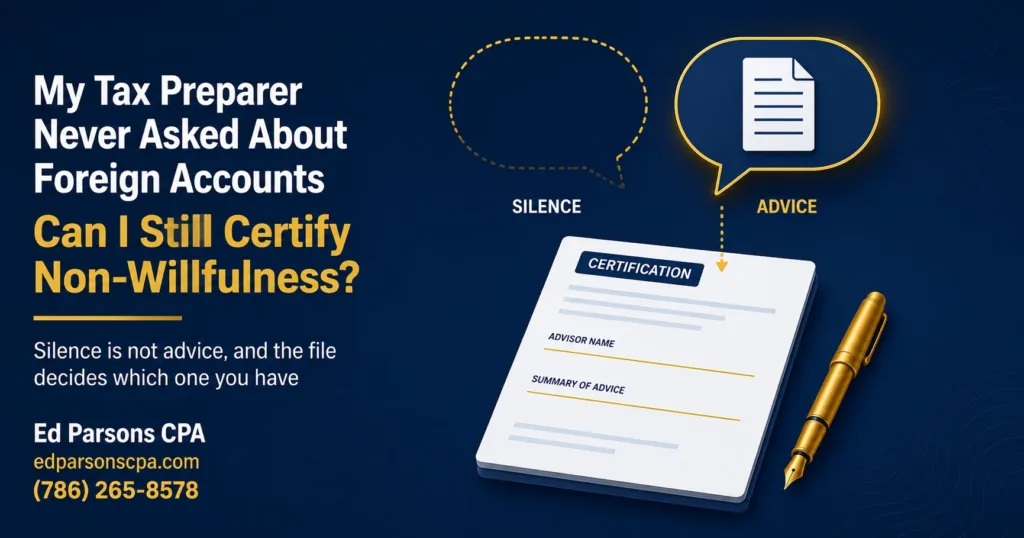
A Preparer’s Silence Is Not the Same as Professional Advice
A preparer’s silence is not professional advice. The IRS requires a certification claiming reliance to identify the advisor and summarize the advice, and Bedrosian shows that communications with an accountant, and disclosure of some but not all accounts, become critical evidence.
The distinction sounds technical, but it is the whole fact pattern. Advice is a statement: the preparer considered the question and answered it. Silence is an absence: nobody considered anything, because the question never entered the room.
A taxpayer can only rely on something that happened. That is why the first task in this fact pattern is not writing an explanation; it is establishing, from documents, what actually passed between taxpayer and preparer.
And to be clear about what this article is not: it is not a case for blaming the accountant. The certification is the taxpayer’s sworn statement, and the analysis runs on what the taxpayer disclosed, what the engagement covered, and what the taxpayer knew from other sources.
What the IRS Asks Taxpayers to Disclose About Advisors
The requirement is written into the certification forms themselves. Form 14653 and Form 14654 instruct that if the taxpayer relied on a professional advisor, the statement must provide the name, address, and telephone number of the advisor and a summary of the advice.
The IRS streamlined domestic FAQ reinforces the same expectation: specific reasons, in the taxpayer’s own facts, for the failure to report income, pay tax, and file the required information returns. A reliance claim without a named advisor and a summarized advice is not a reliance claim; it is a placeholder.
That precision cuts both ways, which is the point. A certification that names the advisor and summarizes advice the file does not support has manufactured its own contradiction; Form 14654 non-willful certification mistakes walks through how those gaps read on review. How the narrative itself gets written is covered in the Form 14653 narrative guide.
What Information Did the Preparer Actually Receive?
Before the reliance story is written, the disclosure record has to be rebuilt. The questions are concrete:
- Did the preparer know the taxpayer lived abroad, or held a green card while working overseas?
- Was foreign income, interest, dividends, rent, or salary, reported on the returns?
- Were foreign bank statements actually supplied, in any year?
- Did the tax organizer ask about foreign accounts, and how was it answered?
- Was ownership of a foreign company ever disclosed?
The last question matters more than it looks, because a preparer who never saw the statements could not evaluate what the accounts required. The universe of foreign accounts that may require both FBAR and Form 8938 is wider than most engagement files ever captured, and the gap between what existed and what was disclosed is exactly what a reviewing agent measures.
There is no protective value in silence alone. If the preparer received nothing foreign, the preparer’s failure to ask explains very little, and the explanation has to come from somewhere else in the record.
Continuity gets read too. The same preparer across many years can support a consistent story, or it can show the same organizer question ignored ten times, and the file decides which one it is. If the advisor was a foreign accountant rather than a U.S. preparer, reliance on a foreign accountant covers the differences, and a preparer who checked No on Schedule B is the situation in the Schedule B question.
Silence vs. Advice: How the Reliance Story Reads
The table below pairs the questions a reviewer asks with the way each answer moves the story.
| Question | Reliance Reads Stronger When | Reliance Reads Weaker When |
| What the preparer was told | Foreign residence, income, accounts, and company ownership were all disclosed | The preparer worked from a file that never mentioned anything foreign |
| The organizer | It asked about foreign accounts and was answered accurately | It asked, and the answer was blank, wrong, or the organizer was skipped |
| The engagement | The preparer held itself out as competent in international filings | A basic domestic return engagement, with nothing foreign in scope |
| What the preparer said | Actual advice was given: a statement that no filing was required | Nothing was said at all; the claim rests on pure silence |
| Outside signals | No banker, attorney, or FATCA letter ever raised the issue | A FATCA letter or another professional mentioned FBAR, and nothing changed |
| Continuity | One preparer, one consistent story, documents to match | Preparers changed, stories shifted, and the file shows the seams |
| Measurement | The file is the measurement: organizers, emails, engagement letters, and what was actually attached to them | The IRS requires the certification to name the advisor and summarize the advice; a story the documents contradict fails at the first read |
The Numbers Behind a Reliance Claim
- 2: the things a certification must do when professional reliance is claimed: identify the advisor and summarize the advice.
- 2: the Third Circuit Bedrosian opinions, one setting the civil standard, one weighing the evidence.
- 10: the disclosure and engagement questions this fact pattern works through before anything is drafted.
- 0: the protective value of a preparer’s silence when nothing foreign was ever disclosed.
- 1: the sworn signature on the certification, and it belongs to the taxpayer, not the preparer.
- Every year: how often the organizer question repeats, which is why the answers get read as a series.
Why Incomplete Facts Can Defeat a Reliance Argument
The Bedrosian litigation shows how this evidence works. In the first Third Circuit opinion, the court held that civil FBAR willfulness includes both knowing and reckless conduct, the same standard that frames every fact pattern in this series.
The later opinion upheld a willfulness finding involving an omitted Swiss account, on a record that included evidence about what the taxpayer and the accountant each knew and said. The case cannot be reduced to bad accountant advice.
Its real lesson is narrower and more useful: communications with an accountant, and disclosure of some but not all accounts, become critical evidence. What was said, what was shown, and what was withheld get reconstructed and read together.
One distinction keeps the stakes in proportion. These are civil willfulness decisions, where recklessness can suffice; criminal false-statement cases run on different standards. The certification’s job is to survive both readings of the same facts.

Reliance only counts once it is written down as something that happened, with a name attached and the advice summarized. That is one reason the certification is the hardest part of a streamlined submission, and it is where five short emails of mine put most of their weight: what the document asserts, why saying you did not know settles nothing, and what a reviewer expects in its place, which is facts, a sequence of events, and a plain account of how the misunderstanding took hold. Send me the five streamlined emails. A confirmation email arrives first and the series holds until you click it. One click also ends it whenever you like.
When Reliance May Be More Credible
Reliance is strongest when it describes something that verifiably happened. The pattern generally includes:
- Full disclosure: foreign residence, income, accounts, and any company ownership were in the preparer’s file.
- An organizer that asked about foreign accounts and was answered accurately.
- An engagement with a preparer who held itself out as competent in international filings.
- Actual advice: a statement, ideally in writing, that no additional filing was required.
- The taxpayer followed the advice rather than picking through it.
- No contrary signals arrived from anyone else during the same years.
When the Taxpayer’s Own Knowledge Still Matters
The reliance story does not exist in a vacuum, because preparers are not the only source of information. A banker’s comment, another accountant’s question, an attorney’s aside, or a FATCA letter from the foreign bank all count as signals.
A taxpayer who received a FATCA letter and changed nothing has a fact to explain that no preparer’s silence can absorb. The same is true where a second advisor mentioned FBAR and the subject was dropped. Timing matters as much as existence: a letter that arrived before the last filed return reads differently from one that arrived after it.
This is why the honest sequence runs disclosure first, signals second, advice third. The certification has to account for all three, because the reviewing agent will have access to the same trail.
Those documents are the whole basis of a reliance claim, and gathering them is the first hour of the work rather than the last. Tell me what is still unfiled and put them through the upload slot, engagement letters and organizers included. Then use the open box to describe, in your own words, what your preparer was actually told and when. The scoping questions around that take about a minute, mostly counts and the country you were living in at the time. No automated response goes out afterwards. It reaches me and I reply, and the reading is done against the documents rather than the recollection.
Documents That Should Be Reviewed Before Drafting the Statement
The reliance story is built from the file, not from memory. The working set:
- Every filed return for the covered years, read the way an agent reads them.
- Tax organizers, blank and completed, for each year available.
- Engagement letters showing what the preparer was actually hired to do.
- Emails and notes passing between taxpayer and preparer.
- Foreign account statements, including anything showing FATCA correspondence.
- Records of any other professional contact that touched the foreign issue.
Two gaps surprise people at this stage. First, the preparer’s file and the taxpayer’s memory rarely match, and the file wins. Second, IRS account records will not fill the hole; why IRS transcripts are not enough to evaluate foreign reporting explains what the transcripts never show.
Common Mistakes With This Fact Pattern
- Treating the preparer’s silence as if it were advice.
- Claiming reliance without naming the advisor or summarizing any advice.
- Writing the disclosure story from memory before pulling the organizers and emails.
- Ignoring FATCA letters and other outside signals the record will show.
- Assuming a long relationship with one preparer proves competence in international filings.
- Certifying before anyone has read the preparer file the way a reviewing agent would.
The Reliance Story Is Built From the File, Not From Memory
The sequence protects the taxpayer: reconstruct the disclosure record, gather the signals, and only then decide whether reliance is the honest explanation or whether the facts point somewhere else.
Finding the weak spots first is the entire value of the review, because a rejected streamlined submission escalates IRS exposure and leaves everything already submitted in the government’s hands.

This is the reliance review Ed Parsons CPA runs before any certification is drafted: the organizers, the engagement letters, the correspondence, and the account trail, weighed together. Start with the Streamlined Filing CPA package, reach Ed through the contact page before you sign anything under penalties of perjury.