Skip to content

Form 14654 is the IRS certification used for the Streamlined Domestic Offshore Procedures. It combines three high-risk elements into one document: the non-willful certification narrative, the 5% penalty calculation, and the eligibility statement. A mistake in any of the three can lead the IRS to reject the entire submission, eliminate streamlined penalty relief permanently, and expose the taxpayer to the full standard penalty structure with no formal appeal available. If the IRS does reject it, what a rejection does to your exposure is worth reading before you file.
Marcus prepared his own Form 14654. He read the IRS instructions, listed his foreign accounts, calculated 5% of his current foreign bank balance, and wrote a brief statement: ‘I was unaware of the FBAR filing requirement.’
Three months later, the IRS rejected the submission. The reasons: the non-willful narrative was insufficient, the penalty base excluded his foreign pension, and one of his listed assets did not match the entry on his amended Form 1040.
His streamlined penalty would have been roughly $9,500. With the submission rejected, the standard penalty exposure now exceeded $60,000. The IRS retained all of his documentation. The streamlined option was gone.
What Form 14654 Actually Certifies?
Form 14654, available on the IRS Form 14654 page, is the official certification required for the Streamlined Domestic Offshore Procedures. It is signed under penalty of perjury and combines three separate certifications into a single document.
Each section is reviewed independently by the IRS, but a defect in any one section can compromise the entire submission:
- Eligibility certification: The taxpayer was a U.S. resident, filed prior returns, and did not meet the foreign residency test
- Non-willful certification: The failure to report foreign accounts and assets was not the result of intentional concealment
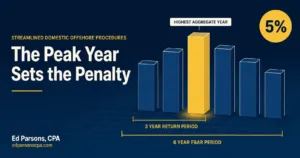
- Penalty calculation: The 5% Title 26 miscellaneous offshore penalty, calculated on the highest aggregate year-end balance across the six covered years
The form was revised significantly in 2017 to require more disclosure, more specific asset listings, and a stronger non-willful narrative. The IRS now treats it as a sworn statement rather than a checklist. A weak certification is treated as evidence of willfulness, not just a paperwork defect. The IRS Streamlined Filing Compliance Procedures page outlines the current standards. The program the form belongs to is set out in plain terms in the Streamlined Domestic Offshore Procedures.
The Three Pieces of Form 14654 That Must Match Each Other
This is where most self-prepared submissions fall apart. Form 14654 does not exist in isolation. It must internally reconcile with the amended tax returns, the six years of FBARs, and any related international information returns.
Three internal consistency checks the IRS performs immediately:
- Asset list on Form 14654 vs accounts reported on the new FBARs
- Penalty base figures on Form 14654 vs supporting asset valuations
- Non-willful narrative on Form 14654 vs facts visible in the amended returns and prior filings
Inconsistency between these sections is treated as a serious credibility issue. A taxpayer whose Form 14654 lists three foreign accounts while the FBARs report four accounts has just contradicted themselves in a sworn document.
Where the Most Critical Form 14654 Mistakes Happen?
Mistakes on Form 14654 cluster around specific sections of the form. Each carries its own type of IRS response.
| Measurement | Mistake on Form 14654 | Likely IRS Response |
| Narrative quality | Vague non-willful statement | Reject submission or open exam |
| Asset listing | Assets on Form 14654 do not match amended returns | Reject submission for inconsistency |
| Penalty base | Pension or insurance excluded from base | Recalculate or reject; full exposure |
| Year-end values | Highest-during-year used by mistake | Penalty recalculated; possible rejection |
| FX rates | Spot rates used instead of Treasury | Penalty figure rejected |
| Eligibility checkbox | Wrong residency or filing-status box selected | Submission rejected outright |
| Spousal certification | Joint filers, only one spouse signed | Submission incomplete; rejected |
The penalty base errors are particularly damaging because they cascade. Excluding a foreign pension from the base does not just understate the penalty. It signals to the IRS reviewer that the taxpayer may not understand the scope of the program, which colors how the non-willful narrative is read.

The Non-Willful Narrative: Where Most Submissions Are Lost
This is the heart of Form 14654. The non-willful certification narrative is the section the IRS reviewer reads first and weighs most heavily. A weak narrative defeats the submission even when the calculations are perfect.
A non-willful narrative is not a single sentence. The IRS expects a multi-paragraph factual statement that addresses:
- How the foreign accounts or assets were originally established
- What the taxpayer believed about U.S. reporting requirements during each covered year
- Why the taxpayer did not know, despite the visibility of FATCA, foreign income reporting, or annual tax filing
- Specific events that brought the reporting requirement to the taxpayer’s attention
- Any factors that could otherwise look like willfulness, including PFIC holdings, Form 3520-A obligations as a foreign trust owner, or having used a foreign tax preparer who knew about the assets
A statement that simply says the taxpayer was unaware of FBAR is almost always rejected. The IRS expects the narrative to acknowledge the specific facts that would normally suggest willfulness and then explain why those facts did not lead to deliberate non-compliance in this case.
What makes this form dangerous is that it does two heavy jobs in one signature: it certifies the conduct was not willful, and it carries the penalty computation. I take that apart in a short email series on streamlined filing, five of them, and the certification gets a full one to itself. Saying you did not know is not an account of anything. The reviewer wants specific facts, a timeline, and a plain explanation of how the misunderstanding arose, and a statement offering none of those is the common way a submission is lost. Send me the five streamlined emails. Confirm your address first, or nothing sends. Unsubscribe from the foot of any of them.
Penalty Calculation Errors Built Into Form 14654
Form 14654 contains a penalty calculation worksheet. The taxpayer fills in the year-end aggregate value of unreported foreign financial assets for each of the six covered years, identifies the highest, and applies the 5% rate. The full mechanics of the SDOP penalty calculation extend well beyond the surface of the worksheet.
Common penalty calculation errors that survive into the final Form 14654 submission:
- Using highest-balance-during-year figures (the FBAR standard) instead of year-end values
- Omitting foreign pensions, insurance with cash value, or foreign trust interests from the base
- Using spot exchange rates instead of year-end Treasury rates for currency conversion
- Excluding assets that were later closed or transferred, when they should still appear in their applicable year
- Inconsistencies with the underlying FBAR filings, which the IRS cross-references
Each of these errors triggers an IRS reviewer to recalculate. If the reviewer’s number exceeds the taxpayer’s number by more than a small margin, the submission is rejected for understatement of the penalty.
Procedural Mistakes That Trigger Rejection
- Submitting Form 14654 without the three amended returns or the six FBARs
- Signing Form 14654 before the amended returns are complete and ready to file
- Missing a spousal signature when joint returns are involved
- Failing to mark the SDOP-specific eligibility boxes correctly
- Mailing the submission to the wrong IRS address or filing electronically when paper submission is required
- Not attaching a copy of Form 14654 to each amended return that is filed
Form 14654 is not a checklist. It is a sworn legal document that consolidates the most consequential elements of a streamlined submission into a single page reviewed by the IRS as evidence of credibility. Errors in the non-willful narrative, the penalty calculation, or the asset listing each create independent grounds for rejection. The Streamlined Filing CPA Package at Ed Parsons CPA covers Form 14654 preparation with the non-willful narrative, the full penalty calculation, and the reconciliation against the amended returns and FBARs that the IRS requires.