Skip to content
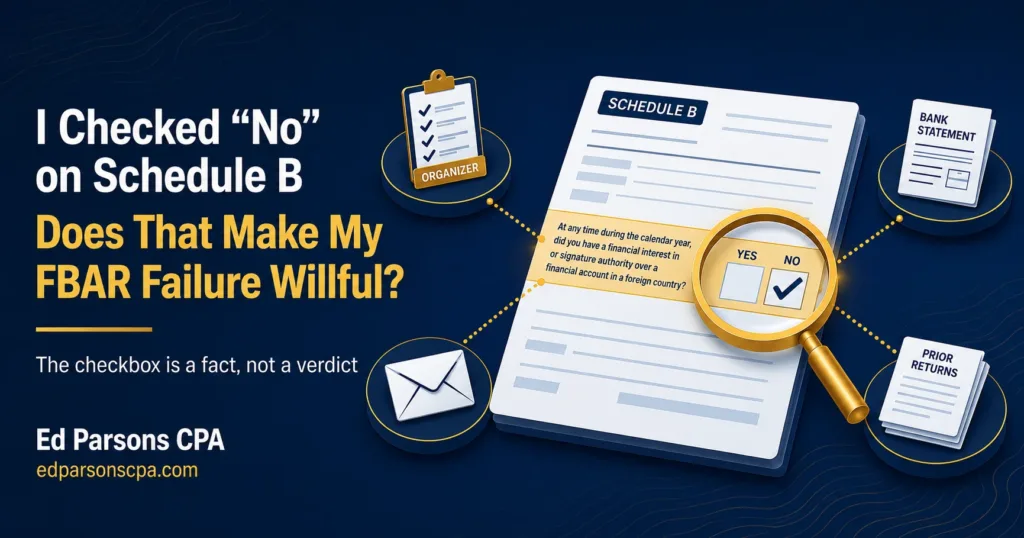
A wrong answer to the Schedule B foreign-account question is a significant fact, but it does not automatically determine whether an FBAR failure was willful or non-willful. The IRS and courts examine the entire record, including what the taxpayer knew, what was disclosed to the preparer, whether the return was reviewed, and whether the taxpayer avoided learning the filing requirement. If your returns carry that answer, tell me which years and accounts are involved and I will scope the correction.
“My accountant checked No on Schedule B for ten years. I never even knew the question existed. Am I willful now?”
“I signed the returns without reading them. Does that help me or hurt me?”
“The foreign interest was on my return the whole time. How can they say I hid the account?”
What Schedule B Asks About Foreign Financial Accounts?
Part III of Schedule B sits at the bottom of a form most people associate with interest and dividends. It asks a direct question: did you have a financial interest in, or signature authority over, a financial account located in a foreign country?
A second line follows, asking whether you are required to file FinCEN Form 114, the FBAR. Two small boxes, one word each, filed under penalties of perjury with the rest of the return.
Most taxpayers never notice the question. Most preparers answer it from habit. And years later, in an FBAR dispute, those two boxes become some of the most closely read words in the entire file.
The question is also broader than people expect. It reaches accounts you own and accounts you can merely sign on, and it does not care whether the account earned a cent. Joint family accounts and business accounts complicate the answer further, which is part of why honest people get it wrong.
Why the “No” Answer Matters in an FBAR Case
Willfulness is the dividing line in FBAR penalty cases, and the Schedule B answer is evidence on that question. A written “No,” signed and filed, is the government’s favorite exhibit when it argues the taxpayer knew or avoided knowing. The underlying stakes are covered in our overview of missed FBAR reporting and streamlined filing.
The answer matters in both directions, though. A taxpayer who gave the preparer the foreign statements, reported the foreign interest, and still ended up with a No in the box has a very different record from one who disclosed nothing.
Reviewers also read the answer alongside what was in the room when the box was checked. The instructions for that year, the organizer, and the preparer’s notes show what information the answer was based on.
That is the point this article keeps returning to: the checkbox is a fact, not a verdict. What surrounds it decides what it means.
What United States v. Williams Says About Signed Returns
In United States v. Williams, the Fourth Circuit reviewed a civil FBAR willfulness finding involving a taxpayer whose returns answered No to the foreign account question. The court discussed the signed return, constructive knowledge of its contents, and willful blindness.
Willful blindness deserves a plain definition, because it is the concept doing the work. It describes deliberately avoiding a fact, and courts can treat that avoidance as the legal equivalent of knowing. The signed return matters because signing charges the taxpayer with knowledge of what the return says.
Read carefully, Williams is a warning, not a rule. It shows that a court may treat the signed return and the Schedule B answer as evidence of willfulness when combined with other facts. It does not hold that every taxpayer who signs a return with a wrong answer is willful.
A second Fourth Circuit decision, United States v. Horowitz, extends the caution. It recognizes that reckless conduct can satisfy the civil willfulness standard where a taxpayer clearly should have known of the risk and could easily have determined the filing requirement.
One distinction keeps both cases in proportion: these are civil willfulness decisions, not criminal convictions. Civil willfulness can include recklessness, and that lower threshold is exactly why the surrounding facts deserve careful review before anyone certifies anything.
The Same “No,” Two Different Records
The table below pairs the factors reviewers actually weigh. No single row decides the question; the pattern across all of them does.
| Factor | May Read Toward an Innocent Mistake | May Harden the Inference |
| Who answered the question | The preparer entered it with no input and never asked | The taxpayer personally completed Schedule B |
| What the preparer received | Foreign statements were provided; the preparer had the facts | Foreign accounts and income were never disclosed to the preparer |
| Return review before signing | Genuine, documented reliance on a professional’s preparation | The return was read, reviewed, and signed with the No answer visible |
| Where the income appears | Foreign interest was reported elsewhere on the return | The foreign income appears nowhere on any return |
| Pattern across years | A single year, corrected once discovered | The identical wrong answer repeating across many years |
| Taxpayer background | No tax, finance, or compliance experience | Professional familiarity with tax, banking, accounting, or compliance |
| Measurement | The record is the measurement: organizers, emails, statements, and the filed returns themselves | Civil willfulness can include recklessness, and willful FBAR exposure can reach 50% of the account balance; the gap between the two answers is an order of magnitude |
The Numbers Behind the Question
- 1: the checkbox on Schedule B Part III that becomes the centerpiece of many FBAR willfulness disputes.
- 2: the Fourth Circuit decisions, Williams and Horowitz, that frame constructive knowledge and recklessness in this setting.
- 50%: of the account balance, the level willful FBAR penalties can reach, against far smaller non-willful amounts.
- 0: the automatic legal conclusions created by the checkbox alone.
- 10: the distinct fact questions a careful reviewer works through before any certification is drafted.
- Every year: how often the question repeats on the return, which is why multi-year patterns get read together.
Facts That May Support an Innocent Mistake Explanation
None of the following decides the question alone, and none should be assumed. Each is a fact to verify against documents:
- The preparer never asked about foreign accounts, verbally or in writing.
- The tax organizer either omitted the question or was never used.
- Foreign interest or dividends were actually reported elsewhere on the return.
- Foreign bank statements were provided to the preparer, who had the facts in hand.
- The taxpayer reasonably believed the question applied only to accounts producing taxable income.
- The taxpayer believed Form 8938 or another filing replaced the FBAR, a confusion covered in FBAR versus Form 8938 reporting.
- The error appears in a single year rather than a long pattern.
- The taxpayer has no background in tax, finance, accounting, banking, or compliance.
A box answered wrong for years is a fact your statement has to absorb rather than avoid, and this is a program that is unforgiving about exactly that sort of thing. I send five short emails on streamlined filing. They cover the conditions deciding whether it is open to you, the track your residency puts you on, the certification signed under penalty of perjury, and the reason a submission is treated as final: there is no appeal, and what you filed stays in the file and travels with the case. Send me the five streamlined emails. You confirm your address before anything sends. Unsubscribe from any of them.
Facts That May Make the Explanation Harder to Sustain
The same review has to name the unfavorable facts honestly, because a reviewing agent certainly will:
- The taxpayer personally completed Schedule B, including the foreign account question.
- The return was read and reviewed before signing, with the No answer visible.
- The incorrect answer repeated across multiple years without change.
- The taxpayer works in tax, finance, banking, accounting, or compliance.
- The foreign income appears nowhere on any filed return.
- Foreign accounts and statements were never disclosed to the preparer at all.
One caution belongs here in plain terms. Do not reach for “I never reviewed my returns” as the fix, because claimed non-review can be its own unfavorable fact depending on what surrounds it. The explanation has to be true, and it has to survive the record. When the preparer simply never asked, that reliance story is built differently, and having heard of the FBAR without understanding it is its own fact pattern.

What the Streamlined Statement Must Explain
The streamlined procedures require a certification of non-willful conduct on Form 14653 or Form 14654, signed under penalties of perjury. The IRS asks for specific reasons for the failure to report income, pay tax, and file the required information returns, including FBARs.
Specific means specific. Per the IRS streamlined domestic FAQ, the narrative should account for the facts, and where professional reliance is claimed, it must identify the advisor and summarize the advice. A certification that cannot be reconciled with the filed returns invites exactly the scrutiny it was meant to avoid; Form 14654 mistakes that can increase streamlined risk covers how those gaps read.
The certification also reserves the government’s position. The IRS states it can examine evidence of willfulness, fraud, or criminal conduct notwithstanding the submission, which is exactly why the narrative is written to the record rather than to hope.
How that narrative gets written is covered in the Form 14653 narrative guide. For this fact pattern, the essential point is that the Schedule B answer will be in front of the reviewer, so the statement has to explain it rather than hope it goes unnoticed.
Common Mistakes With This Fact Pattern
- Treating the checkbox as fatal and skipping the review that might support a different reading.
- Treating the checkbox as harmless because a preparer entered it.
- Drafting the narrative from memory instead of pulling the organizers, emails, and statements first.
- Writing an explanation the filed returns visibly contradict.
- Ignoring the multi-year pattern and explaining only one return.
- Certifying before anyone has read the preparer file the way a reviewing agent would.
The returns themselves are the evidence here, and they are worth reading before anything is certified rather than after. Tell me what is still unfiled and upload the years you have, because the answer sitting in that box is something I would far rather see than hear described. The rest of the form is scope, counts and the country you were living in, plus somewhere to set out in your own words what you understood the question to be asking. Answer that one honestly rather than defensively. Nothing acknowledges the form automatically. It comes to me and the answer you get is mine.
Why the Return and Preparer File Should Be Reviewed Before Certification
The review order matters more than the drafting. The filed returns, the organizers, the preparer’s questions, the account records, and any written advice get read together first, because that is the record the certification must survive.
Timing favors the careful here. Nothing in this review runs on a government clock until something is filed, which makes the pre-certification stage the only part of the process the taxpayer fully controls.
The review also has to be honest about what it finds. If unfavorable evidence surfaces, the path itself may change, and what happens when a streamlined submission is rejected explains why finding those facts before filing beats having the IRS find them after.

This is the fact review Ed Parsons CPA performs before any certification is drafted: the returns, the preparer file, and the account history, weighed the way a reviewing agent would weigh them. Start with the Streamlined Filing CPA package or an FBAR CPA filing engagement, reach Ed through the contact page before you sign anything under penalties of perjury.