Skip to content

If you are a U.S. person and you inherit money or receive a large gift from family in Colombia, you usually owe no U.S. income tax on it, but you may still have to report it. Gifts and bequests from a foreign individual or estate go on Form 3520 once they top $100,000 in a year. The form is informational, not a tax bill, but skipping it carries a penalty of 5 percent of the amount per month, up to 25 percent, which is why it catches so many immigrant and dual-citizen families off guard.
Your family in Colombia helped with a down payment, or a parent passed away and left you an inheritance. These are ordinary, loving things, and nobody thinks of them as a tax event. For a U.S. person, though, money from abroad can carry a reporting duty that has nothing to do with owing tax, and the penalty for missing it is steep. For the wider expat picture, see our guide to U.S. taxes for digital nomads.
Quick Facts on Foreign Gifts and Inheritances
- A foreign gift or inheritance is usually not taxable income to a U.S. recipient.
- Reporting is still required once gifts from a foreign individual or estate top $100,000 in a year.
- Gifts from a foreign company use a much lower threshold that the IRS adjusts each year.
- The penalty for not reporting a foreign gift is 5 percent per month, up to 25 percent of the amount.
- Inherited property, not just cash, counts toward the threshold at its value.
- Inheritances that come through a foreign trust follow stricter rules and a higher penalty.
The Good News: It Usually Is Not Taxable
Start with the part that surprises people in a good way. The United States does not tax gifts or inheritances as income to the person receiving them. When your abuela in Medellin leaves you money, or a parent helps you buy a home, you generally owe no U.S. income tax on what you receive.
The catch is that not owing tax and not having to file are two different things. Form 3520 is an information return. It tells the IRS the money arrived, and the obligation to file it stands on its own, separate from any tax bill.
When You Have to File Form 3520
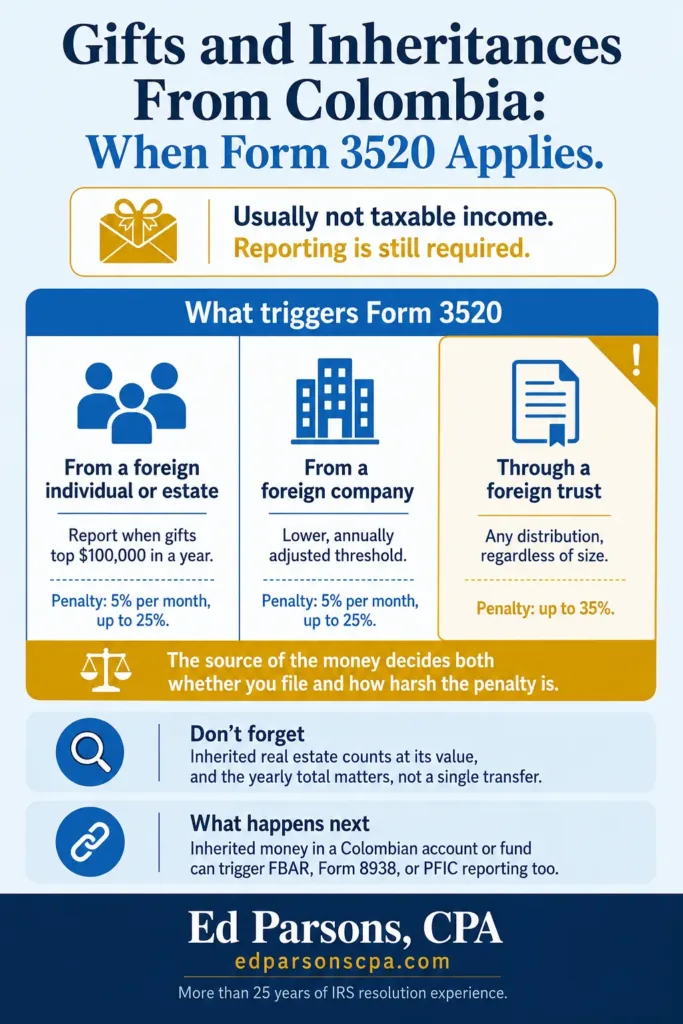
For gifts and bequests from a foreign individual or a foreign estate, the trigger is an aggregate over $100,000 in a single year. It is the yearly total that counts, so several transfers from the same family that add up across the year can cross the line together, even if no single wire looks large.
Two details trip people up. Inherited real estate in Colombia counts toward the threshold at its value, not just cash that lands in your account. And gifts from a foreign corporation or partnership, rather than an individual, use a far lower threshold that is adjusted annually, so a transfer from a family business is judged on a different scale.
Picture three transfers from your parents across one year to help with a wedding and a home, each well under the limit on its own but more than $100,000 combined. That total is reportable, even though no single payment looked like a milestone.
| From a foreign individual or estate | From a foreign company | Through a foreign trust | |
| What it is | Money or property from a relative or their estate | A transfer from a foreign corporation or partnership | A payout from a foreign trust or fiducia |
| Measurement (reporting trigger) | Aggregate over $100,000 in the year | Over a lower, annually adjusted threshold | Any distribution, regardless of size |
| Taxable income? | Generally no | Generally no | Possibly, under trust rules |
| Penalty for missing it | 5% per month, up to 25% | 5% per month, up to 25% | Up to 35% of the distribution |
The gold row is the dividing line. The source of the money and how it reaches you decide both whether you file and how harsh the penalty is.
The Penalty Is Why This Matters
Because no income tax is due, people assume there is nothing to do, and that is the costly mistake. The Form 3520 penalty for failing to report a foreign gift is 5 percent of the amount for each month it is late, capped at 25 percent. On a $200,000 inheritance, that is up to $50,000 in penalties for a form that would have reported a tax-free transfer. The money you received is still yours to keep. The penalty is purely for the paperwork failure, which is what makes it so frustrating when it lands.
The penalty can sometimes be abated for reasonable cause, but reasonable cause has to be established, not assumed, and the IRS has historically been quick to assess these penalties first and ask questions later. That is why getting the filing right in the first place is far cheaper than fighting a penalty afterward.
Inheritance Through a Family Trust Is Different
Many Colombian families hold assets through a fiducia or a family trust, and when an inheritance flows through one of those structures, the rules change. A distribution from a foreign trust is reportable regardless of size, can carry tax under the trust rules, and exposes you to a penalty of up to 35 percent of the distribution.
These arrangements can also pull in additional reporting, and the same foreign trust questions appear with Colombian pension and cesantias accounts. This is a fact-specific area where it pays to confirm exactly what you received and how, rather than treating a trust payout like a simple family gift.
How It Connects to the Rest of Your Reporting
An inheritance rarely sits in isolation. The money usually lands in a Colombian bank account, which can trigger the FBAR and Form 8938, and families often invest it in a local fund, which raises PFIC reporting on Form 8621. One inheritance can quietly create several filings at once, which is exactly how a tax-free event becomes a compliance project.
What to Do, and How to Catch Up
Form 3520 is filed by the due date of your income tax return, including extensions, but it is sent separately to the IRS rather than attached to your Form 1040. If you have received foreign gifts or inheritances in past years and never reported them, you usually have a path back. Non-willful taxpayers can often catch up through Streamlined Filing, and the broader expat issues are covered in our piece on working remotely from Colombia. Coordinating a missed Form 3520 with any related account or investment reporting in one submission is far cleaner than addressing each piece on its own.
Common Mistakes Families Make
- Assuming that because no tax is owed, nothing needs to be filed.
- Looking at a single transfer instead of the yearly total against the $100,000 threshold.
- Forgetting that inherited real estate in Colombia counts at its value.
- Treating money received through a family trust like a simple gift.
- Filing Form 3520 late, or attaching it to the 1040 instead of sending it separately.
- Ignoring the account or investment the inherited money then sits in.
- Assuming the penalty cannot be challenged. Reasonable cause can sometimes help, but it must be established.

Report a foreign gift or inheritance the right way
A tax-free inheritance can still carry a five-figure penalty if the form is missed. Ed Parsons, CPA prepares Form 3520 for foreign gifts and inheritances, including the trickier cases that involve a family trust.Get help with Form 3520 CPA Filing