Skip to content

Update: the IRS has withdrawn the Delinquent FBAR Submission Procedures. The programme’s page on irs.gov now returns an error, and the IRS list of options for taxpayers with undisclosed foreign financial assets names only three routes: the Criminal Investigation Voluntary Disclosure Practice, the Streamlined Filing Compliance Procedures, and the delinquent international information return submission procedures, which is a separate programme for information returns rather than FBARs. This page is kept for reference and describes the procedures as they operated while they were open. Treat the options section as one item short. Acceptable-reason arguments on a late FBAR are still worth making, and beyond them the route is the streamlined procedures. If you need this looked at on your own facts, request a quote or contact me directly.
Filing an FBAR late does not trigger an automatic penalty. If every dollar of your foreign income was reported and taxed, you can file the missed FinCEN Form 114 reports through the IRS delinquent procedures at no cost and with no penalty. If income went unreported, exposure starts at $16,536 per late report and streamlined filing becomes the repair path.
Which side of that line you are on is the only question that matters, and it is answered by your tax returns, not by the FBAR itself.
This guide covers the real penalty numbers, the reasons that hold up for filing late, and a decision tree for choosing between the two correction lanes.
What Is the Penalty for Filing an FBAR Late?
There is no late fee for an FBAR the way there is for a tax return. The Bank Secrecy Act penalties attach to the failure to file, and the IRS asserts them after review, not automatically. The reporting rules sit on the IRS FBAR page.
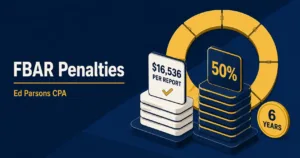
The numbers are severe. Non-willful violations run $16,536 per report at the current inflation-adjusted rate, and under Bittner v. United States that is per report, not per account. Willful violations reach the greater of $165,353 or 50 percent of the account balance.
The ceiling is real. In United States v. Schwarzbaum (11th Cir.), a willful FBAR assessment of $12.5 million was trimmed by only $300,000 as an excessive fine under the Eighth Amendment. The Justice Department declined to seek Supreme Court review, and the First Circuit has ruled the other way, so full exposure remains the working rule.
Here is what the penalty numbers hide: late filers who correct through the right IRS lane usually pay none of this. The lane depends on one fact, whether the income was reported.
That one fact does more work than anything else on this page, and getting it wrong is where most of the expensive outcomes I see begin. The five emails I send on FBARs spend real time on it: how far back a catch-up has to reach, why the delinquent route only fits where no additional tax is owed and no examination is open, and what happens to your relief when the wrong door gets used or a quiet filing is stacked on top of it. Send me the five FBAR emails. A confirmation note goes out first and the series waits on your answer to it. Unsubscribing is one click from any email.
Can You File a Late FBAR Without Penalty?
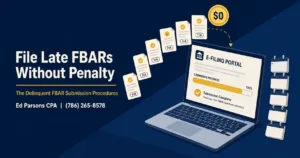
Yes, if your returns are already correct. The Delinquent FBAR Submission Procedures let you e-file every missed year for free with a short reason statement, and the IRS will not impose a penalty where all foreign income was reported, the tax was paid, and you were not already under examination or contacted.
The conditions, the six-year lookback, and the BSA e-filing walk-through are in the full guide to the delinquent FBAR submission procedures. Getting the reports themselves right, maximum balances, currency conversions, account types, is what the Form 114 FBAR CPA Filing service covers.
What If the Foreign Income Was Never Reported?
Then the delinquent procedures no longer protect you, and filing the FBARs alone becomes a quiet disclosure, the one move the IRS has warned against. The correct lane is streamlined filing: three years of amended returns, six years of FBARs, and a signed non-willful certification, with a 5 percent penalty for U.S. residents and 0 percent for those meeting the non-residency test. The program terms sit on the IRS streamlined procedures page.
Case study: A retired teacher came to Ed Parsons CPA ready to self-file through the delinquent procedures. Four accounts, peak balance $268,000. The reconciliation found term-deposit interest that never reached Schedule B, about $1,900 a year, roughly $9,500 over five years. Wrong lane entirely.
We moved her to the domestic streamlined track instead: three amended returns picking up about $7,000 of income, six FBARs, and a 5 percent penalty of roughly $9,500 on the highest year-end balance. Against non-willful exposure of about $99,000 across six reports, the Streamlined Filing CPA Package closed the file at a known number. There has been no examination to date; the procedures do not come with a closing letter. Results depend on your facts. the file at a known number. Eighteen months on, no examination and no correspondence.
What Are Acceptable Reasons for Filing an FBAR Late?
The statute itself carves out reasonable cause. Under 31 U.S.C. 5321(a)(5)(B), a non-willful penalty does not apply where the violation was due to reasonable cause and the account balances are properly reported on the late FBAR.
Reasons that hold up follow a pattern. Recent immigration with no exposure to U.S. information reporting. A preparer whose annual organizer never asked about foreign accounts. Inherited accounts, or signature authority over an employer account you never thought of as yours. Serious illness during the filing window. Records held abroad and genuinely out of reach.
Reasons that fail follow a pattern too. A questionnaire that did ask, answered no. Moving funds after learning of the rules. Anything that reads as not wanting the account seen.
As I tell clients drafting a first explanation: “The IRS does not penalize honest confusion, it penalizes convenient confusion. An acceptable reason is specific, dated, and consistent with your returns. A vague one reads like a strategy.”
What separates an accepted file from a rejected one is usually wording, sequence, and dates. That is judgment work, not template work.
How Do You Decide Which Option to Use?
One question starts the tree: is every dollar of foreign income already on your filed returns, with the tax paid?
Yes, and no IRS contact: Delinquent FBAR Submission Procedures. File every open year free. $0 penalty.
No, and your conduct was non-willful: Streamlined filing. Amended returns plus certification. 5 percent domestic, 0 percent foreign.
Facts lean willful, or the IRS already contacted you: Neither program. Representation first, filings second.
Where your conduct sits on the willful or non-willful line is the hinge of that third branch, and it is not a self-serve call.

Frequently Asked Questions
My Take After 17 Years of Late FBAR Files
The fear economy around FBAR penalties is real. Plenty of marketing quotes the $165,353 willful number at people whose facts would never support willfulness, then sells them a heavier program than they need. The opposite failure is the forum advice to file quietly because nobody checks. Both get the same thing wrong: the lane is decided by your returns, not your nerves.
The underrated move is the same one I give every late filer: reconcile first. Six years of returns against every foreign statement, before anything is transmitted. Ten minutes with Schedule B answers the only question the decision tree asks.

If I were the reader, I would run the tree honestly, pick the lane my facts support, and never split the difference with a quiet disclosure. At Ed Parsons CPA, IRS account work is the core of the practice.