Skip to content

A missed FBAR, Form 8938, or Form 5471 does not by itself decide how serious the problem is or how to fix it. Reconstruct the facts first: what was required, what income was reported, and why the failure happened. Those facts, not your preference, determine the correct correction path.
Finding out that a foreign account or foreign company was never reported correctly is unsettling, and the instinct is to file the missing form right away. That instinct skips the step that shapes everything: understanding what actually happened.
Two taxpayers can miss the same form for very different reasons, and those reasons can change the outcome. This page gives you the framework and points you to the detailed analysis for your specific situation.
The Exposure at a Glance
Foreign reporting penalties are among the steepest in the tax code, which is exactly why characterization and procedure matter. These figures set the stakes; they are not a reason to panic.
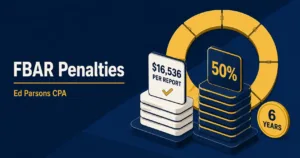
- FBAR, non-willful: up to $16,536 per annual report. Under the Supreme Court decision in Bittner v. United States, this applies per report, not per account.
- FBAR, willful: the greater of $165,353 or 50 percent of the account balance, assessed per account, per year.
- FBAR statute of limitations: six years for non-willful failures, and no statute of limitations for willful failures.
- Form 5471: $10,000 per form, per year under IRC Section 6038, with up to $50,000 in additional penalties after IRS notice, and the return can hold the entire tax year open until it is filed. See how unfiled Form 5471 penalties accumulate.
- Form 8938: $10,000 for a failure to file, rising by up to $50,000 after IRS notice, and separate from any FBAR penalty.
- The trigger: the FBAR is required when foreign financial accounts exceed $10,000 in aggregate at any point during the year.
Know Which Regime You Missed
Foreign reporting is not one requirement. It is a set of separate regimes, and each can be missed on its own. Identifying which one applies is the first fact to establish.
FBAR (FinCEN Form 114). The FBAR reports foreign financial accounts and is filed with the Financial Crimes Enforcement Network, not attached to your tax return. Because it lives outside the Form 1040 process, it is the most commonly overlooked obligation of the group. Our article on how FBAR penalties interact with the Streamlined path covers that exposure in detail.
Schedule B. Schedule B of the Form 1040 asks directly about foreign accounts, and a “No” answer where the truth was “Yes” is often raised as evidence. The answer is a fact in the record, not an automatic finding of willfulness. If this is the detail that worries you, see what a “No” answer on Schedule B may mean in an FBAR case.
Form 8938. Form 8938 is the FATCA information return, filed with your tax return, and it is a separate regime from the FBAR with different thresholds and scope. Filing one does not satisfy the other. We break down Form 8938 penalties and how Streamlined filing addresses them separately.
Form 5471. Form 5471 is the information return for U.S. persons connected to certain foreign corporations, and entity reporting is a separate duty from income reporting. That is why unreported foreign corporation ownership can be a problem even when every dollar of the corporation’s income made it onto your return.
Start With the Facts, Not the Procedure
Before choosing how to correct anything, answer a short set of questions honestly. Each one changes the analysis, and none can be skipped by jumping to a program name.
- What was actually required? FBAR, Form 8938, and Form 5471 have different rules and filers, so the obligation you noticed may not be the only one.
- Was the income reported? Income reporting and information reporting are separate, so reporting foreign interest does not cure a missed FBAR, though it is a meaningful fact.
- What did you understand? What you knew about the FBAR, and when, is part of the record, and “I did not know” is not the whole analysis.
- What did the preparer know? Reliance depends on what was disclosed, what was asked, and what advice was given, not simply that a professional was involved.
- Which procedure fits those facts? Only after the first four questions does a correction path come into focus. The comparison below shows the main options.
The Tax Professional’s Role Deserves Its Own Look
“My accountant handled my taxes” is a sentence, not an analysis. Reliance depends on what was disclosed, what was asked, and what advice was actually given, and the record is what supports or undercuts it.
It matters whether you never told the preparer about the accounts, told the preparer and received no advice, or worked with someone who never asked the question at all. A foreign accountant handling only local-country tax is a different record again. Two patterns are common enough for their own discussions: when the tax preparer never asked about foreign accounts, and relying on a foreign accountant who did not address U.S. reporting.
Which regime you missed is the easier half. Which door you use to fix it is the half that decides the outcome, and that is what the five short emails I send on streamlined filing are about. Between them they cover why filing the FBAR does nothing for Form 8938 and why a proper submission reconciles both histories together, the two streamlined tracks and the residency test that separates them, the certification signed under penalty of perjury, and the fact that a rejected submission gets no appeal and stays in the file. Send me the five streamlined emails. A confirmation note comes first and nothing follows until you answer it. Every email carries an unsubscribe link.
Which Correction Path Fits
There is more than one way to correct prior foreign reporting, and they are not interchangeable. The right one depends on your facts, not on which looks easiest.
| Criterion | Streamlined Filing | Delinquent FBAR Submission | Delinquent Information Return (DIIRSP) |
| What it addresses | Unreported foreign income plus missed FBARs or information returns, certified as non-willful | Late FBARs only, where all income was already reported | Missed information returns such as Form 5471 or Form 8938, with reasonable cause |
| Who it fits | A non-willful failure that also involves some unreported income or assets | A taxpayer otherwise compliant whose only gap is the FBAR | A taxpayer missing information returns but not necessarily income |
| Measurement | SDOP: 5 percent of the highest aggregate year-end balance. SFOP: no offshore penalty, based on residency | No FBAR penalty when the eligibility criteria are met | Penalty relief is reasonable-cause dependent, not automatic |
| Main trade-off | Requires a non-willful certification signed under penalty of perjury | Narrow eligibility; the income must already be reported | No automatic protection; the IRS may still assess a penalty |
| Best when | The facts support non-willfulness and income was also missed | The only thing missed was the FBAR | Only information returns were missed and reasonable cause exists |
For the official criteria, see the IRS pages on the Streamlined Filing Compliance Procedures and the Delinquent International Information Return Submission Procedures. For a plain-English walkthrough of the program most readers land on, start with our overview of IRS Streamlined Filing.
Note that the domestic and foreign tracks differ in both eligibility and penalty, which is why the residency test matters more than most people expect. The domestic offshore track and its 5 percent penalty have their own mechanics. Which path fits your record is a question the facts answer, and a professional review is the reliable way to confirm it.
Questions People Actually Ask
- “I reported the interest, so why do I still have an FBAR problem?”The FBAR reports the account itself, which is separate from the income you reported.
- “My accountant never mentioned it. Isn’t that on them?”It might help, but reliance depends on what you told them and what they asked.
- “My foreign company had no income. Do I really owe Form 5471?”Possibly. It is an information return, and the duty can apply with no income.
- “Can I just use Streamlined and move on?”Only if the facts meet the non-willful standard. It is not a choice you simply make.
Common Mistakes to Avoid
- Assuming that reporting the income cured a separately missed FBAR or information return.
- Treating the FBAR and Form 8938 as the same filing when they are separate regimes.
- Selecting Streamlined because it looks favorable, without testing whether the conduct was non-willful.
- Leaning on “my accountant handled it” without the emails, organizers, and engagement terms that support reliance.
- Assuming a dormant or income-free foreign corporation carries no Form 5471 duty.
- Filing quietly outside a recognized procedure, which can carry its own risk.
- Writing “I did not know” as the entire non-willful narrative instead of a reconstructed account.

Non-Willfulness Is a Narrative, Not a Sentence
A Streamlined non-willful certification is not the phrase “I did not know.” It is a reconstructed account of what happened, and its credibility comes from the facts it assembles.
A strong explanation covers your background, who handled the finances, how the returns were prepared, what was disclosed, what was reported, what was omitted, and when you first learned of the obligation. The goal is to make the reporting history understandable, not merely to assert a conclusion.
The certification forms themselves are unforgiving of thin narratives. Common Form 14654 mistakes show how a missing detail in the certification can put an entire submission at risk, which is why the reconstruction comes before the drafting.

Discovered a Foreign Reporting Problem?
Before choosing a correction procedure, determine what should have been filed, what was disclosed, and why the failure happened. That order, facts first, points toward the right path and away from a costly wrong turn.
Ed Parsons CPA helps taxpayers evaluate FBAR, Form 8938, Form 5471, and other international reporting issues and determine the appropriate way forward, drawing on IRS tax resolution and international tax compliance work as a CPA licensed since 2009.