Skip to content

Update: the IRS has withdrawn the Delinquent FBAR Submission Procedures. The programme’s page on irs.gov now returns an error, and the IRS list of options for taxpayers with undisclosed foreign financial assets names only three routes: the Criminal Investigation Voluntary Disclosure Practice, the Streamlined Filing Compliance Procedures, and the delinquent international information return submission procedures, which is a separate programme for information returns rather than FBARs. This page is kept for reference and describes the procedures as they operated while they were open. The penalty-free filing this page describes is no longer on offer. Where the foreign income was reported and taxed and only the FinCEN forms are missing, the route still open is the Streamlined Filing Compliance Procedures, which carries its own eligibility test and, for U.S. residents, a 5% penalty. If you need this looked at on your own facts, request a quote or contact me directly.
If you reported all of your foreign income on your U.S. tax returns and paid the tax on it, you can file late FBARs through the IRS Delinquent FBAR Submission Procedures and the IRS will not impose a penalty. Each missed FinCEN Form 114 is filed electronically through the BSA E-Filing System with a short statement explaining the delay. Filing costs nothing.
That single qualifier, all income reported and all tax paid, decides everything about how you catch up.
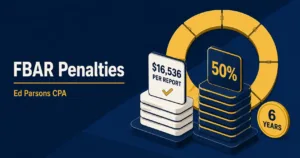
The stakes justify the caution. The non-willful FBAR penalty sits at $16,536 per violation at the current inflation-adjusted rate. Willful violations reach the greater of $165,353 or 50 percent of the account balance.
The delinquent route exists because a large share of people with foreign accounts owe no additional U.S. tax at all. They reported the interest and the dividends. They simply never heard of FinCEN Form 114. Here is who qualifies, who does not, and exactly how the free filing works
What Are the Delinquent FBAR Submission Procedures?
The Delinquent FBAR Submission Procedures are the IRS option for taxpayers who missed FBAR filings but have no unreported income. You file the past-due reports electronically, state the reason they are late, and qualifying submissions draw no penalty. The controlling instructions sit on the IRS delinquent FBAR page.
The FBAR itself comes from the Bank Secrecy Act. FinCEN owns FinCEN Form 114, the IRS enforces it, and the trigger is an aggregate of more than $10,000 across all foreign accounts at any point in the year.
The exposure these procedures erase is not theoretical. In Bittner v. United States, 598 U.S. 85 (2023), the government sought $2.72 million from one taxpayer, $10,000 for each of 272 accounts spread across five late reports. The Supreme Court held that non-willful penalties apply per report, not per account, cutting the number to $50,000.
Even after Bittner, six late years still means six potential violations, roughly $99,000 at the current adjusted rate. For a qualifying filer, the procedures take that figure to zero. Whether your facts even read as non-willful is a separate question, and it matters the moment you do not qualify here.
Who Qualifies to File Late FBARs Without Penalty?
Three conditions, all of them. Every dollar of income from the foreign accounts was reported on your returns and the tax was paid. You are not under IRS civil examination or criminal investigation. And the IRS has not already contacted you about the missing FBARs or the returns for those years.
The first condition is where most self-assessments fail. A few hundred dollars of foreign bank interest that never reached Schedule B is enough to disqualify the file, because these procedures forgive reporting failures, not income failures.
Case study: An engineer who immigrated to the U.S. came to my office with three accounts at his home-country banks and no FBARs, ever. Peak aggregate balance: $412,000. The accounts averaged about $3,800 of interest per year, and every dollar was already on Schedule B, because his preparer had asked about foreign income, just never about foreign accounts.
We reconciled six years of bank statements against six years of returns, confirmed nothing was missing, and e-filed six delinquent FBARs in one afternoon with a two-sentence explanation. We reconciled five years of bank statements against five years of returns, confirmed nothing was missing, and e-filed five delinquent FBARs with a two-sentence explanation. Government filing cost: $0. Penalty asserted: none. Her theoretical non-willful exposure across five reports was more than $80,000. The IRS does not close these files with a letter; to date there has been no correspondence. Results depend on your facts.
That reconciliation step is standard in every delinquent FBAR engagement at Ed Parsons CPA, and it is the step DIY filers skip.
A modest amount of interest that never made it onto a return is the whole difference between the free route and this one, and most people work that out about themselves rather than knowing it going in. Where it applies, five short emails from me lay out what the streamlined route actually demands: the eligibility conditions, the two tracks and the residency test that sorts you into one of them, a certification signed under penalty of perjury, and a set of returns and account reports assembled and filed as one thing rather than in pieces. Send me the five streamlined emails. A confirmation email goes out first and the rest are held behind it. One click unsubscribes.
When Is Streamlined Filing Required Instead?
The moment any foreign income went unreported, the delinquent FBAR procedures stop protecting you. The correct path becomes the Streamlined Filing Compliance Procedures: three years of amended returns, six years of FBARs, and a signed non-willful certification on Form 14653 or Form 14654.
Residency drives the cost. The foreign track carries no penalty for filers who meet the 330-day non-residency test. The domestic track carries a 5 percent penalty on the highest year-end balance of the covered foreign assets. Building that package is exactly what the Streamlined Filing CPA Package covers.
| Factor | Delinquent FBAR Procedures | Streamlined Filing |
| Unreported foreign income | None allowed, disqualifying | Expected, that is what it repairs |
| Returns filed | None, returns already correct | Three years of amended returns |
| FBARs filed | All delinquent years, typically six | Six years |
| Certification | Short late-filing explanation on the e-filed FBAR | Form 14653 or Form 14654 non-willful narrative |
| Measurement | $0 penalty on qualifying files | 5 percent of highest year-end covered balance (domestic) or 0 percent (foreign) |
Filing delinquent FBARs while the returns are still wrong is the classic quiet disclosure mistake: you have pointed FinCEN and the IRS at accounts whose income never hit your Form 1040, under a signed declaration, with every return still open for examination. The lane comparison and the four correction paths show where those facts belong instead.
As I tell every client weighing the two routes: “The delinquent FBAR procedures are the closest thing to a free pass in international compliance, but only for clean files. The moment one dollar of foreign income went unreported, this route stops protecting you and starts documenting you.”
How Do You File a Late FBAR Through the BSA E-Filing System?
Each calendar year gets its own FinCEN Form 114, filed electronically through the BSA E-Filing System. There is no government fee at any step, for any year.
Step 1: Open the BSA E-Filing System and choose the individual filer option. Individuals filing their own reports do not need to register for an account.
Step 2: Pick the online form, or download the fillable PDF, complete it offline, and upload it.
Step 3: Select the reason the filing is late from the dropdown. If none fits, choose Other and use the explanation box, which allows roughly 750 characters. Keep it short, factual, and consistent with your returns.
Step 4: Report each account: institution name and address, account number, account type, and the highest value during the year, converted to U.S. dollars at the Treasury year-end exchange rate.
Step 5: Submit, then save the confirmation and BSA identifier for every year filed.
Preparers filing on your behalf work differently. A registered BSA account supports batch upload, which transmits all six years in one pass under a signed FinCEN Form 114a authorization. That is how the Form 114 FBAR CPA Filing service files.
The mechanics are free and simple. The risk sits upstream: confirming you qualify at all, and getting six years of maximum balances and currency conversions right before anything is transmitted.

How Many Years of Delinquent FBARs Should You File?
Six years is the standard answer. The FBAR assessment window under 31 U.S.C. 5321(b)(1) runs six years from the due date of each report, so filing the six open years closes the entire period the government can still penalize.
The procedures themselves say to file all delinquent FBARs. Whether reaching back further than six years ever makes sense is a judgment call that depends on facts I will not generalize here. The floor is firm: never file fewer years than the open window.
My Take After 17 Years of FBAR Cleanups
The industry gets this wrong in both directions. Some firms route every late filer into streamlined and charge to compute a 5 percent penalty the client never owed. Meanwhile, DIY filers push files through the delinquent procedures with a foreign pension or reinvested fund income that never touched a return, converting a free fix into evidence.
The underrated move is unglamorous: reconcile before you file. Pull six years of returns and every foreign statement, and prove the income trail line by line before opening the BSA system. If the file is clean, full compliance costs you nothing. If it is not, you found out before FinCEN did, while every good option is still open.

If I were in your position, I would not transmit FBAR number one until that reconciliation was finished and the route was chosen deliberately, not hopefully. At Ed Parsons CPA, IRS account work is the core of the practice.
Start through the streamlined filing page to have the six-year reconciliation done and the right lane confirmed before anything is filed.