Skip to content

How IRS Filing Compliance Protects You From Penalties

How IRS Streamlined Filing Compliance Procedures Protect You From Penalties
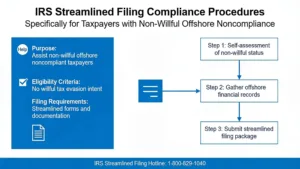
Streamlined Filing Compliance Procedures give non-willful taxpayers a structured path to resolve unfiled foreign financial asset returns while sharply reducing penalty exposure. Under the Streamlined Domestic Offshore Procedures, domestic filers face a 5% miscellaneous offshore penalty a significant reduction from the standard penalty exposure that would otherwise apply. Qualifying taxpayers file amended or delinquent returns, certify non-willful conduct, and achieve a defensible, IRS-recognized compliance resolution.
Key Takeaways

IRS streamlined procedures allow non-willful taxpayers to file 3 years of back tax returns and 6 years of FBARs.
Eligible filers reduce or eliminate penalties through streamlined filing compliance procedures instead of facing standard IRS enforcement actions.
Streamlined procedures require certification that failure to report foreign financial assets did not result from willful conduct.
Edward Parsons, CPA in Doral, FL helps clients navigate streamlined filing to achieve compliance and avoid legal penalties.
IRS streamlined procedures allow non-willful taxpayers to file 3 years of back tax returns and 6 years of FBARs.
Eligible filers reduce or eliminate penalties through streamlined filing compliance procedures instead of facing standard IRS enforcement actions.
Streamlined procedures require certification that failure to report foreign financial assets did not result from willful conduct.
Edward Parsons, CPA in Doral, FL helps clients navigate streamlined filing to achieve compliance and avoid legal penalties.
What Happens When You Miss International Filing Deadlines?
Missing international filing deadlines exposes U.S. taxpayers to serious penalty risk that extends well beyond any unpaid tax balance. A missed international information return triggers penalty exposure that can exceed the underlying tax balance, puts the accuracy of every related filing in question, and if left unaddressed signals to the IRS a pattern of non-compliance rather than an isolated oversight.
Many taxpayers discover the problem late. Unfiled FBARs, unreported foreign brokerage accounts, overlooked PFIC investments. Foreign corporation reporting gaps all create compounding exposure the longer they remain unaddressed. The issue is rarely isolated to one form or one year.
What Types of Filings Are Commonly Missed?
The most frequently overlooked international obligations include:
FinCEN Form 114 (FBAR) – for foreign financial accounts
Form 8938 (FATCA) -for specified foreign financial assets
Form 5471 – for interests in foreign corporations
Form 8621 – for passive foreign investment company (PFIC) holdings
FinCEN Form 114 (FBAR) – for foreign financial accounts
Form 8938 (FATCA) -for specified foreign financial assets
Form 5471 – for interests in foreign corporations
Form 8621 – for passive foreign investment company (PFIC) holdings
Each form carries its own penalty framework, and missing multiple forms in the same year multiplies the exposure significantly.
Can Non-Willful Taxpayers Reduce That Exposure?
The IRS Streamlined Filing Compliance Procedures were designed specifically for this situation. Taxpayers who certify that their failure to report foreign financial assets did not result from willful conduct gain access to a structured path for resolving delinquent filings with reduced penalties. The program requires reconstructing the missing filing history, preparing accurate amended or delinquent returns. Submitting a clear narrative explaining the non-willful nature of the lapse. Filing proactively keeps a manageable compliance problem from escalating into a far more serious one.

What Are the IRS Streamlined Filing Compliance Procedures?
IRS Streamlined Filing Compliance Procedures give eligible non-willful taxpayers a structured, IRS-sanctioned path to file amended or delinquent returns and resolve outstanding tax and penalty obligations. First introduced in 2012, the Streamlined procedures have since been expanded and modified to reach a broader group of U.S. taxpayers who fell behind on international reporting requirements through mistake, inadvertence, or a good-faith misunderstanding of the rules not deliberate concealment.
The filing requirements are specific. Eligible taxpayers must submit:
3 years of delinquent or amended U.S. federal tax returns
6 years of delinquent FBARs (FinCEN Form 114, Report of Foreign Bank and Financial Accounts)
All required international information returns for those years
3 years of delinquent or amended U.S. federal tax returns
6 years of delinquent FBARs (FinCEN Form 114, Report of Foreign Bank and Financial Accounts)
All required international information returns for those years
Two separate tracks exist depending on where the taxpayer resides. The Streamlined Foreign Offshore Procedures apply to qualifying taxpayers living outside the United States. The Streamlined Domestic Offshore Procedures apply to U.S. residents. Each track carries different penalty structures, so identifying the correct track at the outset matters significantly.
Who Qualifies for the Streamlined Procedures?
Qualification turns on a single threshold: whether the failure to file was willful or non-willful. The IRS applies a facts-and-circumstances standard there is no bright-line rule. What matters is whether the taxpayer’s explanation is credible, documented, and rooted in genuine oversight rather than deliberate concealment. Taxpayers who cannot clear that bar are directed to the IRS Voluntary Disclosure Practice, a separate program that carries substantially higher penalties and greater legal complexity. Identifying which path applies at the outset determines the entire compliance strategy.
How Does the Streamlined Process Actually Work?
Each submission follows a defined sequence: first, the full filing history is reconstructed across all relevant years and forms; next, any tax owed is calculated with supporting schedules; then, accurate amended or delinquent returns are prepared; and finally, a signed non-willful certification is submitted Form 14653 for SFOP filers or Form 14654 for SDOP filers documenting the factual and legal basis for the non-willful determination. Ed Parsons CPA has represented hundreds of taxpayers through offshore disclosure and international compliance matters. Including extensive work with Streamlined submissions and delinquent international filings. Handling each case at the senior level to ensure the certification and returns reflect a defensible, well-documented filing position.

How Do SFOP and SDOP Differ in Penalty Protection?
The Streamlined Foreign Offshore Procedures (SFOP) and the Streamlined Domestic Offshore Procedures (SDOP) offer meaningfully different levels of penalty relief depending on where a taxpayer resides: SFOP carries a 0% miscellaneous offshore penalty for eligible foreign residents, while SDOP imposes a 5% miscellaneous offshore penalty for eligible U.S. residents.
Program
Residency Requirement
Miscellaneous Offshore Penalty
SFOP
Outside the United States
0%
SDOP
Inside the United States
5%
That 5% under SDOP still represents a substantial reduction from the full penalty schedule that would otherwise apply to unreported foreign financial assets. For taxpayers with significant offshore holdings, the difference between the streamlined rate and standard IRS penalties can be considerable.
What Assets Does the SDOP Penalty Actually Cover?
The SDOP penalty does not reach every foreign account a taxpayer touches. The IRS has clarified that the penalty is not intended to apply to foreign financial assets in which the taxpayer held no personal financial interest. For example, an employer’s account over which the taxpayer had only signature authority. Taxpayers should carefully identify which accounts they hold a direct financial interest in before calculating the penalty base.
Who Must Meet the Residency Test for SFOP?
Residency eligibility under SFOP is strict. For taxpayers filing a joint return, both spouses must independently satisfy the applicable non-residency requirement. One qualifying spouse does not carry the other. Clients considering the IRS Streamlined Procedures should confirm residency status for each filer before selecting a track, since the choice directly determines penalty exposure SFOP eliminates the miscellaneous offshore penalty entirely, while SDOP imposes a 5% penalty on the highest aggregate balance of unreported foreign financial assets, a difference that compounds quickly on significant holdings.

Who Qualifies and What Forms Are Required?
IRS Streamlined Procedures are available to U.S. taxpayers whose failure to report foreign financial assets resulted from non-willful conduct meaning mistake, negligence, inadvertence, or a good-faith misunderstanding of the rules. Willful violations follow a different, far more costly path.
What Does “Non-Willful” Actually Mean?
A non-willful FBAR violation covers situations where a taxpayer genuinely did not know about a filing requirement, misunderstood the rules, or made an honest mistake it does not cover deliberate concealment or intentional disregard of known obligations. The distinction matters enormously: a willful determination removes access to the Streamlined program entirely and exposes taxpayers to substantially higher FBAR penalties, including civil penalties of up to $10,000 per violation for non-willful failures and up to the greater of $100,000 or 50% of the account balance per violation for willful ones.
What Forms Are Typically Required in a Streamlined Submission?
The filing package depends on each taxpayer’s specific facts, but multi-year catch-up submissions commonly include the following:
Form 2555 – Foreign Earned Income Exclusion
Form 1116 – Foreign Tax Credit
Form 5471 – Information Return for Foreign Corporations
Form 8621 – PFIC (Passive Foreign Investment Company) reporting
Form 8938 – FATCA-related Statement of Foreign Financial Assets
FinCEN Form 114 – FBAR (Report of Foreign Bank and Financial Accounts)
Form 2555 – Foreign Earned Income Exclusion
Form 1116 – Foreign Tax Credit
Form 5471 – Information Return for Foreign Corporations
Form 8621 – PFIC (Passive Foreign Investment Company) reporting
Form 8938 – FATCA-related Statement of Foreign Financial Assets
FinCEN Form 114 – FBAR (Report of Foreign Bank and Financial Accounts)
Taxpayers using the Streamlined Foreign Offshore Procedures must also demonstrate that foreign financial asset income went unreported. That required FBAR filings were missed. The submission often layers foreign tax credits, foreign earned income exclusions, CFC compliance obligations. PFIC reporting into a single coordinated package.
Ed Parsons CPA organizes these overlapping obligations systematically. Identifying which forms apply, reconstructing the filing history, and building a IRS Streamlined Procedures vs. Regular Filing across all relevant years.
How Can IRS Streamlined Procedures Help Prevent Potential Penalties and Legal Consequences?

Taxpayers with delinquent international filings need to act before the IRS acts first. Every month of inaction narrows the available options the Streamlined procedures are only accessible when the taxpayer takes the initiative, not after the IRS has already opened the matter. Acting early preserves the reduced-penalty path; waiting trades that opportunity for full standard enforcement exposure.
What Happens If a Taxpayer Waits Too Long?
Once the IRS initiates a civil examination or criminal investigation, the Streamlined procedures are no longer available. That window closes without warning. Filing proactively means a reduced-penalty resolution; waiting means full exposure to standard IRS enforcement.
What Does the Compliance Process Actually Look Like?
The process begins with reconstructing the client’s full filing history, identifying every year and form requiring disclosure, from FBARs and 8938s to 5471s and 8621s, then preparing accurate returns and disclosures that establish a clear, defensible filing position. Nothing gets handed off to junior staff. Clients work directly with a senior CPA who personally handles each matter from initial review through final submission.
The practical steps typically follow this sequence:
Fact-gathering: Reconstruct account history, foreign entity records, and prior-year income
Obligation mapping: Identify every form and year requiring disclosure
Return preparation: Draft amended or delinquent returns with supporting disclosures
Submission: File under the appropriate compliance pathway with a documented position
Fact-gathering: Reconstruct account history, foreign entity records, and prior-year income
Obligation mapping: Identify every form and year requiring disclosure
Return preparation: Draft amended or delinquent returns with supporting disclosures
Submission: File under the appropriate compliance pathway with a documented position
Ed Parsons CPA operates out of Doral, FL. Serves clients remotely, making senior-level international tax compliance guidance accessible regardless of where a client is located.
The Streamlined Filing Compliance Procedures exist precisely because the IRS recognizes that good-faith taxpayers sometimes fall behind on international reporting obligations. By filing amended returns and required disclosures through this framework, you move from exposure to a defensible compliance position. The penalties are capped, the criminal risk recedes, and you regain control of your tax situation. The path forward is systematic and clear and it starts with understanding what you owe.
FAQ
What penalty do domestic filers face under the Streamlined Domestic Offshore Procedures?
Under the Streamlined Domestic Offshore Procedures, domestic filers face a 5% miscellaneous offshore penalty a significant reduction from the standard penalty exposure that would otherwise apply to unreported foreign financial assets.
What filings does the streamlined program require taxpayers to submit?
Eligible taxpayers file 3 years of amended or delinquent tax returns. 6 years of FBARs, along with a certification that the failure to report was non-willful.
Who helps clients in Doral, FL navigate the streamlined filing process?
Edward Parsons, CPA in Doral, FL helps clients navigate streamlined filing compliance procedures to achieve IRS-recognized compliance and avoid legal penalties.