Skip to content

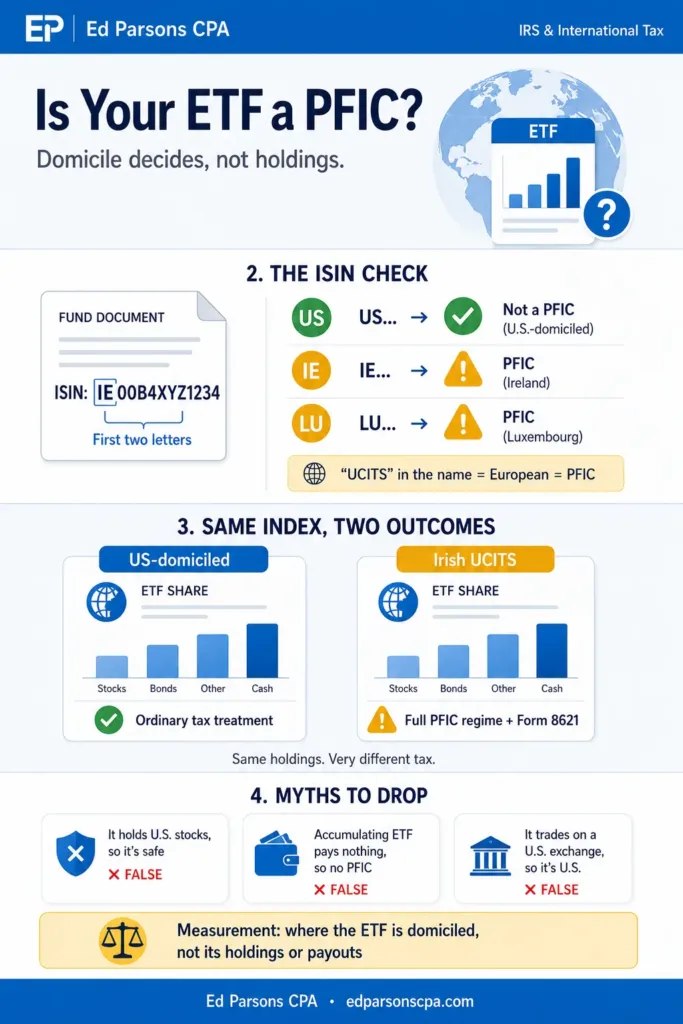
Are foreign ETFs PFICs? Almost always, yes. An ETF organized outside the United States, including the Irish-domiciled UCITS ETFs common in Europe, is treated as a PFIC for U.S. taxpayers, even when it holds U.S. stocks. What matters is where the fund is domiciled, not what it invests in. A U.S.-domiciled ETF is generally not a PFIC.
Exchange-traded funds feel modern, simple, and low-cost, which is exactly why the PFIC problem catches so many people off guard. A foreign ETF can carry the same harsh U.S. tax treatment as an old-fashioned foreign mutual fund, and most holders never see it coming.
This article gives you the plain-language answer for ETFs specifically. For the broader question across all fund types, see is your foreign mutual fund a PFIC, and for the underlying rules, the overview of what a PFIC is.
The Short Answer: Usually Yes
A foreign ETF is a foreign corporation that holds a basket of passive assets, so it is a PFIC for the same reasons a foreign mutual fund is. It earns mostly dividends, interest, and gains, and its assets are almost entirely securities and cash.
Those features mean a foreign ETF usually clears both the income test and the asset test at once, the two ways a company becomes a PFIC, and the IRS instructions for Form 8621 point to those same tests.
That means the safe assumption is the same as for any foreign fund: treat a non-US ETF as a PFIC until a professional confirms otherwise.
Domicile Is Everything
Here is the single most important point about ETFs. PFIC status depends on where the fund is organized, not on what it invests in or where you live.
An Ireland-domiciled ETF that tracks U.S. stocks is still a PFIC. A U.S.-domiciled ETF that tracks foreign stocks generally is not. The holdings can be identical, and the tax outcome is still worlds apart.
A quick way to check: look at the fund’s ISIN, the identifier in its documents. If it starts with US, the ETF is U.S.-domiciled and generally not a PFIC. If it starts with IE for Ireland or LU for Luxembourg, it is foreign-domiciled and almost certainly a PFIC. The word UCITS in a fund’s name is another strong signal that it is European-domiciled.
Same Index, Two Very Different Tax Outcomes
This is where ETF investors are most often surprised. Two ETFs can track the very same index, hold nearly the same stocks, and deliver nearly the same return.
If one is U.S.-domiciled and the other is an Ireland-domiciled UCITS version, a U.S. taxpayer faces ordinary treatment on the first and the full PFIC regime on the second, including a yearly form and a punitive default tax. Same investment idea, completely different tax life.
The difference is not in the investment at all. It comes down to one line of fine print: the country where the fund is registered.
Accumulating ETFs Do Not Escape It
UCITS ETFs often come in two flavors: accumulating, which reinvests income inside the fund, and distributing, which pays cash to your account. Many people assume the accumulating version sidesteps the problem because it never pays them anything.
It does not. PFIC status depends on the fund’s income and assets, not on whether it distributes. The reinvested gains still build up inside the fund, and the harsh default rules can land hard when you eventually sell.
Why U.S. Persons Abroad Get Trapped
There is a structural reason so many U.S. citizens living overseas end up holding PFIC ETFs. European rules generally prevent local brokers from selling U.S.-domiciled ETFs to retail residents, because those funds do not carry the required European disclosure document.
So the products actually available to a U.S. person at a European bank are usually UCITS ETFs, which are PFICs. The very fund that is easy to buy locally is the one that creates the U.S. tax problem, and most people do not learn this until years later. The IRS sets out the form and who must file it on its About Form 8621 page.
The table below sorts the common cases. Domicile is the deciding factor every time.
| ETF type | A PFIC? | Why |
| U.S.-domiciled ETF holding U.S. stocks | No | Organized in the United States |
| U.S.-domiciled ETF holding foreign stocks | No | Still organized in the United States |
| Irish or Luxembourg UCITS ETF | Yes | A foreign-organized fund of securities |
| Non-US ETF that holds U.S. stocks | Yes | Domicile controls, not the holdings |
| Accumulating UCITS ETF (no payouts) | Yes | Status does not depend on distributions |
| Measurement: what decides it | Where it is domiciled | Not its holdings or its payouts |
The exchange an ETF trades on and the stocks it holds tell you nothing about PFIC status. Its domicile does.
Common Mistakes
- Assuming an ETF is safe because it is just a simple index fund.
- Thinking an ETF that holds U.S. stocks cannot be foreign.
- Believing an accumulating ETF avoids PFIC tax because it pays nothing out.
- Judging by the exchange it trades on instead of the domicile or ISIN.
- Overlooking foreign ETFs held inside a non-US pension or investment platform.
Find Out Where You Stand
If you hold ETFs bought through a non-US broker, the odds are high that at least one is a PFIC. The right next step depends on which funds you hold, how long you have owned them, and whether past years were reported.

Have your ETFs reviewed.
A CPA tax resolution case analysis can confirm which holdings are PFICs and whether Form 8621 filing is required for the years involved. Who has to file, and when, is covered in the guide on Form 8621 filing requirements.
Want a quick first read?
Run a fund through the PFIC Analyzer to see whether it is likely a PFIC before you decide what to do next.