Skip to content

By Edward Parsons, CPA | Ed Parsons CPA, Doral, Florida | Representing taxpayers nationwide |
If you moved to the U.S. and brought foreign mutual funds, ETFs, or other pooled investments, those funds are almost certainly PFICs now. Becoming a U.S. resident, by green card or by time spent in the country, makes you subject to the PFIC rules, and there is no automatic reset of your cost basis. Gains that built up before you arrived can still matter. Your first year as a resident is often the best chance to limit the damage. What your first return has to report is in do you need to file Form 8621.
You built a sensible portfolio in your home country. Then you moved to the United States for work, family, or a green card. What nobody told you is that those ordinary funds can turn into a tax headache the moment you become a U.S. resident. It is one of the most common surprises immigrants and returning Americans run into, and it rarely shows up until a tax preparer or a sale brings it to the surface.
This article explains what changes for new residents and why timing matters so much. If the term itself is new, start with the overview of what a PFIC is.
When the PFIC Rules Start Applying to You
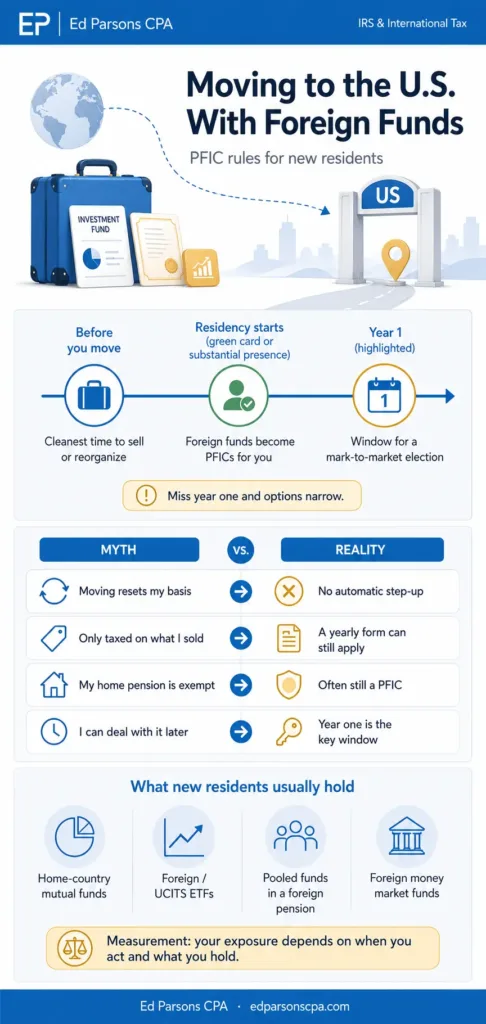
You become subject to U.S. tax rules, including the PFIC rules, once you are a U.S. person. That happens when you receive a green card, or when you spend enough time in the country to meet the substantial presence test. From your residency start date forward, foreign funds you hold are PFICs as to you. That start date is usually the day you became a lawful permanent resident, or the first day of the year you meet the presence test, whichever applies to you.
For most new residents the culprits are the same everyday products: home-country mutual funds and ETFs, including the UCITS funds common in Europe, plus pooled funds tucked inside foreign pensions.
The practical first step is a list of everything you brought with you, because the first-year options further down depend on knowing which holdings are PFICs before your first U.S. return is due. The PFIC Analyzer will sort that list: import your broker’s transaction file or paste the tickers, and it flags the foreign-domiciled funds and tests individual companies on the income and asset tests for each year you held them. Most PFIC calculators assume you already know a fund is a PFIC. This one starts by checking.
The Costly Myth: No Fresh Start on Basis
Many new arrivals assume that moving to the U.S. resets the clock, or steps up the cost basis of what they hold, so that only future growth matters. Under the default PFIC rules, that is not how it works.
The default regime looks back across your entire holding period, which can include the years you owned the fund before you ever set foot in the country. In plain terms, gains that quietly accrued abroad can be pulled into a U.S. calculation later, taxed at the highest rates with an interest charge. This is the single biggest surprise for new residents.
Picture someone who bought a home-country index fund a decade before moving, watched it roughly double, then sells a couple of years after arriving. Under the default rules, that long-held gain does not simply start counting from the move. It can be spread back across the whole holding period and taxed at the top rate, with interest layered on top. The fund felt like a calm long-term holding, and the tax treats it as anything but.
Why Year One Is the Window
Here is the part worth acting on. The first year you are a U.S. resident is often the best, and sometimes the only, chance to limit the exposure.
For marketable funds, a mark-to-market election made in that first year can use a special transition rule that treats your starting value as the fair market value on your residency start date. In effect, it can give you the fresh start that residency alone does not, and it steps you out of the harsh default regime going forward. The trade-offs between this and other options are covered in the guide on the PFIC elections.
Let the first year pass without acting and the door narrows. Most foreign mutual funds and ETFs are marketable, so this route is often available, but it has to be claimed on time. The remaining choices tend to be more complex, more expensive, or simply less favorable, and the default regime keeps compounding for as long as you hold the fund.
Nobody hands you a calendar reminder for a window like that. If you have arrived recently and want the background in your own time, my PFIC email series is where I put it. Five emails, sent to whatever address you give me. They explain how a fund becomes a PFIC, why the default regime reaches back through your whole holding period, and why the more favorable election generally has to be made in the first year you hold the fund. Watch for a confirmation email first, because nothing else sends until you click it. Unsubscribe from any email in the series.
If You Have Not Moved Yet
If a move to the U.S. is still ahead of you, the cleanest planning happens before you arrive. Gains you realize while you are still a nonresident are generally outside the U.S. tax net, so the tax analysis of holdings disposed of before the residency start date is different, which is why timing is reviewed before a move.
That option disappears the day you become a U.S. person, and some funds cannot be sold quickly because of lock-in periods, so lead time matters. People who plan a year or more ahead have the most room to maneuver, and a pre-arrival review generally involves far less work than reconstructing years of PFIC reporting afterward.
What New Residents Typically Hold
If you recognize any of these from your home country, treat PFIC status as the starting assumption:
- Home-country mutual funds, unit trusts, and index funds.
- Foreign ETFs, including European UCITS funds.
- Pooled funds held inside a foreign pension or retirement plan.
- Insurance-based investment or savings products.
- Foreign money market funds.
The table below lines up the common assumptions against what really happens.
| What people assume | What actually happens | Why |
| Moving resets my cost basis | No automatic step-up under the default rules | The look-back can reach gains from before you arrived |
| I only owe tax on what I sold | A yearly form can apply with no sale | PFIC reporting is not based on distributions |
| My home-country retirement fund is exempt | Often still a PFIC | Pooled funds inside it can each be PFICs |
| I can sort it out anytime | Year one is the key window | An early election can limit the look-back |
| Measurement: what controls your exposure | When you act and what you hold | Not your good intentions |
For a new resident, the outcome is shaped far more by timing than by the size of the account.
Common Mistakes
- Assuming U.S. residency wipes the slate clean on foreign gains.
- Letting the first year pass before dealing with it.
- Treating a home-country pension as automatically exempt.
- Selling a foreign fund without realizing the sale itself can trigger PFIC tax and a form.
Forgetting that the foreign accounts may also need FBAR and FATCA reporting, separate from Form 8621.
Questions People Ask
“I became a green card holder last year. Do the PFIC rules apply to me?”
Yes. Green card holders are U.S. persons, so foreign funds you hold are PFICs as to you from your residency start date forward.
“I have not sold anything since moving. Am I in the clear?”
Not necessarily. A yearly form can apply even with no sale, and the look-back can still reach gains that built up before you arrived.
“Can I just sell everything now to get it over with?”
Be careful. A sale after you become a U.S. person can trigger the default PFIC tax and a filing for that year, so selling often creates the problem rather than solving it.
Common PFIC Tax Mistakes New U.S. Residents Make
For new residents, timing is everything. The first year offers options that quietly expire, and the right move depends on which funds you hold, when you became a U.S. person, and whether any years still need to be reported.

Review your situation early.
Which holdings count as PFICs, which first-year elections are worth making, and whether Form 8621 is required all turn on the same test, set out in what makes a fund a PFIC.
Not sure where to start?
Run a fund through the PFIC Analyzer to see whether it is likely a PFIC. The IRS also describes the form on its About Form 8621 page.