Skip to content

By Ed Parsons, CPA | 17 years of tax resolution experience |
The Streamlined Domestic Offshore Procedures are the IRS compliance track for U.S. residents whose failure to report foreign income or foreign financial assets was non-willful.An SDOP submission requires three years of amended returns, six years of FBARs, a certification of non-willful conduct on Form 14654, and payment of a 5 percent miscellaneous offshore penalty calculated on the highest aggregate value of the foreign financial assets the program covers.
SDOP by the Numbers
- 3 years of amended income tax returns
- 6 years of FBARs filed electronically through FinCEN
- 5 percent penalty, applied once, on the highest aggregate year-end value
- 4 eligibility gates, all of which must be open
- 1 form carries the sworn certification: Form 14654
- 2 conditions disqualify you outright: an open IRS examination or a criminal investigation
Who Usually Ends Up in This Program?
Almost nobody who lands here was hiding anything. They simply did not know an obligation existed.
- A dual citizen with a savings account in their birth country that has sat quietly for years
- Someone who inherited a share of a family account or property held through an entity abroad
- A green card holder whose retirement plan stayed behind in their home country
- An investor who bought foreign mutual funds without knowing the U.S. rules treated them differently
The trigger is usually external: a FATCA notice, an inheritance, or a new preparer asking a question none of the previous ones asked.
What Is SDOP, in Plain Terms?
It is one of two IRS tracks for people who fell out of foreign reporting compliance by mistake rather than by choice. This one is for people living in the United States.
The trade is simple. You bring three years of returns and six years of foreign reports up to date, certify the failures were not deliberate, and pay one penalty instead of the stacked penalties the IRS could otherwise assess.
It is not an amnesty and it is not a negotiation. The IRS publishes the terms and you either meet them or you do not.
Do I Qualify for SDOP?
Four gates. All four have to be open on the same taxpayer, for the same years.
- You live in the United States and therefore fail the residency test that opens the foreign track
- You already filed a U.S. tax return for each of the most recent three years for which the due date has passed
- You failed to report income from a foreign asset, and may also have missed FBARs or information returns
- Every one of those failures was non-willful
Two more conditions end the conversation: you need a valid Taxpayer Identification Number, and the IRS must not have opened a civil examination or criminal investigation.
The second gate removes more people than the others. SDOP is an amendment program, so it assumes a return already exists for each covered year.
Why Do I Have to Fail a Residency Test?
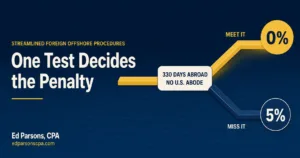
The IRS runs both tracks off one test. Meet it and you pay no penalty at all. Fail it and you pay 5 percent.
That determination is the difference between zero and a five-figure number for many taxpayers. Before assuming you belong here, read the guide to the foreign track and its residency test.
The test is factual and measured year by year. Green card holders, mid-year movers, and dual residents guess wrong in both directions routinely.
What Does Non-Willful Actually Mean?
The IRS defines it as conduct due to negligence, inadvertence, or mistake, or conduct resulting from a good faith misunderstanding of the law.
Form 14654 carries a written statement, signed under penalty of perjury, explaining the facts behind the failure. It is the only place you speak to the IRS in your own words, and it determines whether the rest of the package holds.
A statement that repeats the IRS definition back and stops is weak. So is one that argues legal conclusions or leaves gaps where you clearly knew something.
Because it is sworn, an overstated statement is not returned for revision. It becomes a document the government keeps. More on drafting standards and the errors that sink a strong case in the non-willful statement guide.
Is the 5 Percent Based on My Current Balance?
No, and this is the most expensive misunderstanding in the program. It is not 5 percent of the unpaid tax, not of today’s balance, and not of the average.
The base is the highest aggregate year-end value of the foreign assets the penalty covers, measured across every year in both periods. Three years for the returns, six years for the FBARs, aggregated within each year, with the single highest year setting the number.
An account closed long before you ever heard of the FBAR can still set your penalty, because a year inside the six-year window counts even though it sits outside the three-year one.
There is no reduced rate, no hardship tier, and no negotiation. The 5 percent figure is a term of the procedure, not an opening position.
Which of My Assets Count Toward the Penalty?
An asset enters the calculation for a given year if any one of three things is true of it that year.
- It belonged on an FBAR and was not reported
- It belonged on Form 8938 and was not reported
- It was reported correctly, but the income it produced was not
That third condition catches people off guard. A properly disclosed account whose interest never reached Schedule B still pulls its full year-end value in.
The categories reach well past bank accounts:
- Foreign pensions and retirement arrangements
- Foreign life insurance and annuity contracts with cash value
- Ownership interests in foreign corporations and partnerships
- Foreign mutual funds and exchange traded funds under the PFIC rules
- Real estate held through a foreign entity
Property held directly in your own name generally stays out. The line between direct ownership and ownership through a structure moves the number substantially, and the IRS guidance for taxpayers residing in the United States does not resolve the judgment calls behind it.
What Goes Into a Complete Submission?
- Amended returns for the three covered years, reporting all previously omitted foreign income
- Every required international information return for those years
- FBARs for the six covered years, filed through FinCEN
- Form 14654, signed by both spouses on a joint submission
- Full payment of tax, interest, and the 5 percent penalty at the time of filing
There is no installment option inside the program. A submission without full payment does not carry the protection the procedure offers.
On a joint submission both spouses certify and both are bound by it, so unequal knowledge has to be resolved before anything is signed.
What Goes Wrong With SDOP Filings?
- The wrong track was chosen. Defaulting here because you hold a U.S. address can mean paying a penalty you never owed.
- The base was built from bank statements, which capture accounts but not pensions, insurance values, entity interests, or PFIC holdings.
- The statement argues instead of explains. Sworn documents that read as advocacy invite scrutiny; ones with gaps invite more.
- Pieces were filed early. Returns or FBARs sent ahead of a complete package create a record you then have to explain.
- Only one spouse was considered. Joint submissions bind both signers to the same certification.
Silence was read as acceptance. The IRS issues no acceptance letter and no closing agreement, and a rejected streamlined filing narrows your options considerably.

SDOP and SFOP Side by Side
| Factor | SDOP (Domestic) | SFOP (Foreign) |
| Measurement | 5 percent miscellaneous offshore penalty | No miscellaneous offshore penalty |
| Who it is for | Taxpayers who fail the non-residency requirement | Taxpayers who meet the non-residency requirement |
| Certification form | Form 14654 | Form 14653 |
| Prior returns | Returns must already be filed for all three covered years | Delinquent returns accepted for the covered years |
| Tax return period | Three years | Three years |
| FBAR period | Six years | Six years |
| Penalty base | Highest aggregate year-end value of covered foreign financial assets | Not applicable |
| Non-willful conduct | Required | Required |
| Payment at submission | Tax, interest, and the 5 percent penalty | Tax and interest |
What SDOP Does Not Do
- It does not cover willful conduct. Willfulness routes to a different and far more serious process.
- It does not rescue a return that is already under civil examination or a taxpayer under criminal investigation.
- It does not produce a closing agreement, an acceptance letter, or any form of IRS confirmation.
- It does not immunize the covered years from examination. The IRS retains full authority to select any of them.
- It does not address state-level filing exposure, which runs on separate rules and separate deadlines.
The penalty relief the program offers is conditional. Where a submission is complete and the conduct was in fact non-willful, accuracy-related penalties, information return penalties, and FBAR penalties are not imposed on the covered years. Where the IRS later concludes the conduct was willful, that protection does not survive, and the certification the taxpayer signed becomes part of the record.
Why This Is Not a Filing to Attempt Alone
Every input in an SDOP submission depends on a judgment made earlier in the chain. Residency sets the track. The track sets the form. The inclusion conditions set the asset list. The asset list sets the penalty base. The facts set the certification. An error at any point moves everything downstream, and the whole package is signed under penalty of perjury and filed with full payment attached.
There is no draft stage, no review cycle with the IRS, and no correction window. The submission is the position.
Our IRS Streamlined Filing CPA Package handles the full engagement: track eligibility analysis, reconstruction of the covered years, penalty base construction across both covered periods, preparation of the amended returns and delinquent foreign reports, and drafting of the certification. Taxpayers who are already living outside the United States should start instead with the expat streamlined filing overview.
For the full map of the streamlined filing track, including how the domestic and foreign programs sit alongside voluntary disclosure and delinquent filing procedures, see the IRS streamlined filing hub.

About the Author
Ed Parsons is a Certified Public Accountant with 17 years of tax resolution experience. He practices from Doral in the Miami area and represents U.S. taxpayers across the country and in more than a dozen countries abroad.
His work centers on international tax compliance and IRS collection matters, including offshore disclosure submissions for dual citizens, green card holders, immigrants, and returning residents who fell out of foreign reporting compliance without intending to.
Ongoing analysis of streamlined filing, FBAR and FATCA reporting, controlled foreign corporations, and IRS collection procedure is published at edparsonscpa.com.