Skip to content

If you already own a Colombian company and you have been filing Form 5471, the real question is not whether you filed, but whether you filed correctly. The IRS treats a Form 5471 that uses the wrong filing category or omits required schedules as if it were never filed at all. That means the $10,000 penalty and the open statute of limitations can still apply, even though you sent something in. A focused CPA review checks the category, the schedules, and the earnings and profits history that drives everything else.
You own a Colombian S.A.S. or another local company, you have been filing Form 5471, perhaps on your own, through tax software, or with a general preparer, and something about it nags at you. That instinct is worth trusting. Form 5471 is one of the most error-prone returns in the entire code, and an incomplete one offers no protection at all. For the wider expat picture, see our guide to U.S. taxes for digital nomads and the tax issues of working remotely from Colombia.
Quick Facts for U.S. Owners Reviewing a 5471
- A substantially incomplete Form 5471 can be treated as if it were never filed.
- The wrong filing category, or missing schedules, is a common trigger.
- That means the $10,000 penalty and open statute of limitations can still apply.
- Earnings and profits errors on Schedule J cascade into GILTI, Subpart F, and distributions.
- Self-prepared and software-prepared 5471s often miss required schedules.
- A review can determine whether amended returns or a corrective filing are needed.
A Filed 5471 Is Not Always a Safe 5471
Most owners assume that sending in a Form 5471 ends the obligation. It does not. When a 5471 is substantially incomplete, the IRS can treat it as a failure to file, which means the same $10,000 penalty per form and the same open statute of limitations that apply to someone who filed nothing. You can do the work, mail it in, and still be exposed if the form was wrong in the ways that matter. The depth behind Form 5471 is exactly why this happens so often. Worse, you may have assumed you were protected for years, when in fact each of those years remained open. The gap between filing and filing correctly is where the real risk lives.
| Filed correctly | Filed but incomplete | Not filed | |
| How the IRS treats it | Accepted | As if never filed | Not filed |
| Measurement (what determines it) | Right category, all schedules complete | Wrong category or missing schedules | No form submitted |
| Penalty exposure | None if complete and timely | $10,000 per form, as if never filed | $10,000 per form, per year |
| Statute of limitations | Starts running | Stays open | Stays open |
The gold row is the trap most owners miss. The middle column feels safe because a form went in, but in the eyes of the IRS it can sit right beside not filing at all.
Where Form 5471 Goes Wrong
The errors cluster in predictable places. The most common is the filing category. There are several, each attaching a different set of schedules, and choosing the wrong one leaves the return missing pieces the form’s instructions require. To the IRS, a return missing required schedules is substantially incomplete.
Beyond category, reviews routinely surface missing schedules, mishandled GILTI and Subpart F inclusions, currency translation that was never done properly, and constructive ownership that was overlooked. Any one of these can move a return from compliant to incomplete, and most were introduced quietly, by software or by a preparer who does not specialize in international forms. None of these errors announce themselves. The form looks finished, the return was accepted, and the problem only surfaces when someone with the right lens reads it closely.
Earnings and Profits: The Error That Compounds
If there is one place where small mistakes grow into large ones, it is earnings and profits on Schedule J of Form 5471. E and P is the master figure that feeds your GILTI inclusion, your Subpart F income, your previously taxed income, and the character of any distribution. It is tracked from the company’s first year forward.
When the historical E and P is wrong, the error does not stay contained to one return. It cascades into every later year, quietly distorting inclusions and distributions down the line. This is the single most common reason a Colombian company’s 5471 history needs to be rebuilt rather than simply continued, and it is rarely visible without a careful look back to the beginning.
Picture a company that miscounted a single distribution in its second year. Left uncorrected, that one error can misstate previously taxed income and GILTI for every year since, each return quietly inheriting the mistake from the one before it.
What a CPA Review Actually Checks
A proper review is not a glance at last year’s form. It works through the things that decide whether your filings hold up. The aim is to know where you stand and what, if anything, needs to be corrected, before the IRS is the one asking.
- The correct filing category for each year you owned the company.
- Whether every required schedule is present and complete.
- The earnings and profits history, rebuilt where the records do not support it.
- GILTI and Subpart F inclusions, and any Section 962 election.
- Currency translation and constructive ownership across related parties.
- Your penalty exposure, and whether amended returns or a corrective path fit better.
How It Connects to the Rest of Your Reporting
A company rarely sits in isolation. The business and your personal accounts can trigger the FBAR and Form 8938, and if the company holds investments, the PFIC rules can overlap with the CFC rules. Your broader footprint may also include local pension and cesantias accounts. A complete review looks at the company in the context of everything else you file.
If Past Years Are Wrong
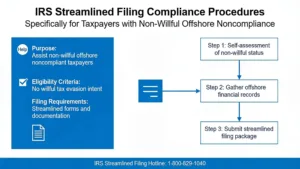
Because the statute of limitations stays open on an incomplete 5471, prior-year errors do not age out. They remain exposed until they are corrected, which is unsettling but also means there is almost always a path to fix them. Depending on the facts, that path may be amended returns, the Streamlined Filing Compliance Procedures, or a reasonable-cause filing, and the review is what tells you which one applies. The sooner that path is chosen, the sooner the open years finally close, which is usually the outcome that matters most.
Common Mistakes Existing Owners Make
- Assuming that because a 5471 was filed, the matter is closed.
- Filing under the wrong category and omitting the schedules that category requires.
- Carrying forward an incorrect earnings and profits balance year after year.
- Treating GILTI and Subpart F as someone else’s problem when the company is profitable.
- Missing constructive ownership that changes the category or even CFC status.
- Relying on general tax software that does not handle 5471 schedules well.
- Waiting, while the open statute of limitations keeps prior years exposed.


Have your Colombian company’s Form 5471 reviewed
If you are not sure your 5471 is right, the safest step is a professional review before the IRS takes a closer look. Ed Parsons, CPA reviews and corrects Form 5471 for U.S. owners of Colombian companies, rebuilds the earnings and profits history, and maps the cleanest way to fix prior years.
contact us to start.Form 5471 CPA Filing