Skip to content

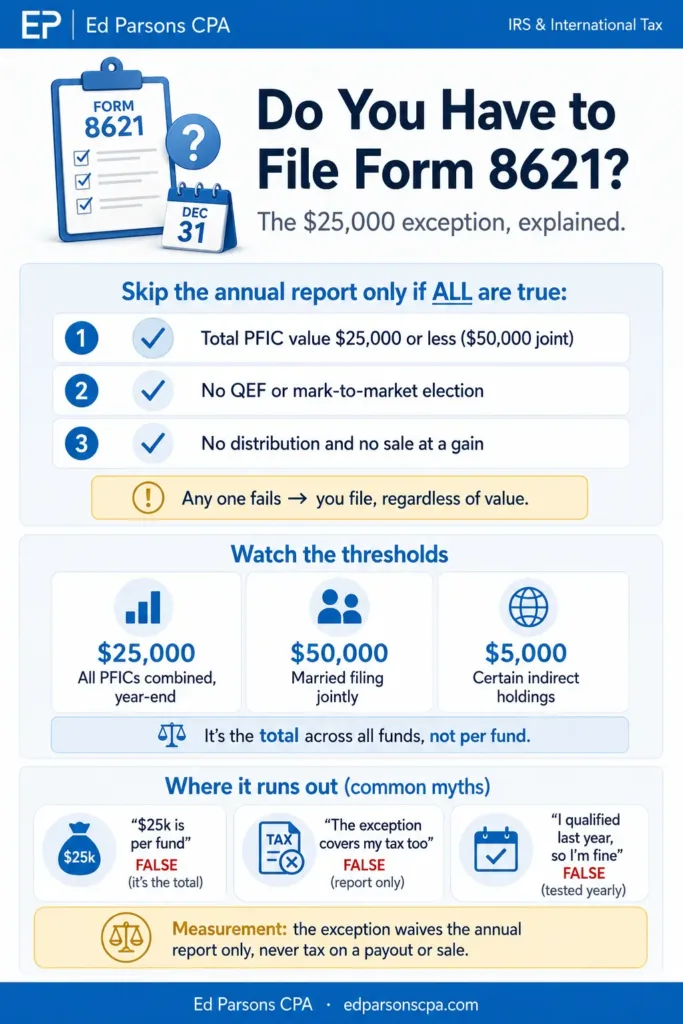
Do you have to file Form 8621? Not always. The de minimis exception lets you skip the yearly PFIC report if the total value of all your PFIC holdings is $25,000 or less ($50,000 married filing jointly) at year-end, you have no QEF or mark-to-market election, and you did not receive a distribution or sell at a gain. The moment any of those is untrue, you file regardless of value.
Most writing about PFICs assumes you have to file. This guide looks at the other side: the one exception that can let you skip the yearly report, and the exact point where that path runs out.
If you are still working out whether your holdings are PFICs at all, the overview of what a PFIC is comes first. This article assumes you already know you hold one and are asking whether you must file for it.
What the Exception Actually Waives
The de minimis exception is narrower than it sounds. It waives only the annual information report, the filing that can otherwise apply even in a quiet year when nothing happened with the fund.
It does not waive tax, and it does not waive filing when something does happen. If you receive a distribution or sell at a gain, you file and report regardless of value. For the full list of situations that require a return, see the guide on who must file Form 8621.
Why the annual report matters is worth a moment. An unfiled Form 8621 can keep your entire tax return open to IRS review with no fixed end date, so qualifying for the exception is not only about saving paperwork. It can be what lets a year close cleanly instead of staying open indefinitely.
The $25,000 Threshold
The exception is built around a dollar limit measured at the close of the tax year:
- $25,000 or less in total PFIC value, counting all your PFIC stock owned directly and indirectly.
- $50,000 or less for taxpayers who are married filing jointly.
- A lower $5,000 limit for certain PFIC stock you own indirectly through another PFIC.
The figure that matters is the total across every PFIC you hold, not the value of any single fund. This is the first place people misread the rule, because several small funds can add up to more than the limit even when each one looks harmless.
Counting the total means adding up the value of every PFIC you hold, including funds sitting inside foreign brokerage or retirement accounts and funds you own indirectly through another entity. Leaving any of them out can make a total look smaller than it really is and turn a filing year into a missed one.
The Three Conditions
To skip the annual report, all three of these have to be true for the year. The IRS instructions for Form 8621 set out the same conditions:
- Your total PFIC value is at or under the threshold at year-end.
- You have no QEF or mark-to-market election in place for the fund.
- You received no distribution and recognized no gain on a sale during the year.
If even one of these fails, the exception does not apply, and you file. The conditions work together, so a clean value alone is not enough. That is also why the exception helps fewer people than the dollar figure suggests. Plenty of taxpayers stay well under $25,000 yet still file, because of a single distribution or a routine sale during the year.
Where the Exception Runs Out
The exception is easy to lose without realizing it. These are the situations that end it:
- A distribution or a sale. Either one removes the exception for that year, no matter how small your holdings are.
- Aggregation across funds. Five funds worth $6,000 each total $30,000, which is over the line even though no single fund is close.
- Year-end swings. A market gain or a currency move late in the year can push your total over the threshold on the one date that counts.
- An election. Making or maintaining a QEF or mark-to-market election takes you out of the exception, because the election itself is reported on the form.
The table below lines up the conditions so you can see, at a glance, what keeps you exempt and what forces a filing.
| Condition | Stay exempt | Must file |
| Total PFIC value at year-end | $25,000 or less ($50,000 joint) | Over the threshold |
| Distribution received this year | None | Received one |
| Sale of PFIC stock at a gain | None | Sold at a gain |
| QEF or mark-to-market election | None in place | Election in place |
| Measurement: what the exception covers | The annual report only | Never the tax on a payout or sale |
Even when the exception applies, it only switches off the yearly report. It never erases the tax on a distribution or a sale.
A Quick Example
Consider two snapshots of the same investor on December 31.
First snapshot. She holds three foreign funds worth $18,000 in total, took no distributions, sold nothing, and has no election in place. She generally qualifies for the de minimis exception and can skip the annual report for that year.
Second snapshot. The same funds have grown to $26,000 by year-end. The total is now over the line, so the annual report applies, even though she bought nothing, sold nothing, and received nothing.
Same investor, same funds, one number different. The threshold is measured on a single date, and that date does the deciding.
Common Mistakes
- Treating the $25,000 limit as per-fund instead of a total across all PFICs.
- Assuming the exception covers the tax on a sale or distribution. It does not.
- Forgetting that a year-end market or currency move can push you over the line.
- Thinking a QEF or mark-to-market election still lets you skip the filing.
- Reusing last year’s exempt conclusion in a year that had a distribution or sale.
Counting only direct holdings and missing PFICs held through another foreign fund.
Questions People Ask
“All my foreign funds together are worth about $20,000. Can I skip Form 8621?”
Possibly, if you also had no distribution, no sale, and no election that year. All three conditions have to hold at once, not just the value.
“I am just over the line at year-end because of a market bump. Does that matter?”
Yes. The test looks at your total PFIC value at the close of the year, so a late gain can pull you over and bring back the annual report.
“I sold one small fund. The rest are tiny. Am I still exempt?”
The sale itself requires filing for that fund, and the gain ends the exception, so a single sale changes the picture for the year.
Not Sure Where You Land?
The exception is real, but the conditions interact in ways that are easy to misjudge, especially the aggregation rule and the year-end timing. Concluding that you are exempt when you are not can leave a return open to IRS review long after you thought the year was settled.

Confirm your position.
A CPA tax resolution case analysis can total your holdings the right way, check each condition, and handle Form 8621 filing for any year that needs it.
Still confirming the basics?
Run a fund through the PFIC Analyzer to see whether it is a PFIC in the first place. The IRS also describes the form on its About Form 8621 page.