Skip to content
You paid taxes in Colombia. Maybe DIAN withheld tax. Maybe you paid Colombian tax on rental income, pension income, dividends, interest, business income, or the sale of property.
Then you filed a U.S. tax return in Miami and assumed the U.S. side was handled.
But now you are wondering:
Did my U.S. return correctly use the Colombian taxes I paid?
That question matters because paying tax in Colombia does not automatically mean your U.S. return is correct. It does not automatically remove the U.S. reporting requirement. It also does not automatically mean the U.S. return claimed the right foreign tax credit.
For Colombian taxpayers in Miami, this is one of the most common refund and risk areas. The issue may involve Colombian income, Form 1116, foreign tax credit limits, exchange rates, income categories, Colombian property, pensions, IRS transcripts, or a prior preparer who never asked enough questions.
If you need the basic income article first, read: Do Colombians in Miami Need to Report Colombian Income on U.S. Taxes?.
Quick Answer:
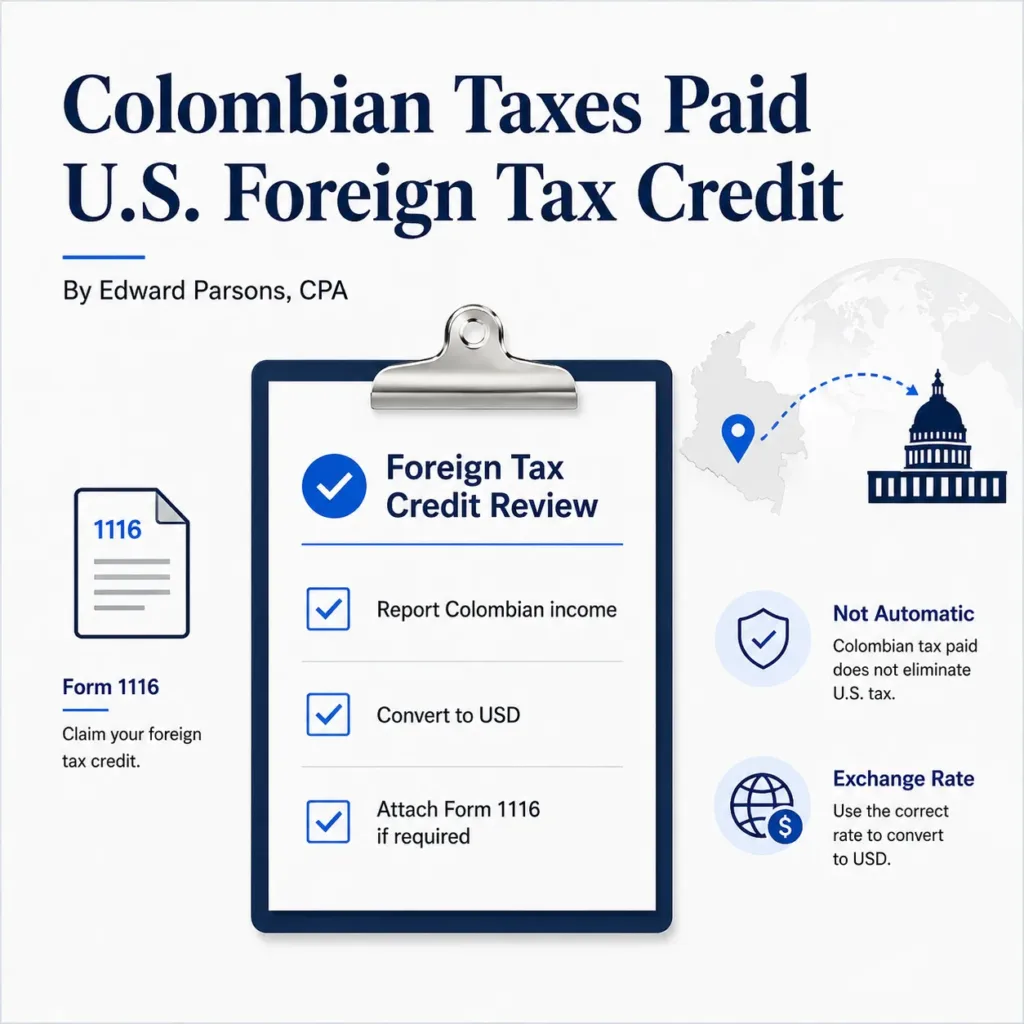
Colombian taxes paid may qualify for a U.S. foreign tax credit in some cases, but the credit is not automatic. The U.S. return generally still needs to report the Colombian income, determine whether the Colombian tax qualifies, convert amounts to U.S. dollars, use the correct income category, apply the foreign tax credit limitation, and attach Form 1116 when required. Common mistakes include omitting Colombian income, ignoring Colombian taxes paid, claiming the wrong amount, using the wrong exchange rate, missing carryovers, or assuming tax paid in Colombia means no U.S. reporting is needed.
First, Paying Tax in Colombia Does Not End the U.S. Question
Many taxpayers think:
“Ya pagué taxes en Colombia, so I am done.”
That can be wrong.
For U.S. citizens and resident aliens, the IRS says worldwide income generally must be reported, even when the taxpayer lives abroad or the income comes from outside the United States.
That means the U.S. return may still need to report the Colombian income first. Then it may need to consider whether a foreign tax credit applies.
The IRS foreign tax credit page says individuals generally file Form 1116 to claim the foreign tax credit when they paid or accrued certain foreign taxes to a foreign country or U.S. possession.
So the sequence matters:
- Was the Colombian income reported?
- Was Colombian tax actually paid or accrued?
- Does the tax qualify for the foreign tax credit?
- Was Form 1116 required?
- Was the credit limited?
- Was any unused credit tracked?
If the return skipped the first step, the credit analysis may already be off.
Mistake 1: Omitting the Colombian Income but Expecting the Tax Credit
The foreign tax credit is connected to income.
A taxpayer cannot simply say, “I paid Colombian tax,” and ignore the Colombian income on the U.S. return.
For example, if you had rental income from an apartment in Colombia, the U.S. return may need to consider the rental income, expenses, depreciation, foreign taxes paid, and possible foreign tax credit treatment. If only the tax paid was mentioned, but the income itself was not reviewed, the return may be incomplete.
This can happen with:
- Colombian rental income
- Colombian pension income
- Colombian dividends
- Colombian interest
- Colombian business income
- Colombian capital gains
- Colombian property sales
- Colombian investment income
If Colombian property is involved, read: Colombian Property, Rental Income, and U.S. Tax Return Risk.
Mistake 2: Assuming Every Colombian Payment Is a Creditable Tax
Not every payment to Colombia automatically qualifies for a U.S. foreign tax credit.
The IRS explains that, for the foreign tax credit, you can generally take a credit for income, war profits, and excess profits taxes paid or accrued to a foreign country or U.S. territory.
The IRS also explains that a foreign tax must meet qualification rules, including that the tax must be imposed on you by a foreign country or U.S. possession.
That distinction matters.
A Colombian tax withholding on income may be different from a fee, penalty, social contribution, municipal charge, property-related assessment, or other payment. The U.S. return should not treat every Colombian payment as a creditable income tax without reviewing what the payment actually was.
Awareness-level takeaway: “Paid to Colombia” is not the same as “automatically creditable on Form 1116.”
Mistake 3: Missing Form 1116 Entirely
Form 1116 is the main form individuals generally use to claim the foreign tax credit.
The IRS says individuals, estates, and trusts generally file Form 1116 to claim the credit for certain foreign taxes paid or accrued. Topic 856 also states that to choose the foreign tax credit, taxpayers generally must complete Form 1116 and attach it to Form 1040, Form 1040-SR, or Form 1040-NR.
For Colombian taxpayers in Miami, Form 1116 may come up when the return includes:
- Colombian rental income
- Colombian pension income
- Colombian dividends or interest
- Colombian wages or contractor income
- Colombian property sale gain
- Other foreign-source income with Colombian tax paid
If your preparer never asked whether Form 1116 applied, that is worth reviewing.
If the issue is specifically Form 1116 preparation, Edward Parsons CPA offers Form 1116 CPA Foreign Tax Credit Filing. The product catalog describes this as CPA-prepared Form 1116 for taxpayers with foreign income and foreign taxes paid or accrued, including foreign wages, dividends, interest, rental income, pensions, capital gains, and related credit analysis.
Mistake 4: Confusing the Foreign Tax Credit With a Deduction
The foreign tax credit and a deduction are not the same thing.
The IRS explains that foreign income taxes taken as a deduction reduce U.S. taxable income, while foreign taxes taken as a credit reduce U.S. tax liability.
The IRS also explains that instead of claiming a credit for eligible foreign taxes, a taxpayer can choose to deduct foreign income taxes on Schedule A, and that to choose the credit, the taxpayer generally completes Form 1116 and attaches it to the U.S. return.
This matters because a preparer may have:
- Ignored the Colombian taxes
- Deducted taxes when a credit should have been reviewed
- Claimed a credit without proper support
- Failed to compare the tax impact
- Failed to track unused foreign tax credit amounts
The better question is not “Did I pay Colombian tax?” The better question is “How did the U.S. return treat that Colombian tax, and was that treatment correct?”
Mistake 5: Not Understanding the Foreign Tax Credit Limitation
The foreign tax credit is not always dollar-for-dollar.
There is a limit on the amount of credit that can be claimed in a tax year. IRS Publication 514 explains that if qualified foreign taxes exceed the credit limit, the taxpayer may be able to carry back or carry over the excess to another tax year.
The IRS foreign tax credit “how to figure the credit” page also notes that foreign taxes available for credit but unused because of the foreign tax credit limit may be carried back to the previous tax year and forward to the next 10 tax years.
This is where refunds can be affected.
If the preparer did not calculate the limitation correctly, the return may show:
- Too little credit
- Too much credit
- Missed carryover
- Wrong income category
- Wrong allocation
- No clear record for future years
The key point is simple: Colombian tax paid does not automatically equal Colombian tax credited.
Mistake 6: Using the Wrong Income Category
Form 1116 uses categories of income.
The 2025 Form 1116 states that a separate Form 1116 is used for each category of income listed on the form.
This can matter for Colombians because different types of income may fall into different categories.
For example:
- Colombian wages or self-employment income may not be the same category as passive investment income.
- Colombian rental income may need different review than Colombian dividends.
- Pension income may require its own analysis.
- A property sale may not be the same as interest income.
This article is not a line-by-line Form 1116 guide. The important education point is that the category can affect the credit calculation. If all Colombian taxes were thrown into the wrong bucket, the return may deserve a second look.
Mistake 7: Ignoring Currency Conversion
Colombian income and taxes are usually in Colombian pesos.
U.S. returns report in U.S. dollars. The IRS states that taxpayers must express amounts reported on a U.S. tax return in U.S. dollars, and if income or expenses are in foreign currency, they must be translated into U.S. dollars.
The IRS foreign currency page explains that if the U.S. dollar is the taxpayer’s functional currency, items of income, expense, and taxes received, paid, or accrued in foreign currency must generally be translated into dollars when they affect the tax computation.
This can affect both sides of the calculation:
- Colombian income amount
- Colombian tax paid
- Refunds or additional payments
- Rental income and expenses
- Sale proceeds
- Exchange gain or loss questions in some cases
A common mistake is using rough conversions without support or using inconsistent exchange rates year to year.
Mistake 8: Claiming Colombian Taxes Without Matching Documents
Foreign tax credit review depends on documentation.
The U.S. return may need to connect the Colombian income, Colombian tax paid or withheld, year, currency, income category, and U.S. reporting position.
Potential support may include:
- Colombian tax returns
- DIAN payment records
- Withholding certificates
- Bank statements
- Rental statements
- Pension documents
- Brokerage records
- Property sale documents
- Exchange rate support
This is one reason a CPA review should not be based only on the U.S. Form 1040 PDF. The U.S. return may show a number, but the question is whether the number matches the underlying Colombia-side facts.
Mistake 9: Missing Carryovers From Prior Years
Foreign tax credit carryovers are easy to miss.
If the U.S. return could not use all available foreign tax credits because of the limitation, there may be a carryback or carryover issue. IRS Publication 514 explains that excess qualified foreign taxes may be carried over or carried back when foreign taxes exceed the credit limit.
This can affect future years.
A taxpayer may lose value if:
- A prior preparer did not track carryovers
- The current preparer did not ask for prior Form 1116
- Prior-year returns are missing
- Colombian income was reported inconsistently
- The return software did not carry the amount forward correctly
If you suspect a missed refund or missed foreign tax credit carryover, the next article to read is How IRS Transcripts Can Reveal Refunds, Penalties, and Filing Problems. Transcripts will not solve Form 1116 by themselves, but they can help show IRS-side filing, refund, penalty, and account activity.
Mistake 10: Forgetting Colombian Accounts Connected to the Tax Paid
Colombian taxes paid often connect to Colombian accounts.
For example, the taxpayer may have:
- A Colombian account receiving rental income
- A Colombian account receiving pension income
- A Colombian brokerage account with dividends or interest
- A Colombian account used to pay DIAN
- A Colombian investment account with withholding
That can create two separate questions:
- Was the Colombian income and tax paid handled correctly?
- Did the Colombian account trigger FBAR or Form 8938?
FinCEN says FBAR can apply when a U.S. person has foreign financial accounts exceeding $10,000 in aggregate at any time during the year. The IRS states that Form 8938 is used to report specified foreign financial assets when the total value exceeds the applicable threshold.
If Colombian accounts are involved, read: FBAR vs Form 8938 for Colombian Accounts.
Mistake 11: Treating a Business Tax Issue Like a Personal Form 1116 Issue
Some Colombian taxpayers in Miami are also business owners.
That can change the routing.
A personal Form 1040 foreign tax credit concern is different from a business entity issue. A business may involve entity-level returns, payroll taxes, business deductions, foreign ownership reporting, partnership items, S corporation items, or other business tax rules.
If your concern is personal income, personal Colombian taxes paid, rental income on your personal return, pension income, or personal investment income, a personal return review may fit.
If the issue involves an LLC, corporation, partnership, payroll, business penalties, business IRS account activity, or entity-level foreign reporting, it should be routed separately.
The cluster’s product strategy separates personal assessment, business assessment, and known IRS-problem routing so business owners are not pushed into the wrong offer.
Mistake 12: Waiting Until an IRS Notice Arrives
A foreign tax credit mistake may show up in different ways.
Sometimes the return simply produces a lower refund than it should have. Sometimes it produces a refund that is too high because income or forms were missed. Sometimes nothing happens for a while, and then later a transcript, notice, or mismatch creates concern.
If there is already an IRS notice, balance due, penalty, lien, levy, audit, or collection issue, that may be beyond a basic refund and risk review.
If you are still in the “algo feels off” stage, the right move is usually classification first. If there is already a known IRS problem, a deeper tax resolution case analysis may be more appropriate than a basic review.

Review, Form Filing, or Tax Resolution?
Here is the clean routing framework.
| Situation | Better next step |
|---|---|
| You are unsure whether Colombian taxes were used correctly | Review issue |
| Your refund seems wrong and Colombian taxes were paid | IRS transcript and return review |
| You know Form 1116 is needed for a current return | Form 1116 filing support |
| You also had Colombian accounts | FBAR/Form 8938 review |
| You have multiple missed years, foreign accounts, and foreign income | Streamlined eligibility review may be relevant |
| You already received an IRS notice, penalty, balance, audit, lien, or levy | Tax resolution analysis |
Edward Parsons CPA offers a CPA-led Tax Refund & Risk Assessment (Personal) for personal tax concerns involving missed refunds, penalties, IRS account issues, filing gaps, income mismatch indicators, and personal tax risks based on IRS transcript history.
For Form 1116 specifically, the separate Form 1116 CPA Foreign Tax Credit Filing route may fit when the taxpayer already knows foreign tax credit preparation is needed.
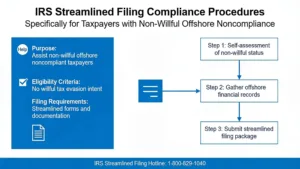
If multiple years of foreign income, FBARs, or foreign forms may be missing, the IRS Streamlined Filing Compliance Package By CPA may be relevant only if eligibility facts fit. The catalog describes it as a package for eligible non-willful taxpayers who may have missed returns or FBARs and may involve Form 1116, Form 8938, and other foreign forms where applicable.
The Safer Next Step
If you paid taxes in Colombia, do not assume the U.S. return handled them correctly.
Start by checking:
- Was the Colombian income reported?
- Was the Colombian tax paid or accrued?
- What type of Colombian tax was it?
- Was Form 1116 attached if required?
- Was the correct income category used?
- Were Colombian pesos converted consistently into U.S. dollars?
- Was the foreign tax credit limited?
- Was any unused credit tracked?
- Were Colombian accounts also reviewed for FBAR or Form 8938?
- Do IRS transcripts show refund, balance, penalty, or mismatch clues?
Then continue through the cluster:
- Do Colombians in Miami Need to Report Colombian Income on U.S. Taxes?
- Taxes Colombia USA: What Dual Citizens Often Miss
- Common U.S. Tax Return Mistakes for Dual U.S./Colombian Taxpayers
- FBAR vs Form 8938 for Colombian Accounts
- Colombian Bank and Other Financial Accounts, FBAR, and Form 8938
- How IRS Transcripts Can Reveal Refunds, Penalties, and Filing Problems
- Colombian Property, Rental Income, and U.S. Tax Return Risk
- CPA Tax Return Review for Colombians in Miami
Tranquilo. The goal is not to claim the biggest possible credit. The goal is to make sure the Colombian income, Colombian tax paid, and U.S. return position are correct and defensible.
Foreign Tax Credit for Colombian Taxes Paid: Common Questions
These FAQs help Colombian taxpayers in Miami understand common Form 1116 and foreign tax credit issues before they amend, ignore the issue, or assume Colombian tax paid was handled correctly.
If I paid taxes in Colombia, do I still report the income in the U.S.?
In many cases, yes. U.S. citizens and resident aliens generally report worldwide income, including Colombian income. Paying tax in Colombia may help with foreign tax credit analysis, but it does not automatically remove the U.S. reporting requirement.
Start with Do Colombians in Miami Need to Report Colombian Income on U.S. Taxes? .
Official source: IRS worldwide income guidance
What is the foreign tax credit?
The foreign tax credit is a U.S. tax mechanism that may reduce U.S. tax when a taxpayer paid or accrued certain foreign taxes to a foreign country or U.S. possession. Individuals generally use Form 1116 to claim it.
If the issue is specifically Form 1116 preparation, review Form 1116 CPA Foreign Tax Credit Filing .
Official source: IRS foreign tax credit guidance
Does every Colombian tax qualify for the foreign tax credit?
No. The foreign tax credit generally applies to certain income, war profits, and excess profits taxes paid or accrued to a foreign country or U.S. territory. Not every Colombian payment, fee, penalty, or assessment automatically qualifies.
If you are unsure whether your Colombian taxes were used correctly, the broader review article Common U.S. Tax Return Mistakes for Dual U.S./Colombian Taxpayers may help classify the issue.
Official source: IRS foreign taxes that qualify for the foreign tax credit
What is Form 1116?
Form 1116 is the form individuals, estates, and trusts generally use to claim the foreign tax credit. It may apply when Colombian income and Colombian taxes paid or accrued need to be reviewed on a U.S. return.
If the Colombian income came through a bank or investment account, also read FBAR vs Form 8938 for Colombian Accounts .
Official source: IRS Form 1116 guidance
Why did I not get a full dollar-for-dollar credit for Colombian tax paid?
The foreign tax credit is subject to limits. If qualified foreign taxes exceed the credit limit for the year, some credit may be unused and may need carryback or carryover review.
If the refund seems wrong, read How IRS Transcripts Reveal Refunds, Penalties, and Filing Issues .
Official source: IRS how to figure the foreign tax credit
Can unused foreign tax credits carry over?
In some cases, yes. The IRS explains that foreign taxes available for credit but unused because of the foreign tax credit limit may be carried back to the previous tax year and forward to the next 10 tax years.
If you suspect a missed carryover or refund issue, a personal transcript and return review may be appropriate: Tax Refund & Risk Assessment (Personal) .
Official source: IRS foreign tax credit carryback and carryover guidance
Do Colombian pesos need to be converted to U.S. dollars?
Yes. Amounts reported on a U.S. tax return must be expressed in U.S. dollars. Colombian income, expenses, and taxes paid in pesos generally need currency conversion before being reported on a U.S. return.
If currency conversion connects to Colombian property or rental income, read Colombian Property, Rental Income, and U.S. Tax Return Risk .
Official source: IRS foreign currency and exchange rate guidance
Can Colombian rental property create a foreign tax credit issue?
Yes. Colombian rental income, related expenses, Colombian taxes paid, currency conversion, and Form 1116 may all need review depending on the facts. Foreign tax credit review should not happen separately from the rental income analysis.
Read Colombian Property, Rental Income, and U.S. Tax Return Risk .
Official source: IRS Publication 514
Can IRS transcripts show whether the foreign tax credit was wrong?
IRS transcripts can help show filing history, refund activity, balances, penalties, and account changes, but they do not replace a review of Form 1116, Colombian income records, Colombian tax documents, and exchange rate support.
Read How IRS Transcripts Reveal Refunds, Penalties, and Filing Issues .
Official source: IRS Get Transcript
When should I use a review, Form 1116 filing, streamlined filing, or tax resolution analysis?
Use a review when you are unsure whether Colombian income, taxes paid, refunds, IRS transcripts, or prior returns were handled correctly. Use Form 1116 filing when you already know the foreign tax credit form is needed. Consider streamlined filing only when multiple years of foreign income, FBARs, or returns may be missing and the facts fit. Use tax resolution analysis when there is already an IRS notice, balance, penalty, lien, levy, audit, or collection problem.
Personal review: Tax Refund & Risk Assessment (Personal) . Form 1116 filing: Form 1116 CPA Foreign Tax Credit Filing . Streamlined filing: IRS Streamlined Filing Compliance Package By CPA . Known IRS problem: Personal CPA Tax Resolution Case Analysis .
Official source: IRS choosing a tax professional